
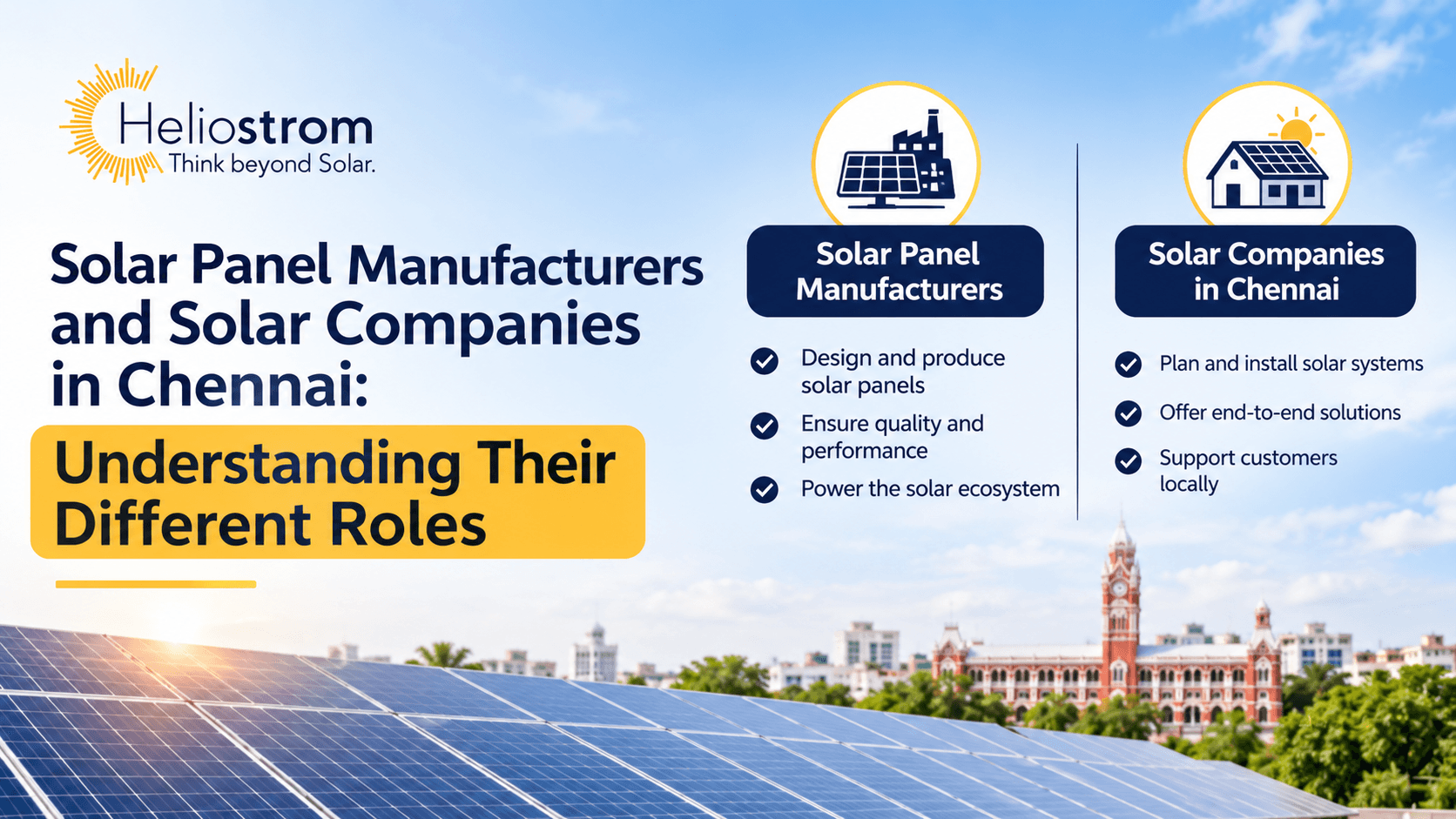
Searches for solar panel manufacturers in Chennai quickly return results mixed with installers, dealers, and consultants, all describing themselves as solar companies. The confusion is understandable, because both groups work with the same product and often advertise in the same way. Yet a business that makes panels and a business that designs, installs, and services a system do very different jobs, carry different responsibilities, and should be judged by different standards. Knowing which one you are dealing with and which one you actually need can save you from paying for the wrong expertise or chasing the wrong party when something goes wrong. This article explains the two roles, where they overlap, and how to decide who to approach first.
Why the Two Terms Get Confused
In everyday conversation, “solar company” covers almost anyone who sells or fits solar equipment. Shopfront dealers, project contractors, module makers, and online aggregators all use the phrase. Part of the problem is that the industry blurs the lines itself. A firm may put its own brand on a panel built by someone else, and a manufacturer may also run an installation team. Another reason is that buyers see the same logo on a roof, a website, and a warranty card and assume one organisation does everything.
In reality, the journey from silicon to a working rooftop system has several distinct stages, and different organisations handle each of them. Separating those stages makes every later decision easier.
What a Panel Manufacturer Actually Does
From Wafer to Finished Module
A manufacturer’s work happens in a factory. Silicon is processed into wafers, which are used to make cells. The cells are then connected, laminated between glass and polymer layers, framed, fitted with a junction box, and tested. Some producers handle the whole chain, while many assemble modules from cells they buy elsewhere. The difference matters because the cell largely determines a panel’s efficiency and behaviour in heat, whereas assembly quality governs how well the finished module survives years of sun, rain, and vibration.
Factories, Certification, and Domestic Content
Tamil Nadu has become a significant base for this work. By March 2026, the state had about 15.2 GW of module manufacturing capacity and about 7.97 GW of cell capacity, among the highest in the country. Large facilities include Tata Power’s 4.3 GW cell and module plant in Tirunelveli and Vikram Solar’s 6 GW module plant at Gangaikondan, inaugurated in August 2026, with a cell line scheduled to begin production in December 2026. Notice that these sites are in the south of the state rather than in Chennai itself, which is a good reason to ask any local business exactly where its modules are made.
Manufacturers answer to a particular rulebook. That includes listing under the government’s approved models and manufacturers framework, BIS registration, and international test standards. For homeowners who want the central subsidy, domestic content requirements also apply, so the origin of the cells and modules can affect eligibility, not just quality.
How a Panel Travels From Factory to Rooftop
Between the factory gate and your roof, modules usually pass through a distributor or the installer’s own warehouse. Handling matters at every step. Panels that are stacked badly, dropped, or left in the sun on an open truck can develop micro-cracks that are invisible to the eye but reduce output later. A careful installation company inspects deliveries, checks serial numbers against the invoice, and stores modules properly before installation. This hidden stage explains why two systems using identical panels can perform differently, and why the party that delivers and fits the equipment deserves as much scrutiny as the one that built it.
What Solar Service Companies Do Differently
An installer or project firm is, in simple terms, the party that turns a stack of modules into a working power source for one specific building. Its product is a properly designed and commissioned system, of which panels are only one component.
Design and Engineering
The work starts with a site survey, a study of electricity bills, a shadow analysis, and a check of the roof. From there, the firm selects the inverter, sizes the strings, designs the mounting structure, plans the cable routes, and specifies earthing and lightning protection. A factory cannot perform this assessment because it does not know your roof, meter, or electricity consumption.
Installation, Approvals, and Subsidy Paperwork
The physical work of solar panel installation covers structures, wiring, and commissioning, but it also includes dealing with the electricity distribution utility for net metering and, for eligible homes, the national subsidy portal. Reports in late 2026 indicated that more than 94,000 rooftop systems had been completed in Tamil Nadu under the PM Surya Ghar scheme, highlighting the importance of efficiently managing the associated approvals and paperwork.
Monitoring and Servicing
After commissioning, someone has to clean the panels, inspect connections, investigate inverter alarms, and compare actual output with what was promised. A module maker rarely does this for individual customers. This ongoing relationship is why the quality of an installation company becomes most evident after the sale rather than before it.
Where the Roles Overlap and Where Claims Get Fuzzy
Real businesses do not always fit neatly into one box. Some are pure manufacturers selling to distributors and developers. Some own a brand but have their modules manufactured by third parties under contract. Some are integrated groups that make panels and also execute projects. Many installers simply source from several brands and choose what suits each job.
None of these models is wrong, but each carries different accountability. A useful question to ask any business is whether it makes the cells, assembles the modules, or sources and rebrands them. Phrases such as “made in India” may refer to module assembly alone, so ask separately about where the cells are manufactured. Where a group does both manufacturing and installation, check that the installation team is truly in-house and not a subcontracted crew working under the same name.
Matching the Provider to Your Project
For Homes
A homeowner almost never needs to deal with a factory. What you need is a competent installer who can survey your roof, handle the paperwork, and stand behind the finished system. Your role is to ask which module brand and model they use and review the datasheet and certifications for the proposed product.
For Businesses
Businesses exploring commercial solar for Chennai projects at warehouses, schools, hospitals, and offices need engineering depth more than anything. That means load analysis, a structural check of the roof, phased rollout where needed, and clarity about ownership and financing models. Large developers sometimes purchase modules directly from manufacturers to control cost and supply, but they still depend on engineering and construction partners to deliver the plant.
Common Misunderstandings Worth Clearing Up
Buying directly from a factory is not automatically cheaper or better. Manufacturers often sell in bulk quantities, they do not design your system, and you would still need someone to install it, secure the approvals, and take responsibility for the workmanship. Savings on the module can disappear once those services are bought separately.
A well-known brand name does not guarantee a good installation either. The panel’s reputation says little about how well it was mounted, wired, or commissioned on your roof. In the same way, a factory in Tamil Nadu does not automatically mean quick local service for your home. Always ask who will actually attend to a problem, how fast, and from which location.
Who Stands Behind What: Warranty and Responsibility
Responsibility is divided in the same way as the work. The manufacturer’s warranty covers the product, including defects in materials and workmanship, as well as guaranteed power output over time. The installer’s warranty covers its own work: mounting, wiring, roof sealing, and commissioning. A leak around a roof fixing, a loose connector, or an incorrectly sized string is an installation issue, whereas a cracked cell or premature power loss may indicate a module-related issue.
A practical risk arises if the installer later closes or changes its business. A manufacturer’s warranty claims process normally requires proof of purchase, serial numbers, and installation records. Ask your installer to hand over a document pack at commissioning, listing module serial numbers, invoices, test results, and the warranty terms, and agree in advance who will raise a claim if one becomes necessary.
Questions to Ask Each Type of Business
When speaking with a manufacturer or brand owner, ask:
- Where are the cells and modules made, and are both made by you?
- Is the model enlisted in the approved list, and does it meet domestic content requirements where relevant?
- Can you provide test reports and certificates that name the exact model and factory?
- Who handles warranty claims for customers in Chennai?
When speaking with an installer or project firm, ask:
- Is the installation team in-house or subcontracted?
- Which modules and inverters do you propose, and why those for my roof?
- Who manages utility approvals and any subsidy paperwork?
- What does your workmanship warranty cover, and what service support follows commissioning?
Final Thoughts: Know Who You Are Hiring
Solar involves a chain of specialised roles, and problems often arise when buyers expect one party to take responsibility for another’s work. Manufacturers are judged on cell quality, certification, and the durability of what leaves the factory. Installation companies are judged on design, workmanship, paperwork, and after-sales support. When you understand that split, you can ask sharper questions, compare quotes more fairly, and know exactly whom to call when something needs attention.
If you are unsure which kind of provider suits your home or business, our team can explain the options and help you compare them honestly. Contact us to talk through your requirements and get clear guidance on the next step.
Thinking about your own installation? rooftop solar installation for homes in Chennai or book a free site survey.


