Rooftop solar for apartment associations in Chennai

Solar for Apartments in Chennai

Solar for apartments in Chennai can help an association reduce electricity purchased for suitable common-area loads. Heliostrom assesses the common electricity connection, shared roof and daytime demand before recommending a rooftop system and preparing a proposal for committee review.

  • Sized around common-area loads: pumps, lifts and lighting
  • A clear proposal your committee can review and approve
  • Roof rights, permissions, installation and handover planned

Free site check

Apartment solar check

What runs on the common connection?
  1. Assess
  2. Review
  3. Permissions
  4. Install
  5. Handover

Pumps, lifts and treatment equipment may be part of the assessment where connected to the relevant common service. The proposed arrangement must fit the building's electrical design and approved utility requirements. Common-area solar does not automatically reduce every resident's individual flat bill.

Our commercial solar solutions (opens in a new tab) explain broader project-planning considerations; an apartment proposal additionally needs clear association approval, roof-use and common-service arrangements.

Share your apartment location and your role in the association. We will explain what is needed to assess suitability, expected savings and the next steps.

Which Common Loads Can Solar Support

  • Pumps and treatment systems

    Water pumps, sewage treatment and water treatment equipment may offer useful daytime demand. The survey reviews operating schedules, connected circuits and whether timing can be adjusted safely without affecting residents.

  • Lifts and shared facilities

    Lift operation, security equipment, association offices and clubhouse facilities should be assessed against the relevant common connection. Motor starting and backup requirements need appropriate electrical design.

  • Lighting and evening consumption

    Corridor, parking and landscape lighting often operates after sunset. This matters because solar generates during daylight. The financial case must account for the approved treatment of exported daytime energy and later grid imports.

The most useful starting point is the common-service bill and load schedule. A building with many flats does not necessarily need a larger system than a smaller property with substantial daytime common loads.

Is Your Apartment Suitable for Solar

The association should establish technical and administrative suitability before collecting funds or selecting a standard equipment package.

Suitability check and what should be established
Suitability checkWhat should be established
Roof rights and association authorityPermission to use shared space and approve expenditure
Structural condition and accessSafe installation, maintenance routes and roof capacity
Shade-free spaceA layout that retains access to tanks, drainage and fire routes
Common electricity accountConnection category, sanctioned load and eligible arrangement
Bills and equipment schedulesConsumption across the year and daytime demand
Existing rooftop installationsAny equipment or earlier solar projects affecting the proposal

Where available, prepare up to twelve months of common-service bills, basic rooftop photographs and a list of major equipment. A resident who is not a committee member can begin the discussion, but the proposal needs review by authorised association representatives.

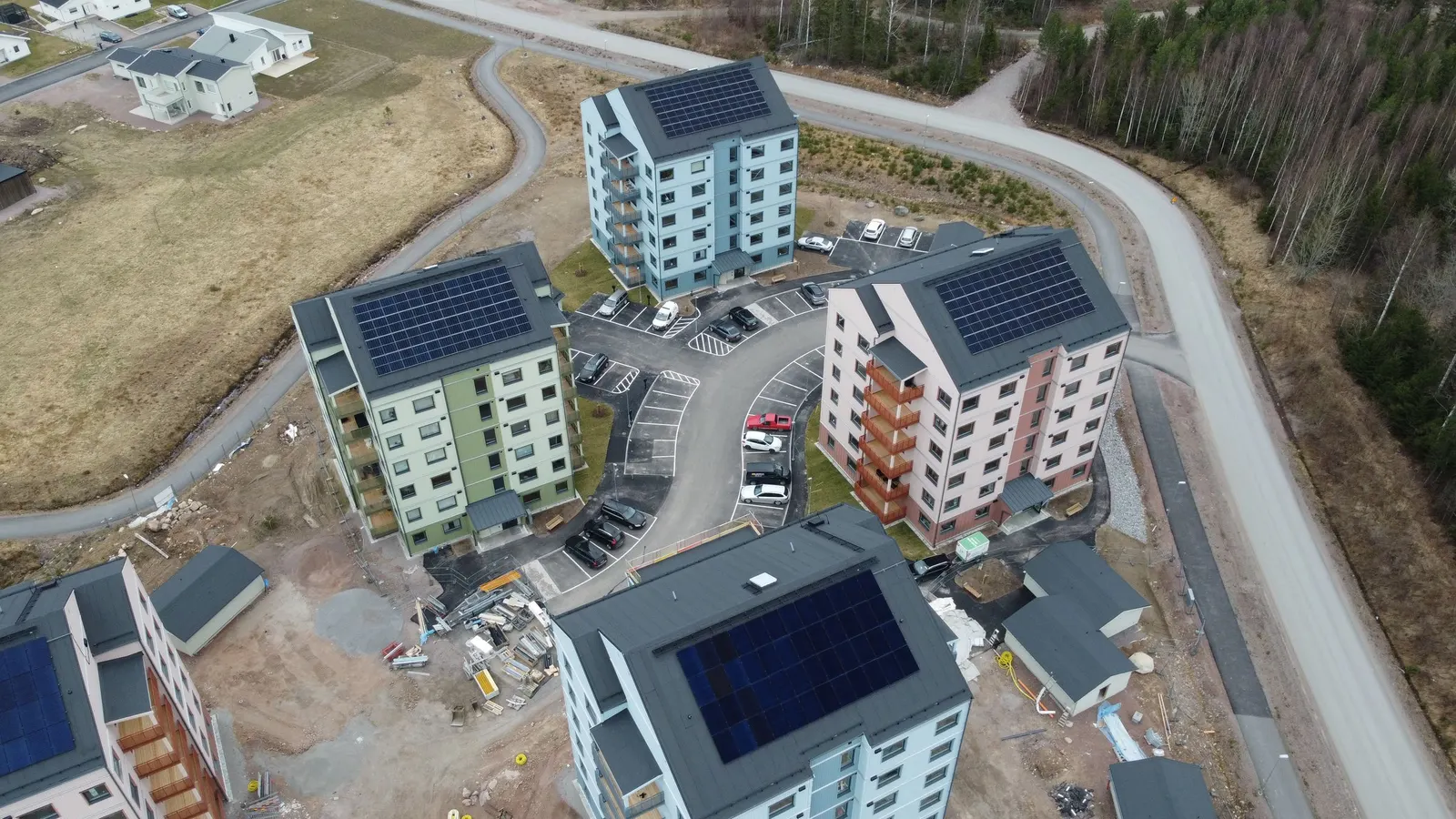
Aerial view of four multi-storey residential blocks, each with a large solar array on its roof, around a small car park

Get a Proposal Your Association Can Review

  • What the proposal covers

    A useful committee proposal should explain the recommended capacity, layout, equipment, installation scope, maintenance and funding assumptions. Compare quotations against the same requirements, including taxes, utility charges, civil work and any battery storage.

  • How savings are estimated

    The savings estimate should separate generation, electricity used directly, permitted export value and operating costs. For illustration only, an assumed ₹12,00,000 net project investment with ₹2,40,000 annual net benefit gives five-year simple payback. These are assumed inputs, not an apartment quotation or guaranteed outcome.

  • Scheme support

    Eligible group housing or resident welfare association projects may receive support for qualifying common facilities under current scheme conditions. Eligibility, limits, documents and the approved electrical arrangement must be confirmed before assistance is included in the funding plan. Use the official TNPDCL scheme guidance (opens in a new tab) to check the current route.

Illustrative five-year simple payback

Based only on the assumed figures above. Your proposal should use the building's own bills, survey and approved arrangement.

From Committee Discussion to Installation

  1. Assess the building

    Share common-service bills, location, rooftop details and equipment schedule. We review structure, shade, connection and access.

  2. Committee review

    The committee reviews capacity, costs, responsibilities and expected savings, following the association's own approval rules.

  3. Permissions

    The plan sets out documentation and utility coordination. No universal voting percentage should be assumed.

  4. Installation

    Site work is scheduled around residents, working hours, shared access and any planned shutdowns.

  5. Commission and hand over

    Testing, approvals, monitoring access, warranties and support contacts. On-grid solar is not lift backup in an outage.

Apartment Solar FAQs and Assessment

Start with a practical suitability discussion for your building. Share the apartment location, your role and a contact number. Common-service bills and rooftop details can follow when the assessment is arranged.

An association can evaluate a shared rooftop installation subject to roof rights, structural and electrical suitability, association approval and the applicable utility requirements.

Not automatically. A system connected to the common service is assessed for common-facility consumption. Any allocation or supply to individual flats requires a separately permitted and approved arrangement.

Standard on-grid solar shuts down when the grid fails. Lift backup needs a separately engineered arrangement that considers starting current, inverter power, storage and safety.

There is no single flat-count rule for technical suitability. Common electricity use, roof space, connection details and the applicable scheme conditions are more useful assessment inputs.

An association president, secretary, facility manager or authorised committee member is well placed to coordinate. A resident can initiate contact and involve the committee for the proposal and approvals.

A battery is not automatically required for a grid-connected common-area system. It should be considered separately if the association needs defined backup or another justified storage application.

Enquiry form

We use your details to respond to this enquiry

Call +91 95516 87608 or discuss your requirement on WhatsApp (opens in a new tab). Share your recent electricity bill during follow-up so the proposed system can be assessed against actual usage.