
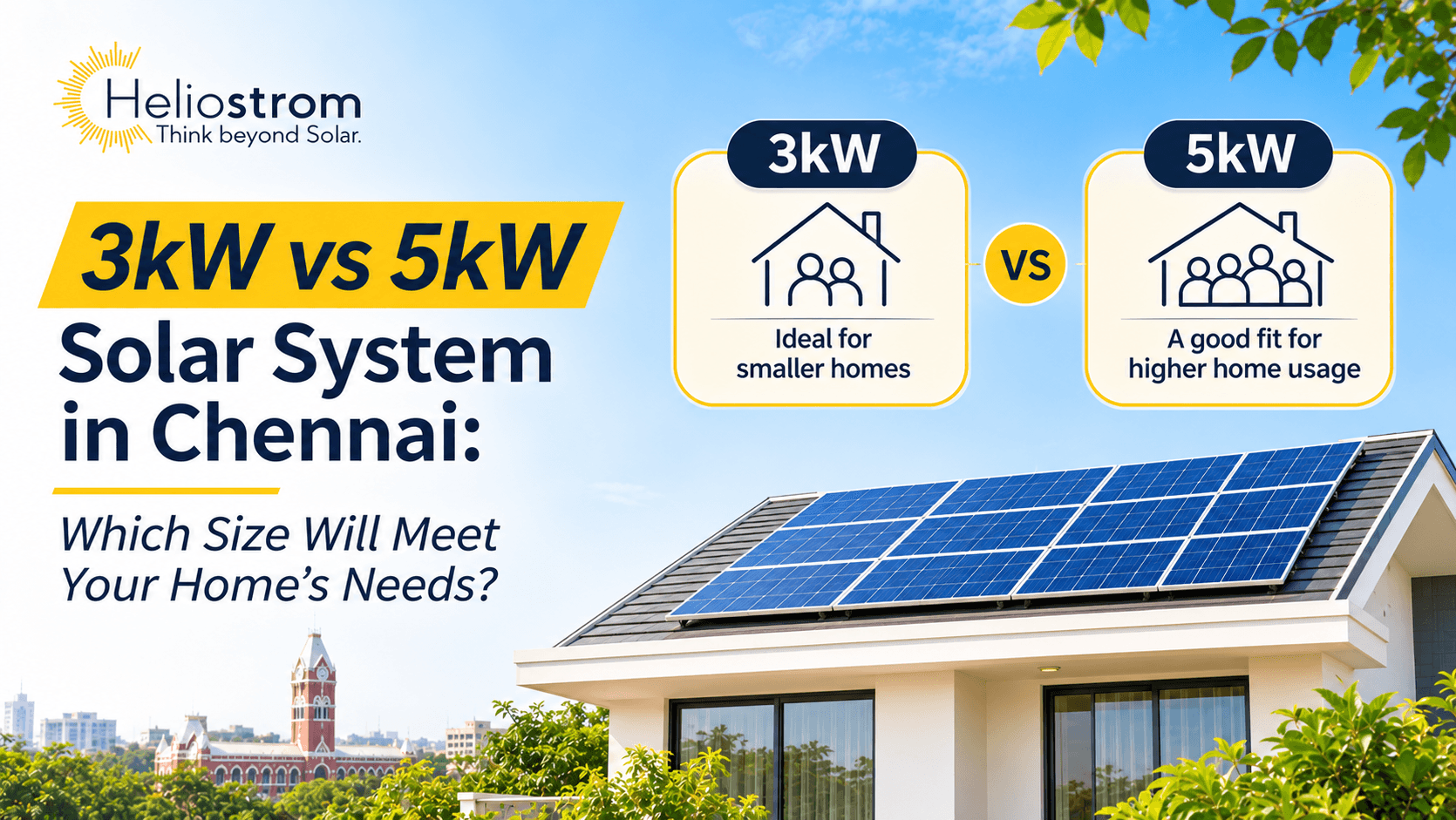
Choosing a rooftop solar system often begins with one question: should you install 3kW or 5kW? Both capacities can be suitable for homes in Chennai, but they are designed for different electricity requirements. A household with moderate consumption and limited daytime loads may find a 3kW system adequate. A larger home with multiple air conditioners, pumps or plans to add new appliances may need a higher capacity.
The decision should not be based on the system size that a neighbour has installed or the capacity that appears most popular in an advertisement. It should start with your electricity consumption, the timing of your usage, the roof available for panels and your likely needs over the next few years.
This guide compares 3kW and 5kW systems in practical terms so you can discuss the right option with a solar installer and why setting up rooftop solar for a new home in Chennai goes more smoothly when the building and the power system are designed together.
First, understand what 3kW and 5kW mean
The kW rating describes the solar array’s rated power capacity under standard test conditions. It does not mean that a 3kW system produces exactly 3 units every hour or that a 5kW system produces 5 units throughout the day.
Actual energy generation is measured in kilowatt-hours (kWh), commonly called units on electricity bills. It varies with sunlight, panel orientation, roof angle, shade, temperature, dust, inverter performance and system losses. Chennai has a strong solar resource, but the output will still change from day to day and season to season.
For initial planning, a solar company may provide an estimated daily or monthly generation range. Treat this as a site-specific estimate rather than a guarantee. Ask what assumptions were used and whether the estimate accounts for shading and system losses.
3kW vs 5kW: the basic difference
A 3kW system has a smaller solar array and generally requires less roof area and a lower initial investment than a 5kW system. A 5kW system has greater generation potential, but it also needs more suitable roof space and a higher project budget.
The table is a general comparison, not a substitute for a design. Panel wattage, module dimensions, mounting layout and roof access affect the actual space requirement.
How do you know how much solar your home needs?
Start with your electricity bills for at least six to twelve months if available. Look at the units consumed, not just the rupee amount. The bill value can change because of tariff slabs, adjustments and billing periods, while units give a more direct picture of energy use.
Next, identify when the electricity is consumed. A home may use a large amount of power in the evening because the family returns from work and switches on ACs, lights and kitchen appliances. Another home may have substantial daytime consumption because someone works from home or the family runs appliances during the day.
This timing matters. Solar panels generate electricity during daylight hours. A grid-connected system can offset consumption while generating and may export surplus electricity under the applicable metering arrangement. It does not physically store daytime energy for use at night.
Finally, list major appliances and planned additions. Air conditioners, water heaters, pumps, induction cooktops, electric vehicle chargers and additional refrigerators can change the household’s energy requirement.
Example 1: when a 3kW system may be worth considering
Consider a household that uses around 250–350 units per month, has one AC used for a limited number of hours and operates most other appliances at moderate levels. If the roof has adequate unshaded space and the household’s consumption pattern matches the expected solar generation, a 3kW system may be a sensible option to evaluate.
This is only an illustrative profile. It does not mean that every home using 300 units needs exactly 3kW. Two households with the same monthly units may have different peak loads, appliance schedules and roof conditions. One may use more electricity at night, while another uses it during the day.
The installer should compare the proposed system’s estimated monthly generation with the household’s consumption and explain how much energy may be self-consumed and how much may be exported.
Example 2: when a 5kW system may be more appropriate
Now consider a larger household with two or more ACs, a water pump, several work-from-home devices and plans to add another appliance. Its monthly electricity consumption may be significantly higher, especially during Chennai’s hotter months.
A 5kW system may be worth evaluating if the roof can accommodate the additional panels and the utility connection and applicable rules permit the proposed capacity. It can generate more energy than a 3kW system under comparable conditions, but the extra generation must have a useful purpose.
If the home has very low daytime consumption and the export arrangement does not provide the expected value for surplus electricity, installing a larger system simply because the roof has space may not be the best financial decision. The goal is not to maximise panel count; it is to select a capacity that makes sense for the household.
Why daytime usage changes the decision
A solar system is most directly useful when the home consumes electricity while the panels are generating. For example, daytime use of a refrigerator, computers, fans, water pump and an AC can absorb part of the solar output as it is produced.
If most of your electricity use happens after sunset, you may still benefit from grid-connected solar through the applicable export and billing arrangement. However, you should understand the rules and the way energy imports and exports are accounted for before estimating savings. A battery is a separate investment if you want to store electricity for later use.
Do not assume that a 5kW system will eliminate the bill. Fixed charges, taxes, minimum charges, consumption outside solar hours and the applicable utility settlement rules can affect the final bill.
How much roof space will you need?
A 5kW system generally needs more panel area than a 3kW system. The exact requirement depends on the wattage and dimensions of the selected modules, mounting structure, spacing, roof shape and maintenance access.
A roof survey should identify:
- Clear, usable area after accounting for water tanks, staircases and other structures.
- Shade from trees, nearby buildings, parapet walls and overhead equipment.
- The best practical panel orientation and tilt.
- Safe access for installation, cleaning and maintenance.
- Structural condition and any work required before mounting.
A roof that looks large from the ground may have limited usable area once shade and access paths are considered. Conversely, a well-planned layout may use the available area efficiently. The installer should show the proposed panel layout rather than relying on a rough estimate.
What about ACs and other high-consumption appliances?
If your home uses one or more ACs, do not size the system using tonnage alone. Check the model’s input power and energy-consumption information, then estimate how many hours it operates. A 1.5-ton AC does not consume the same amount of electricity in every home or under every condition.
Also consider simultaneous usage. Two ACs running at the same time, along with a pump and kitchen appliances, create a different demand profile from one AC operating alone. Solar generation also changes throughout the day, so the inverter and electrical design must be appropriate for the intended loads.
If you plan to use ACs during a power cut, discuss battery backup separately. A standard grid-connected system normally disconnects during a grid outage for safety and should not be treated as an automatic backup source.
Should you install 3kW now and expand later?
Starting with a smaller system can be practical when the budget is limited or current consumption is moderate. However, expansion is not always as simple as adding a few panels. The inverter capacity, string design, roof layout, electrical connection, sanctioned load and utility approvals may limit future additions.
If you expect your electricity use to increase, tell the installer before the first system is designed. Ask whether the inverter can accommodate additional modules, whether the mounting layout leaves expansion space and what approvals may be required. It may be more economical to plan for the likely future requirement from the beginning.
Do not pay for unused capacity without a clear reason, but do not ignore a well-founded future load either.
Subsidy and utility approvals: what should you verify?
Eligible residential consumers may be able to apply for central assistance under the PM Surya Ghar: Muft Bijli Yojana, subject to current scheme guidelines and the required process. Tamil Nadu’s state rooftop solar portal also publishes information on the state-level top-up, eligibility and application steps. Scheme amounts, conditions, vendor requirements and portal procedures can change, so verify the current details before making a financial decision.
The Tamil Nadu portal explains that residential applicants seeking central subsidy must register through the national portal and then follow the state utility’s process using the relevant reference details. It also publishes the applicable documents and FAQs. Do not assume that a subsidy is automatic or that every system configuration qualifies.
Your quotation should clearly distinguish the system price, eligible subsidy assumptions, utility-related charges if any, and the amount you are expected to pay. Confirm the current requirements with the relevant official portal and utility before installation.
Compare the total value, not just the quoted price
When comparing 3kW and 5kW quotations, check whether both include comparable equipment and services. A lower quote may use different panel specifications, inverter features, mounting materials or warranty coverage.
Ask for:
- 1Solar module make, model, wattage and product warranty.
- 2Inverter make, model, capacity and warranty.
- 3Mounting structure material and corrosion protection.
- 4Cable, protection, earthing and lightning-protection specifications.
- 5Estimated generation and the assumptions behind it.
- 6Monitoring facility and after-sales support.
- 7Utility application and net-meter coordination responsibilities.
- 8Any exclusions, additional civil work or electrical upgrades.
A good quotation should explain the design in language you can understand. It should not rely only on a large projected savings figure.
How Heliostrom can help you choose the right capacity
The right capacity comes from combining your bills, appliance usage, roof conditions and future plans. Heliostrom’s residential assessment considers electricity consumption, usable rooftop area, shading and the electrical setup before recommending a system. If you are comparing options for your house, explore home solar installation in Chennai and request a site-specific assessment rather than choosing a capacity based only on a standard package.
A useful proposal should show why the recommended size is appropriate, what generation range is expected, how the system will connect to your home and what the installation includes.
Frequently asked questions
Is 3kW enough for a 2BHK house in Chennai?
It may be suitable for some 2BHK homes, but the number of rooms does not determine electricity consumption. Check monthly units, AC usage, other appliances, daytime demand and available roof space before deciding.
Is 5kW too much for a normal independent house?
Not necessarily. A home with multiple ACs or higher electricity consumption may benefit from 5kW. But if much of the additional generation cannot be used or credited economically, the larger system may not offer the best value.
How many units can a 3kW or 5kW system generate?
Generation varies with weather, season, shading, orientation, temperature and system design. Ask the installer for a Chennai-specific estimate for your roof, including expected monthly variation and system losses.
Can I run an AC with a 3kW solar system?
It may be possible depending on the AC’s input power, operating hours, solar generation at that time and other loads. A load assessment is necessary before making a commitment.
Does a 5kW system need a larger roof?
Generally, yes, because it uses more modules than a 3kW system. The actual area depends on panel dimensions, wattage, layout and safe access requirements.
Can I increase my system from 3kW to 5kW later?
Possibly, but it depends on inverter capacity, system design, roof space, electrical connection and utility approval. Discuss expansion before installing the initial system.
Make the decision using your home’s actual consumption
A 3kW system is not automatically better because it costs less, and a 5kW system is not automatically better because it can generate more. The right choice is the one that matches your electricity use, roof and budget while allowing for realistic future needs.
Keep your recent EB bills ready, list your major appliances and arrange a roof assessment. With those details, you can compare 3kW and 5kW on generation, usable energy, cost and long-term value before committing to an installation.
Are you planning a new home and want the solar installation handled properly from day one? Contact us to review your drawings and get a clear, realistic plan.
Planning solar for your home? rooftop solar installation for homes in Chennai or get a free solar quote.


