
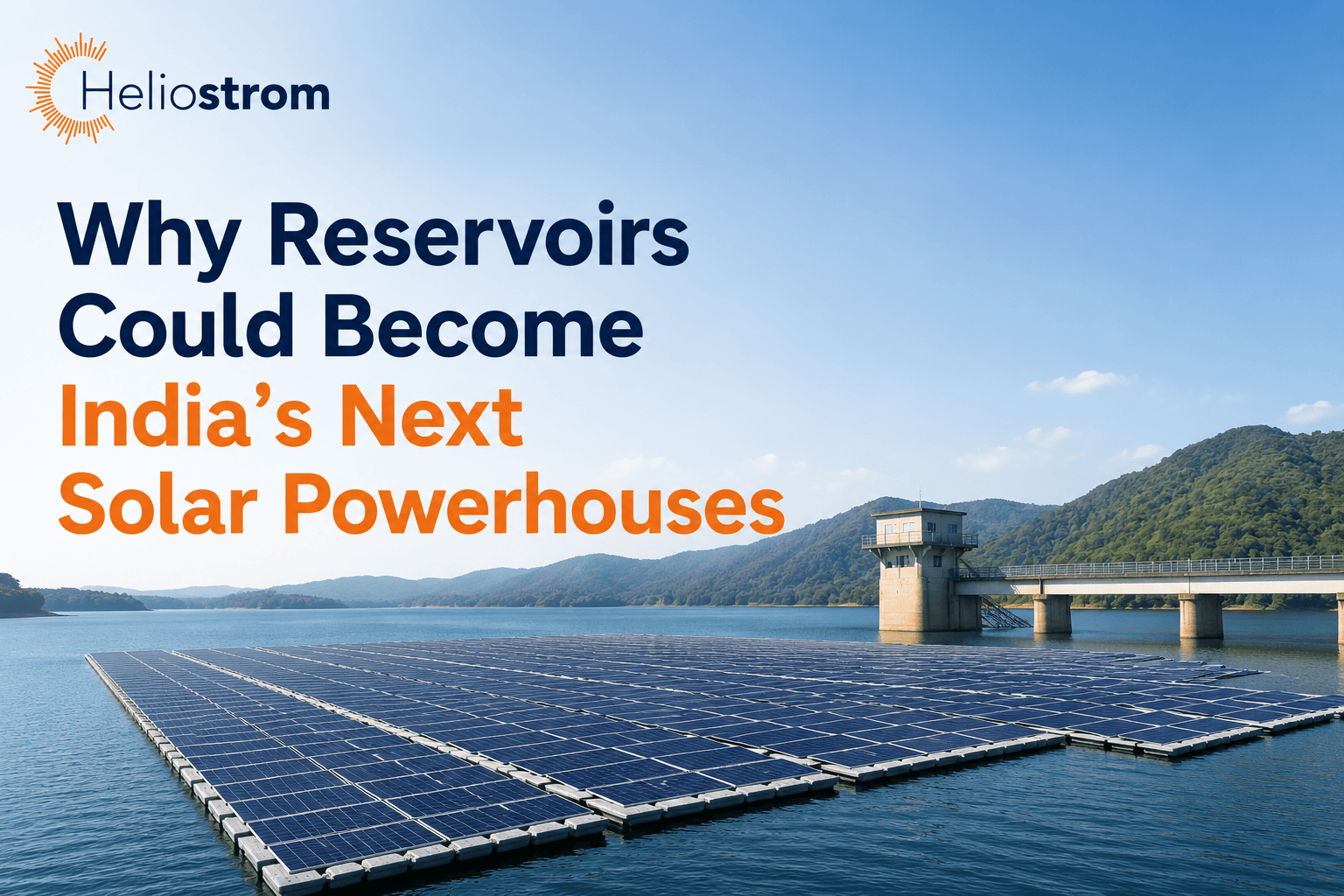
India has spent the last decade racing to add solar capacity, and most of that growth has come from large ground-mounted plants spread across open land. That approach is now running into a wall. Land is scarce, expensive, and often tied up in farming, forestry, or local livelihoods. A new government assessment suggests the country may not need as much fresh land as once assumed. The answer, it turns out, could be floating on the surface of the reservoirs India already has. Many businesses exploring Solar Power Plants in Chennai are watching this shift closely, since it points to where large-scale solar capacity is headed next.
The Land Problem Behind India's Solar Push
Ground-mounted solar still makes up the bulk of India's installed base, which reached about 164.59 gigawatts of total installed solar capacity as of July 2026, while floating solar accounts for only around 0.7 gigawatt so far. The trouble with ground-mounted plants is that a solar farm needs roughly three to four times more land than the panels themselves occupy, once you account for spacing, access roads, and maintenance corridors. Acquiring that much land is rarely simple. Farmers are reluctant to give up fertile fields, state governments face delays in clearing titles, and disputes over compensation can stall a project for years before a single panel is installed.
This is where reservoirs enter the conversation. India built thousands of dams and water storage bodies over the past century for irrigation, drinking water, and hydropower. Their surfaces are largely unused space, and putting solar panels there does not compete with agriculture or housing in the way ground-mounted projects often do.
What Floating Solar Actually Involves
Floating solar, sometimes called floatovoltaics, places photovoltaic panels on buoyant platforms anchored to the bed or banks of a reservoir, lake, or large pond. The panels sit just above the waterline and are connected by cables that run to an onshore substation. The core generation technology is the same as any rooftop or ground-based solar panel installation, but the mounting structure and anchoring system are built to handle water movement, humidity, and, in some cases, seasonal changes in water level.
The concept is not new globally. Japan installed one of the earliest commercial floating arrays back in 2007, and China has since become the world leader, including a large array built over a former coal mining subsidence area that filled with water near Poyang Lake. India's own footprint has been modest by comparison, but that is changing quickly.
How Much Potential Do India's Reservoirs Actually Hold
In June 2026, the National Institute of Solar Energy, an autonomous body under the Ministry of New and Renewable Energy, released the first comprehensive national assessment of floating solar potential. The findings were striking.
The Numbers Behind the Assessment
The report estimated that India's reservoirs and other suitable inland water bodies could host around 102.18 gigawatts of floating solar capacity. That figure assumes developers use only about 20 percent of a reservoir's surface area, leaving the rest free for fishing, irrigation withdrawal, and other existing uses. With this addition, India's total assessed solar potential across all formats now stands at roughly 3,445 gigawatts, according to figures released alongside the study.
Where the Best Sites Are Located
The assessment found the largest concentrations of suitable reservoirs in Maharashtra, Madhya Pradesh, Karnataka, Odisha, Telangana, and Gujarat, states with a mix of large irrigation dams and hydropower reservoirs. Southern states, including Tamil Nadu, also hold meaningful reservoir capacity, which matters for regions like Chennai where land near industrial corridors is already tight and demand for reliable daytime power keeps climbing.
A National Scheme to Back the Numbers
Numbers on paper only matter if there is money and policy behind them. On 31 July 2026, the Union Cabinet approved the Pradhan Mantri Surya Sarovar Yojana, a scheme carrying a financial outlay of about 5,070 crore rupees. It targets 5 gigawatts of floating solar capacity paired with battery energy storage systems offering at least two hours of backup, adding up to roughly 10 gigawatt-hours of storage nationwide. The Solar Energy Corporation of India is expected to play a lead role in implementing the scheme.
Projects under the scheme will be sanctioned between the 2026 to 2027 and 2030 to 2031 financial years, with financial support continuing through 2032 to 2033. Developers who commission projects successfully stand to receive central financial assistance of about 1 crore rupees per megawatt. As part of this framework, the scheme also sets aside a preparatory grant of up to 50 lakh rupees per project for detailed feasibility studies and environmental and social impact assessments, meant to de-risk projects before financial closure, since reservoirs often serve multiple stakeholders including fishers, farmers, and drinking water utilities who need to be consulted first.
Projects Already Running on Indian Waters
India's commissioned floating solar capacity currently stands at around 700 megawatts, still small next to the target but growing steadily. The Omkareshwar Floating Solar Park on the Narmada River in Madhya Pradesh leads the pack at 278 megawatts, with plans to scale toward 600 megawatts over time. Unlike projects sanctioned under the new PM-SSY scheme, Omkareshwar does not include co-located battery storage, which is part of why the newer scheme makes storage mandatory. NTPC has also built floating arrays at Ramagundam in Telangana at 100 megawatts, Kayamkulam in Kerala at 92 megawatts, and Simhadri in Andhra Pradesh at 25 megawatts. Together these plants demonstrate that the technology works at scale on Indian reservoirs, not just in pilot form.
Globally, total floating solar capacity reached close to 9.6 gigawatts by 2024, with almost 90 percent of it built in Asia. If India delivers even a fraction of its new scheme, the country's floating solar build over the next five years would exceed the entire installed base the world has accumulated since the technology first appeared in 2007.
Why Floating Solar Offers More Than Just Land Savings
Beyond freeing up land, floating arrays bring a couple of practical side benefits that ground-mounted plants cannot match.
Cutting Down Evaporation Losses
Panels covering part of a reservoir's surface reduce direct sunlight hitting the water, which in turn slows evaporation. Field studies on covered water surfaces have reported evaporation reductions ranging from around 20 to 60 percent, with some Indian reservoir trials showing meaningful water savings even at 30 to 50 percent surface coverage. For a country where water scarcity affects large parts of the population during summer months, this is a valuable secondary gain, particularly for reservoirs that double as drinking water or irrigation sources.
Cooler Panels, Better Output
Solar panels lose efficiency as they heat up. Sitting above a water surface tends to keep floating panels several degrees cooler than their land-based counterparts, especially during peak afternoon hours. Several field studies on floating installations report yield gains of a few percentage points compared with similarly rated ground-mounted systems, largely due to this cooling effect.
The Practical Hurdles Still Ahead
None of this comes without complications. The NISE report focuses on technical potential and does not provide a detailed cost estimate for building out the full 102 gigawatts. Actual project costs in India will depend on anchoring design, water depth variation, cable routing, and local environmental clearances, all of which vary widely from one reservoir to the next.
Multi-purpose reservoirs also complicate matters. A dam that supplies drinking water to a city, irrigation to farmland, and power through a hydropower turbine has several stakeholders whose interests need balancing before a floating array can go ahead. That is precisely why the new scheme sets aside a dedicated feasibility grant rather than pushing developers straight into construction.
What This Shift Means for Homes and Businesses
Large reservoir projects will take years to reach full scale, but the broader momentum behind Indian solar policy has a direct effect on smaller-scale adoption too. As state grids add more renewable capacity and manufacturing scales up domestically, the case for a rooftop Solar Panel Installation for a house or a factory roof keeps getting stronger, both on cost and on payback timelines. Businesses in fast-growing industrial and IT corridors are also finding that Commercial Solar for Chennai projects make financial sense sooner than expected, given rising grid tariffs and falling panel prices.
A stronger domestic policy push, backed by schemes like PM-SSY, also tends to support local supply chains. Working with established Solar Panel Manufacturers in Chennai gives homeowners and businesses access to equipment suited to Indian climate conditions, along with after-sales support that imported systems may not always provide.
The Road Ahead for India's Reservoirs
India's solar story has largely been written on land so far. The next chapter looks set to play out on water instead. With 102 gigawatts of estimated reservoir potential, a dedicated national scheme, and a handful of large projects already proving the concept works, floating solar is moving from a niche idea to a serious pillar of the country's renewable energy plan. Whether it lives up to that promise will depend on how quickly feasibility studies, environmental clearances, and financing come together over the next few years.
For now, the direction is clear. Reservoirs that once served a single purpose are being reimagined as multi-use assets, generating clean power while continuing to support irrigation, drinking water, and fisheries. That is a meaningful shift for a country still working to meet its non-fossil energy targets.
Get Expert Guidance on Your Solar Journey
Whether you are exploring solar for a home, a factory, or a commercial property, the right guidance can make the process far simpler. To understand what solar options work best for your property and budget, Contact Us and speak with a team that has helped homes and businesses across Chennai move to solar power.
Ready to claim your subsidy? home solar installation in Chennai or get a free solar quote.


