
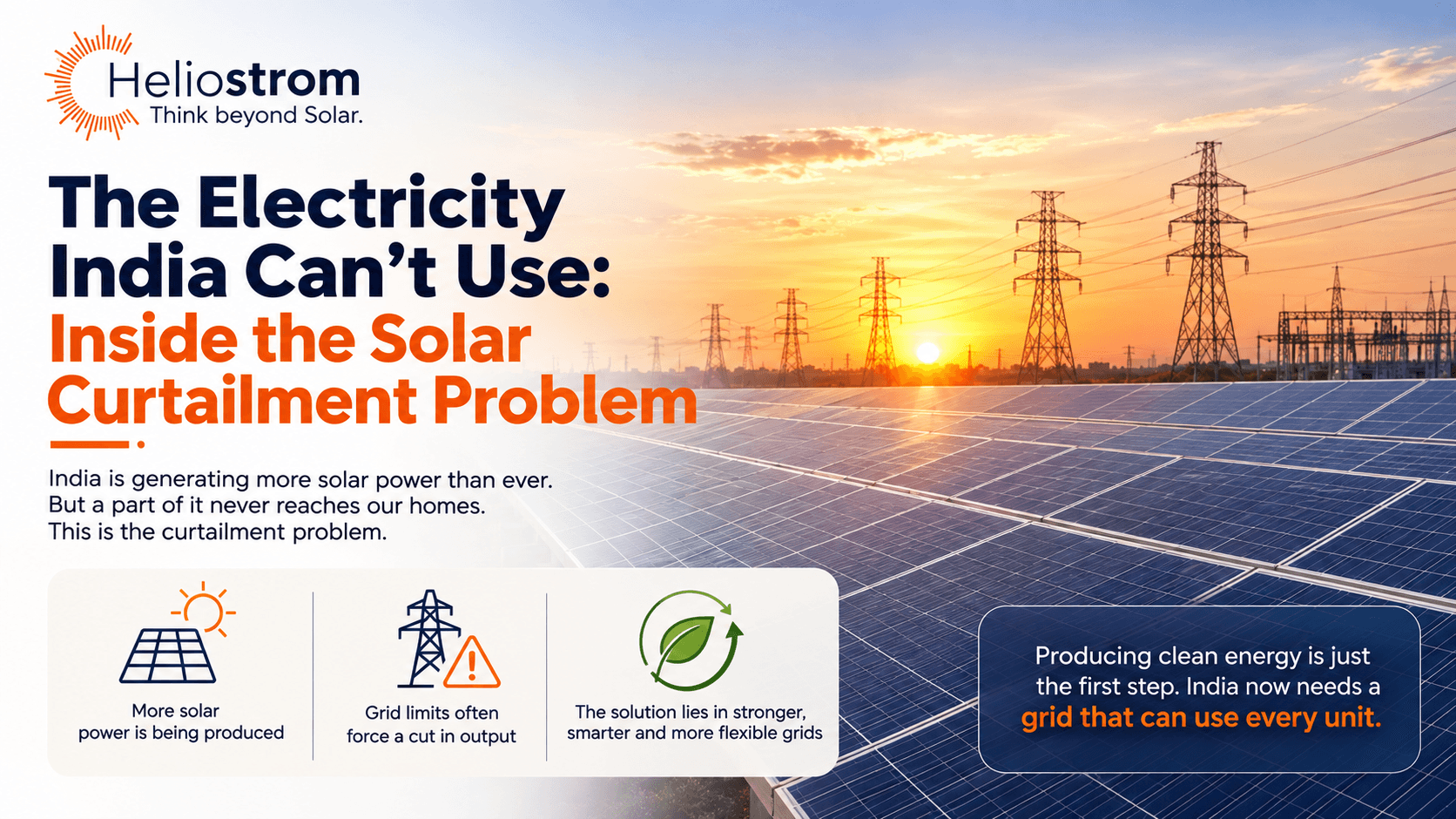
India curtailed 8,133 gigawatt hours of solar power between April and June 2026 alone, electricity that solar plants were fully capable of generating but were not allowed to feed into the grid. That is enough clean power to matter, wasted not because the sun stopped shining but because the grid could not safely absorb or transport it. For anyone evaluating installing a home solar system, this national level problem rarely affects an individual rooftop directly, but understanding it explains why grid readiness has become as important a conversation as panel efficiency in India's solar story.
What Solar Curtailment Actually Means
Curtailment Is Not the Same as a Power Cut
Curtailment means deliberately reducing how much electricity a solar plant is allowed to generate or feed into the grid, even though the plant could technically produce more given the available sunlight. This is different from a power cut affecting consumers, since curtailment happens on the generation side, restricting how much power a plant can inject into the grid when the network cannot safely accommodate or transmit the additional electricity at that moment. A consumer experiencing a power outage and a solar developer facing curtailment are dealing with two entirely separate problems, even though both ultimately trace back to the same underlying grid capacity constraints.
How Much Solar Power India Is Actually Curtailing
8,133 Gigawatt Hours in a Single Quarter
The government informed Parliament that India curtailed approximately 8,133 gigawatt hours of solar power during the first quarter of the 2026 to 2027 financial year, from April through June 2026. The figure broke down to roughly 2,417 gigawatt hours in April, 3,235 gigawatt hours in May, and 2,481 gigawatt hours in June, based on data from Grid Controller of India Limited cited in the Ministry of New and Renewable Energy's parliamentary response. That is a meaningful volume of clean electricity that was technically available but never made it onto the grid during a single three month stretch.
Installed Capacity Has Grown Faster Than Evacuation Infrastructure
India's installed solar capacity had reached approximately 162.15 gigawatts by the end of June 2026. That scale of generation is a genuine achievement, but the same government response attributed the curtailment to two related factors: grid security requirements and a mismatch between the pace of transmission line commissioning and the pace of new renewable energy project commissioning, meaning generation capacity is arriving faster than the infrastructure needed to carry that power away.
Two Reasons Behind the Curtailment
Grid Security and Stability Constraints
Solar output varies with weather and time of day, creating additional challenges for balancing generation and demand across the network. During periods of high solar generation, grid operators may need to restrict output when the network cannot safely accommodate or transport all available electricity because of transmission congestion or other system security constraints, since pushing too much variable generation into a constrained grid can threaten frequency stability rather than simply being an inconvenience.
Transmission Lines Are Not Keeping Pace With New Projects
Credit rating agency ICRA has pointed to significant execution risk in India's transmission buildout, noting that projects awarded through the tariff based competitive bidding route have frequently faced delays tied to land acquisition, right of way issues, and regulatory approvals. Of the transmission projects commissioned by March 2026 under this route, only about 12 percent were completed within their original scheduled timeline, with the remainder delayed by anywhere from two months to three years and a median delay of more than ten months.
The T-GNA Route: A Temporary Fix With Real Costs
What ICRA Found
ICRA reported that around 33 percent of the 54.8 gigawatts of recently commissioned renewable energy capacity was being evacuated through the Temporary General Network Access, or T-GNA, route as of May 2026. T-GNA allows projects to use available transmission margins on an interim basis while dedicated transmission systems are still being built, but it comes without the same guaranteed access that a plant with formal General Network Access receives, which helps explain why projects using T-GNA are particularly exposed to curtailment when transmission margins tighten during high-generation periods.
Why Curtailment Is Worse During Solar Hours
According to ICRA's May 2026 assessment, curtailment under T-GNA was highest during solar hours, reaching roughly 50 percent to 60 percent in the affected network, a figure describing T-GNA connected capacity specifically rather than India's nationwide curtailment rate. This pattern makes sense given how solar generation concentrates output into the middle of the day, precisely when transmission corridors serving high solar density regions are most likely to reach their capacity limits.
Why Some Regions Are Hit Harder Than Others
ICRA's analysis found that solar curtailment is considerably more prominent in Rajasthan and Gujarat, states with very high concentrations of installed solar capacity relative to their transmission corridors, while curtailment in the southern region remains limited even during peak solar generation hours. This is a regional finding rather than data specific to any single city, including Chennai, but it illustrates how curtailment risk tracks closely with how concentrated renewable capacity is relative to the transmission infrastructure built to carry it.
What Curtailment Means for Project Revenue
Whether a project is compensated for curtailed generation depends on its power purchase agreement, contractual arrangements, and the applicable regulatory framework. For projects without contractual protection or compensation, every unit of electricity that cannot be scheduled represents potential lost revenue. ICRA has also flagged that developers face compounding pressures beyond curtailment itself, including delayed power purchase agreements, with an estimated 40 to 45 gigawatts of awarded capacity still lacking a signed PPA as of April 2026, alongside land acquisition hurdles and financially strained distribution companies.
What Is Being Done to Fix It
ICRA estimates the transmission sector needs annual additions of roughly 20,000 circuit kilometres of transmission lines and 120 gigavolt amperes of substation capacity, backed by an estimated 5 to 6 trillion rupees in transmission investment between 2026 and 2032, to keep pace with the more than 900 gigawatts of non-fossil-fuel capacity the government aims to integrate into the grid by FY 2035-36. Battery energy storage systems and pumped storage projects are also being positioned as tools to absorb midday solar surplus that the grid cannot immediately use, reducing reliance on curtailment as the default response. Policy responses are also evolving. In August 2026, India's power sector regulators moved toward measures aimed at reducing the financial impact of transmission delays, including proposals for transmission charge relief for renewable projects affected by unavailable grid infrastructure and mechanisms allowing some delayed projects to retain grid access under revised conditions. For businesses evaluating solar power installations across Chennai or exploring commercial solar setups in Chennai, these national infrastructure investments matter less for day-to-day project economics than the fact that southern grid regions have so far avoided the curtailment levels seen in Rajasthan and Gujarat.
Does This Change Anything for Homeowners and Businesses in Chennai
For rooftop solar specifically, the type of curtailment described in the national data is primarily associated with larger grid-connected projects and transmission-level constraints, rather than the typical residential rooftop system. However, rooftop projects can still face local export limits or distribution-network constraints depending on their connection and operating arrangement. The broader lesson for any solar buyer is less about direct exposure and more about recognizing that generation capacity and grid infrastructure need to be planned together, which is exactly the kind of site-specific assessment a proper installation proposal should already account for.
Conclusion
India curtailed enough solar power in a single quarter to represent a genuine gap between what the country can generate and what its grid can currently absorb. The causes, including grid security requirements and a transmission buildout that has not kept pace with new renewable capacity, are well documented and are being addressed through new investment and evolving network access rules. If you want to understand how grid readiness factors into a well planned solar project, speak with our solar team before finalizing your system design.
Frequently Asked Questions
What is solar curtailment?
Solar curtailment is the deliberate reduction of electricity generation from a solar plant, even though more power could be generated given available sunlight, typically because the grid cannot safely absorb or transport that additional electricity at that moment.
How much solar power has India curtailed recently?
The government reported that India curtailed approximately 8,133 gigawatt hours of solar power during the first quarter of the 2026 to 2027 financial year, from April through June 2026, citing data from Grid Controller of India Limited.
Why is India curtailing solar power despite growing demand for clean energy?
The government has cited two main factors: grid security requirements that limit how much variable generation the network can safely absorb at once, and a mismatch between how quickly new transmission lines are being commissioned compared with how quickly new renewable energy projects are being built.
What is the T-GNA route and why does it matter for curtailment?
Temporary General Network Access allows renewable energy projects to use available transmission capacity on an interim basis before dedicated transmission infrastructure is completed. According to ICRA, about a third of recently commissioned renewable capacity relies on this route, and curtailment under T-GNA is significantly higher during solar generation hours than at other times.
Does curtailment affect homes and businesses with rooftop solar?
Curtailment risk is generally more significant for utility-scale and large grid-connected projects with substantial electricity export requirements than for small rooftop systems, although the actual exposure depends on the project's grid connection and operating arrangement.
Can battery storage help reduce solar curtailment?
Battery energy storage systems can help reduce curtailment when they are integrated into the project and grid connection in a way that allows excess generation to be stored and used later rather than wasted, though storage alone does not eliminate curtailment without adequate transmission and grid planning alongside it.
Ready to claim your subsidy? home solar installation in Chennai or get a free solar quote.


