
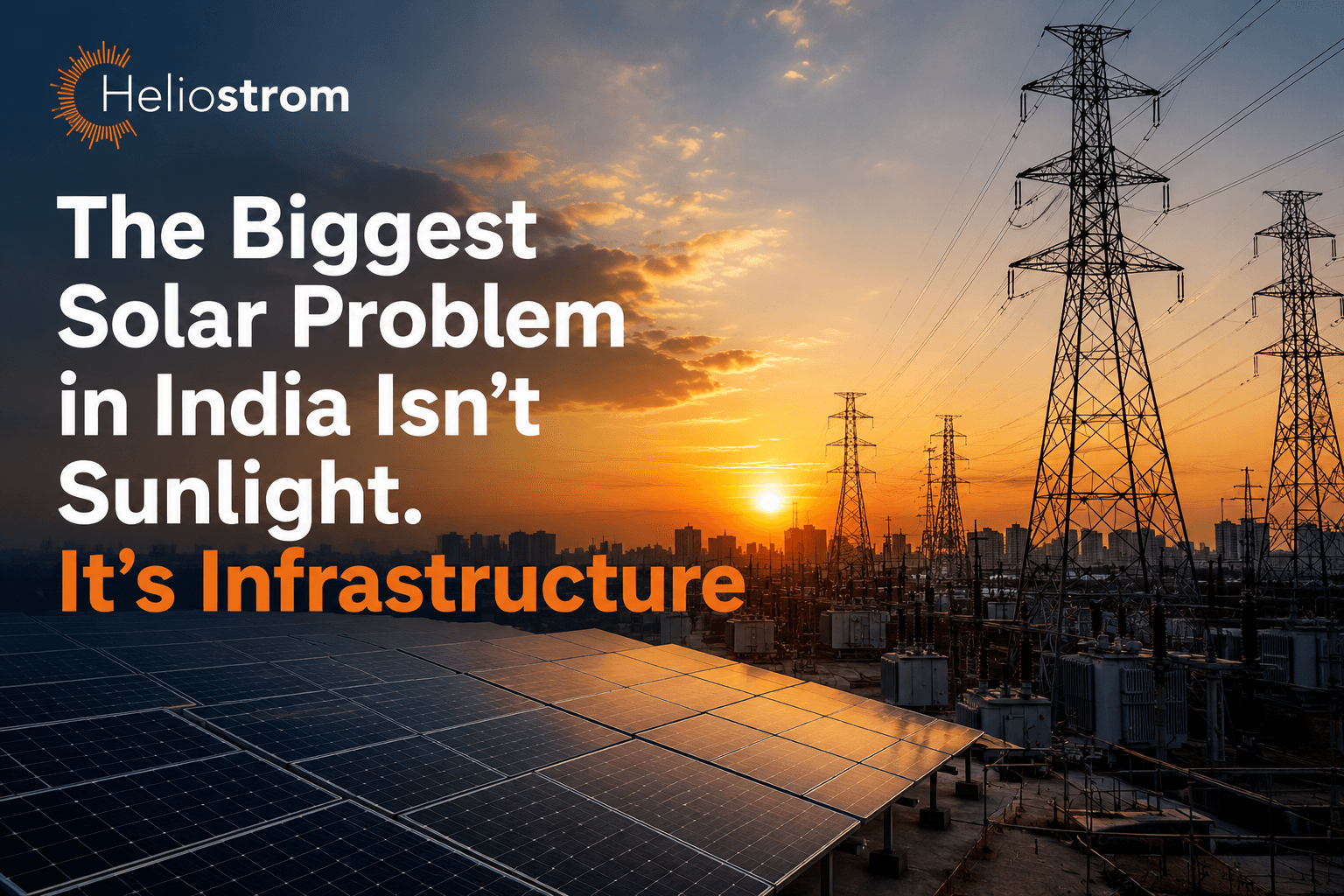
India receives more usable sunlight than almost any other large economy, yet the country's solar story in 2026 is no longer about how much light falls on rooftops and open land. It is about what happens after the panels are switched on. Grid bottlenecks, delayed transmission lines, and storage gaps have become the real ceiling on how much clean power actually reaches homes, factories, and offices. For anyone evaluating solar power plants in Chennai, understanding this shift is as important as understanding panel efficiency, because infrastructure readiness now decides whether a solar investment delivers its full value from day one.
India's Solar Capacity Has Outgrown Its Grid
The numbers tell an unusual story. India's cumulative installed solar capacity stood at around 162 gigawatts as of 30 June 2026 according to official government data, with some industry trackers placing it closer to 165 gigawatts. Either way, the country now ranks as the world's third largest solar market. Renewable sources account for roughly 43 percent of India's total installed power capacity, though their share of actual electricity generation is considerably lower, closer to 20 to 26 percent depending on the quarter, since solar and wind only produce power for part of the day. Utility-scale solar additions grew sharply over the past two years. On paper, this looks like a clean energy success story. In practice, generation has been growing faster than the wires needed to carry that power to where it is consumed.
Government data presented in Parliament showed that India was unable to deliver over 8,000 gigawatt hours of solar electricity to the grid between April and June 2026 because of transmission bottlenecks, a figure that already exceeds the losses recorded through the entire previous financial year. Roughly 12 gigawatts of installed clean-energy capacity is currently unable to operate at full output during peak sunlight hours because transmission networks cannot safely absorb the load, while another 21 gigawatts or so is running on temporary grid connections while dedicated evacuation infrastructure is still being built. This is not a sunlight problem. It is an infrastructure problem, and it is becoming one of the defining challenges of India's clean energy transition.
Curtailment: The Hidden Cost Behind the Growth Numbers
Curtailment describes a simple problem: a solar plant is generating power, but the grid tells it to scale back because the network cannot safely absorb the extra load. It usually happens around midday, when solar output peaks across an entire region at once and local substations reach their thermal limits. For a plant owner, curtailment means generating electricity that never gets paid for, which quietly erodes the return promised at the time of commissioning.
This is not a rare or isolated event anymore. It is showing up consistently in states with the fastest solar growth, including Rajasthan, Gujarat, and Karnataka, which together account for the majority of India's utility-scale capacity. As more projects come online in the same feeder zones, the risk of curtailment rises unless matching investment goes into substations, transformers, and storage. This is one more reason project location and grid study matter as much as panel wattage when a system is being planned.
Why Transmission Can't Keep Up With Panel Installations
Solar projects can be built in months, but the transmission corridors, substations, and evacuation infrastructure that carry that power to the grid take years to plan and construct. This mismatch in timelines is at the heart of the current strain.
Evacuation Infrastructure Lags Behind Generation
Many utility-scale projects are commissioned and ready to generate power, but they sit idle or run at reduced capacity because the connecting transmission line has not been completed. Developers often finish a plant months ahead of the grid link meant to carry its output, which wastes the investment until infrastructure catches up.
Domestic Manufacturing and Component Constraints
Since 1 June 2026, the Ministry of New and Renewable Energy's Approved List of Models and Manufacturers for solar cells, known as ALMM List-II, has required most grid-connected and net-metered projects to use modules built with domestically approved cells, hitting newer TOPCon technology hardest. Approved module capacity in India stands at roughly 217 gigawatts, but approved domestic cell capacity is only about 32 gigawatts, with just around 10 gigawatts of that in TOPCon. This gap has created short-term supply pressure and higher prices. To ease the transition, the government extended an exemption for net-metering and open-access projects until 31 December 2026, after which full compliance becomes mandatory.
Land and Right of Way Delays
Securing land for new transmission corridors involves multiple layers of approval, compensation negotiation, and local consent, especially in densely populated or agriculturally active regions. These delays are rarely about a shortage of engineering talent. They stem from coordination across state agencies, landowners, and utility companies, and that coordination has not scaled at the same pace as panel deployment.
What This Means for Chennai's Businesses and Homeowners
Tamil Nadu has been one of the more active states in India's renewable expansion, and Chennai's industrial belt, from Ambattur to Sriperumbudur, continues to add manufacturing and commercial load every year. That growth puts real pressure on local distribution networks, particularly during peak summer demand when both air conditioning load and solar generation peak within the same window. In parts of the southern grid, including Tamil Nadu, a meaningful share of recently commissioned renewable capacity is operating on temporary grid access while permanent evacuation infrastructure is completed, which raises the risk of daylight-hour curtailment as more projects come online in the same feeder zones.
Smaller residential systems typically clear feasibility approval and net-metering sign-off faster than large commercial installations, which may need additional load studies if the local transformer is already close to capacity. Under TANGEDCO's process, feasibility approval alone can take around 15 to 25 working days, with a similar window for post-installation inspection, so the full journey from application to grid connection often runs 90 to 120 days when documentation is in order.
For homeowners, this is precisely why a well-planned solar panel installation should be sized around actual consumption patterns and net metering rules rather than rooftop area alone. Oversizing a system without accounting for local grid absorption capacity can lead to longer payback periods if export limits or curtailment come into play.
The stakes are higher for factories and commercial establishments, where downtime or unreliable supply has a direct cost. A thoughtfully designed commercial solar setup for Chennai needs to factor in feeder capacity, transformer loading, and whether the local substation can comfortably absorb the exported power during low demand hours. Skipping this evaluation is one of the most common reasons commercial projects underperform their projected savings.
Building Resilience Against Grid Delays
Since infrastructure gaps are unlikely to close overnight, the more practical question for households and businesses is how to design a system that delivers reliably even when grid conditions are not ideal.
Battery Storage and Hybrid Configurations
Pairing solar with battery storage reduces dependence on real-time grid export and import, which matters most during curtailment events or voltage fluctuations. Hybrid inverters that can shift between grid, battery, and solar sources automatically are increasingly common in both residential and industrial proposals, and they help the system deliver reliably even when generation timing and actual usage do not line up.
Right Sizing Instead of Maximum Sizing
A system sized to match genuine daytime consumption, with a modest buffer for future load growth, tends to perform more predictably than one designed purely around available roof space. This also keeps export dependency low, useful in areas where feeder capacity is already tight.
Choosing an Installer Who Understands Local Grid Conditions
Design decisions like inverter selection, cable sizing, and metering configuration should reflect the realities of the local distribution network, not just generic sizing charts. Working with established solar panel manufacturers in Chennai who understand Tamil Nadu's grid approval process and substation constraints tends to reduce the administrative back-and-forth that often holds up commissioning and net-metering sign-off.
The Road Ahead for India's Grid
Policymakers are aware of the gap. Plans for expanded Green Energy Corridors, faster rollout of battery energy storage systems, and pumped storage projects are all aimed at giving the grid more flexibility to absorb variable solar output. Investment in smart grid technology and better generation forecasting is also expected to reduce the scale of curtailment over the next few years.
None of this changes the near-term reality. Until transmission and storage infrastructure catches up with installed capacity, the value a solar system delivers depends heavily on how well it is designed for local conditions, not just on how many panels are placed on a roof.
Common Questions About Solar and Grid Reliability
Is solar still worth it in Chennai despite grid constraints?
Yes, in most cases. Chennai's electricity tariffs and daytime consumption patterns still make solar financially attractive, especially for homes and businesses that use most of their power during daylight hours. The key is designing the system with realistic export expectations rather than assuming unlimited grid absorption.
How long does grid approval take for a rooftop or commercial system?
As a rough guide, most households can expect the full cycle, from application to final connection, to fall within the 90 to 120 day range noted earlier, provided paperwork is complete and there are no capacity constraints at the local transformer. Delays usually stem from incomplete documentation or feeder capacity issues rather than the approval process itself, which is why choosing an installer who files applications correctly the first time makes a real difference.
Final Thought
Sunlight was never India's constraint. The country has abundant solar resources across nearly every state, and that has not changed. What has changed is the recognition that generation capacity alone does not guarantee reliable power. Grid readiness, storage, and thoughtful system design now matter just as much as the panels themselves.
If you are planning a rooftop, industrial, or commercial solar project and want a system designed around real grid conditions rather than generic assumptions, contact us to speak with our solar engineers about what will actually work for your location.
Ready to claim your subsidy? home solar installation in Chennai or get a free solar quote.


