
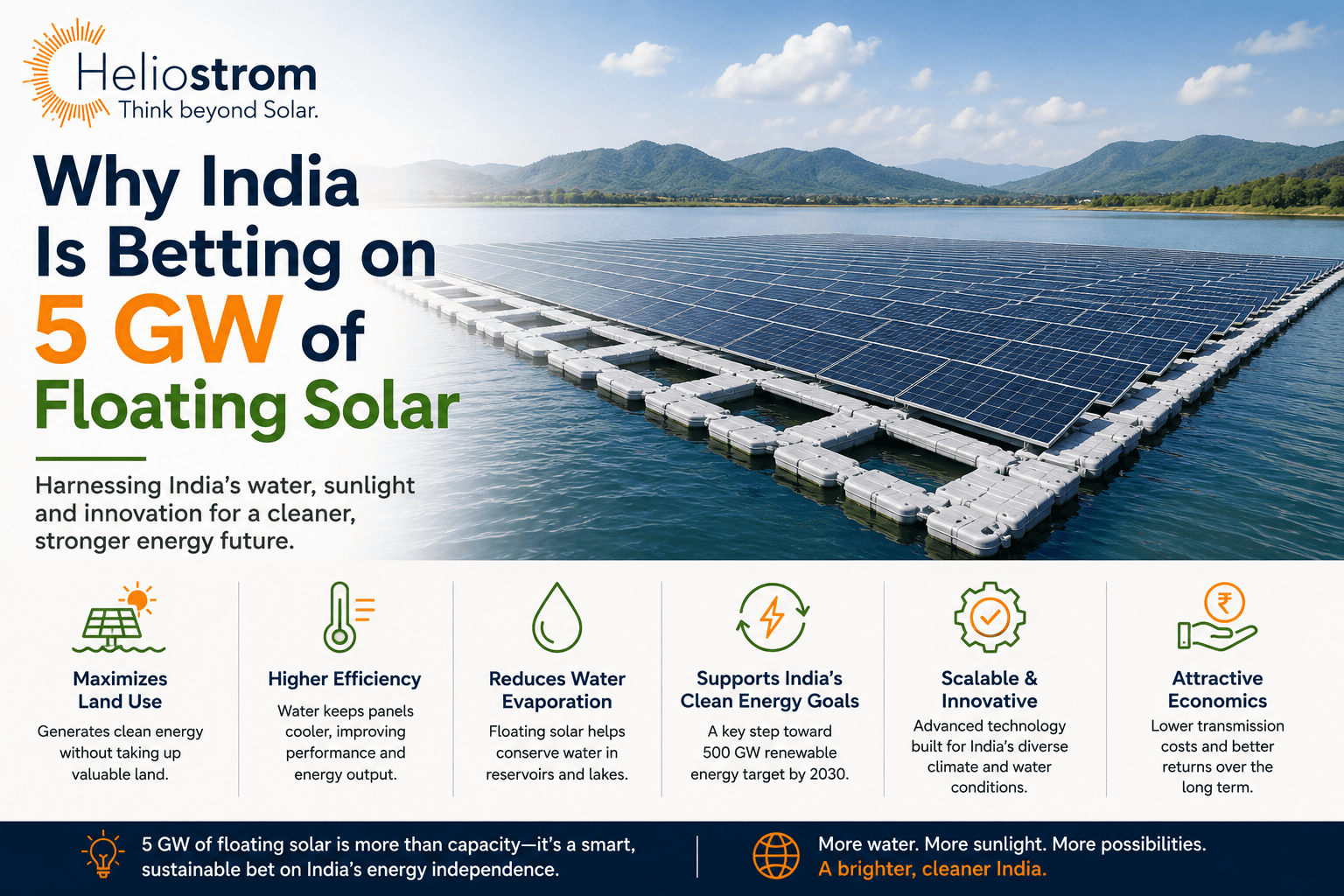
India's Union Cabinet has approved a scheme to build 5,000 megawatts of floating solar capacity with co-located battery storage between 2026-27 and 2030-31, backed by roughly 5,070 crore rupees in central funding. That single program would add more than seven times India's current floating-solar capacity, which the government puts at around 700 megawatts. The government expects the program to cut roughly 10 million tonnes of carbon dioxide emissions annually and create between 16,000 and 17,000 jobs across the floating solar value chain once fully rolled out. Understanding why the government is betting so heavily on water-based solar, rather than simply continuing to expand solar power plant installations in Chennai and other land-based sites, comes down to a straightforward resource problem that floating panels solve in a way ground-mounted systems structurally cannot.
What the New Scheme Actually Means
India's new PM Surya Sarovar Yojana will support 5 gigawatts of floating solar projects paired with at least two hours of co-located energy storage. Approved by the Union Cabinet in July 2026, the 5,070 crore rupee scheme is designed to use reservoirs and other inland water bodies for renewable generation while reducing pressure on land and improving grid flexibility.
The Scheme Driving This Push: PM Surya Sarovar Yojana
What the Program Actually Funds
The Pradhan Mantri Surya Sarovar Yojana, or PM-SSY, targets 5 gigawatts of floating solar paired with a minimum of two hours of co-located energy storage, equivalent to a minimum of 10,000 megawatt-hours of co-located energy-storage capacity across the program. Developers receive central financial assistance of about 1 crore rupees per megawatt after a project is commissioned, along with additional support of up to 50 lakh rupees per project to cover feasibility studies such as bathymetry surveys, hydrography assessments, and environmental review. The scheme is intended to benefit all states and union territories, which spreads its reach well beyond the handful of states that have hosted India's floating solar pilot projects so far.
Why Storage Is Bundled Into Every Project
Making battery storage mandatory alongside every floating solar project reflects a deliberate design choice rather than an afterthought. Adding energy storage allows solar generation to be shifted beyond the hours when the sun is available, helping grid operators manage peak demand and improve reliability. At reservoir sites that are also linked to hydropower, solar and hydro resources can potentially complement each other. Requiring at least two hours of storage on every project also means the scheme is not simply adding raw generation capacity, it is adding capacity that grid operators can actually rely on during the evening demand peak that solar alone cannot cover.
How Much Room India Actually Has for This
The National Institute of Solar Energy estimates India's technical floating-solar potential at approximately 102.18 gigawatts-peak across reservoirs and other suitable inland water bodies. Against that backdrop, a 5 gigawatt program represents a meaningful first step rather than anything close to the ceiling of what India's water bodies could theoretically support.
Why Floating Solar Solves a Real Land Problem
Ground-Mounted Solar Competes With Other Land Uses
Utility-scale, land-based solar parks require large, contiguous tracts of land, which frequently means diverting agricultural fields, clearing forest cover, or navigating lengthy land acquisition disputes before a single panel goes up. These are not hypothetical concerns in a country with India's population density and competing demands on usable land, and they have delayed or complicated numerous ground-mounted projects over the years. A large solar park that looks straightforward on a map can take years longer than planned once local land rights, compensation negotiations, and environmental clearances enter the picture, costs that rarely show up in the headline capacity figures announced when a project is first proposed.
Reservoirs and Industrial Ponds Offer Land the Country Already Has
Floating solar uses water-surface areas that can potentially host power generation without requiring the same additional land footprint as a ground-mounted solar park, on reservoirs, irrigation tanks, and industrial ponds that already serve another primary purpose. This is precisely the appeal officials have cited in describing the scheme, framing it as a way to make productive use of existing water infrastructure while reducing competition for scarce land resources. A reservoir built decades ago for irrigation or drinking water supply continues serving that original function while its surface simultaneously generates electricity, a dual use that a purely land-based project could never replicate on the same footprint.
Benefits Beyond Simply Avoiding Land Disputes
The water environment can help reduce module operating temperatures, potentially improving energy yield under hot conditions, although the actual benefit depends on system design and local conditions. Partial surface coverage can also reduce evaporation from the covered portion of a reservoir, although the water-saving effect varies with local climate, coverage, and reservoir conditions. Project approvals can impose limits on the proportion of a water body's surface that can be covered, taking into account ecological conditions and existing uses such as fisheries and water management, rather than allowing panels to blanket an entire water body.
What Existing Projects Reveal About the Model
India's Largest Operating Plants Today
The 278 megawatt operational capacity at the Omkareshwar Floating Solar Park in Madhya Pradesh is currently India's largest commissioned floating-solar project by capacity, part of a project ultimately planned for 600 megawatts. NTPC's 100 megawatt floating solar project at Ramagundam in Telangana, with panels mounted on floating platforms across the reservoir surface, and NTPC's Kayamkulam floating solar project in Kerala, with around 92 megawatts of capacity, round out the country's most significant operating sites. Smaller additions commissioned by NTPC group companies have continued arriving too, showing the model scaling across a widening range of project sizes rather than staying limited to a handful of flagship developments.
Lessons Learned From These Early Deployments
Early Indian projects have built practical expertise around floating-solar challenges, including anchoring systems that accommodate changing water levels and floating structures designed to withstand long-term exposure to sunlight and water. That experience will be important as the new scheme expands deployment across more sites, giving developers a track record to draw on rather than starting from a blank slate every time.
What This Means for Businesses and Land-Based Solar Buyers
Floating solar's scale ambitions do not diminish the case for rooftop and ground-mounted systems on properties that already have the space for them. Businesses evaluating commercial solar options for Chennai facilities or homeowners considering a standard rooftop solar panel installation are working with a fundamentally different site profile than a utility-scale reservoir project, and the underlying economics, financing structures, and equipment choices remain distinct. Floating solar expands India's total renewable capacity without competing for the same rooftop or land-based sites most homes and businesses are actually evaluating.
Frequently Asked Questions
Is floating solar meant to replace rooftop or ground-mounted solar in India?
No. Floating solar targets a different resource entirely, reservoir and pond surfaces rather than rooftops or open land, and is intended to add capacity alongside rooftop and ground-mounted solar rather than substitute for either category.
How is a floating solar installation physically built on water?
Panels are mounted on buoyant floating platforms, typically made from durable, UV-resistant materials such as high-density polyethylene, which are anchored to the reservoir bed or banks to hold the array in a stable position despite changing water levels and wind.
Does covering part of a reservoir with solar panels harm the water body itself?
Regulatory guidance for these projects generally limits coverage to a defined share of total reservoir surface area specifically to protect aquatic ecosystems and existing uses like fishing, meaning full or near-full surface coverage is not the intended model under current policy design.
When will most of this new floating solar capacity actually come online?
Projects under the PM Surya Sarovar Yojana are expected to be sanctioned between the 2026-27 and 2030-31 financial years, with financial disbursement continuing through 2032-33, meaning the bulk of this capacity will be phased in gradually over roughly the next six to seven years rather than arriving all at once.
Conclusion
India's 5 gigawatt floating solar push reflects a practical response to a resource constraint that land-based solar cannot escape, the simple fact that usable land is finite and contested, while reservoir surfaces sit largely idle. With technical potential estimated at roughly 20 times the current program's target, this scheme looks more like an opening move than a final ambition. For homes and businesses evaluating solar on the land or rooftop they already have, that resource logic does not go away just because reservoirs are entering the picture too. If you want to understand how solar technology has evolved for your own property in Chennai, contact our solar experts to discuss what fits your site.
Ready to claim your subsidy? home solar installation in Chennai or get a free solar quote.


