
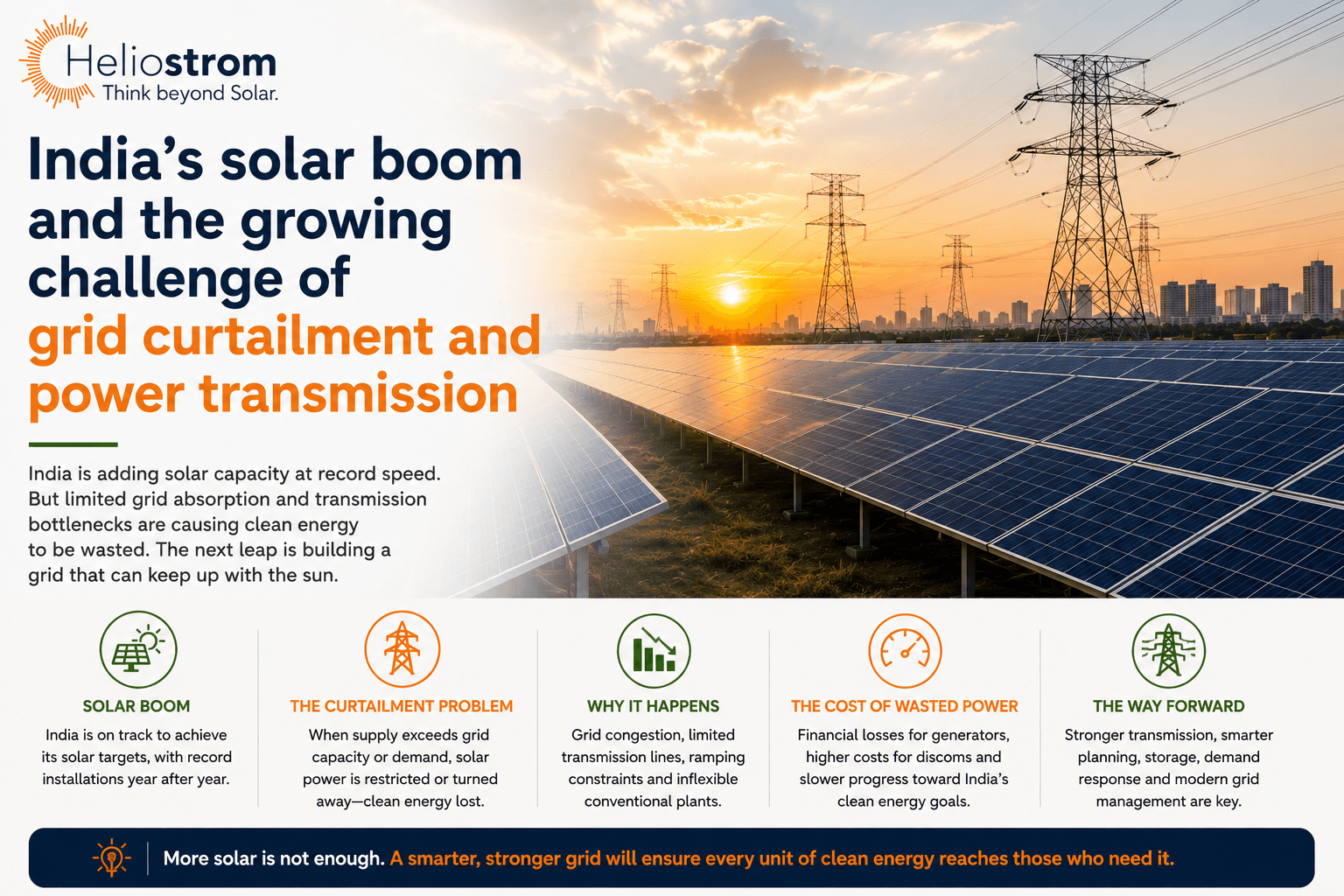
India crossed 300 gigawatts of non-fossil power capacity by July 2026, with solar accounting for a large share of that growth. Solar capacity stood at 162.15 gigawatts at the end of June and rose to 164.59 gigawatts by 31 July. This should be an uncomplicated success story, and in many ways it is. But the government also told Parliament that roughly 8,133 gigawatt-hours of solar power were curtailed between April and June 2026 alone, meaning solar electricity that could otherwise have been generated had to be restricted because the grid could not safely absorb or transmit all of it at that moment. India's problem is increasingly less about adding generation capacity and more about having enough transmission, flexibility and storage to use that electricity at the right time and in the right place, a problem that changes how anyone should think about solar power plant installations in Chennai and every other new solar project being planned right now.
What Curtailment Actually Means
Solar Power Being Deliberately Switched Off
Curtailment happens when a grid operator instructs a solar plant to reduce or stop generating, not because of a technical fault, but because the grid cannot safely absorb or transmit any more power at that moment. This can happen because of transmission constraints, grid security requirements, system balancing needs and other operational limitations, including a mismatch between how quickly renewable energy projects and the transmission lines meant to carry their power get commissioned. The electricity that could have been generated is therefore lost rather than being delivered to consumers or stored for later use.
The Scale of What India Is Currently Losing
According to figures the government shared with Parliament, solar curtailment ran to roughly 2,417 gigawatt-hours in April 2026, climbed to about 3,235 gigawatt-hours in May, and eased slightly to around 2,481 gigawatt-hours in June, adding up to that 8,133 gigawatt-hour total for the quarter. ICRA reported in August 2026 that around 37 percent of the capacity at impacted substations in northern, western and southern India operating under Temporary General Network Access (T-GNA) faced curtailment of 30 to 50 percent during solar hours, a level that directly affects project revenue rather than remaining a purely technical inconvenience. The financial consequences are becoming significant. Reuters reported in August 2026 that the government was considering low-cost, long-tenure loans for renewable developers affected by transmission-related curtailment, with industry sources estimating losses of about ₹4,500 crore since February 2025.
Why Success Created This Exact Problem
The Duck Curve Explained Simply
Solar generation and electricity demand often peak at different times of day. Solar output is strongest around the middle of the day, while demand in many parts of the system rises again during the evening once the sun has already gone down and homes and businesses switch on lights, air conditioning, and appliances. Graphed together, the gap between the two creates a shape widely nicknamed the duck curve, and as solar capacity keeps growing faster than the grid's ability to shift power across time, that curve keeps getting steeper. India's domestic solar manufacturing base has also expanded rapidly. By December 2025, module manufacturing capacity had reached about 210 gigawatts, while cell manufacturing capacity stood at about 27 gigawatts.
Why Coal Flexibility Matters
Coal continues to supply roughly 70 percent of India's electricity generation. A major challenge is that parts of India's coal fleet cannot reduce output indefinitely. Minimum technical-load requirements mean some thermal units have to keep generating even when solar output is surging, leaving less room for renewable electricity on the grid. Ember estimated that coal plants operating around their minimum technical load contributed to about 2.1 terawatt-hours of renewable curtailment in FY2025-26, and India's Central Electricity Authority is working on a roadmap to bring coal plants toward a 40 percent technical minimum load.
Extreme Price Swings During Solar Hours
The same imbalance can also show up in wholesale electricity markets. India has experienced periods of extremely low or even zero spot power prices during high-solar hours, reflecting the combination of strong daytime generation and weaker demand. Moments like this illustrate the duck curve in its most dramatic form, though the underlying pattern shows up in a milder version on ordinary days across much of the year.
Why This Matters for Businesses Considering Solar
Curtailment Risk Is Becoming a Financial Planning Question
Corporate renewable procurement also faces a more complicated market environment. BloombergNEF reported that global corporate clean-energy PPA volumes fell 10 percent in 2025, while APAC activity declined more sharply. In India, transmission constraints, PPA delays and growing interest in firm and dispatchable renewable power are changing how new projects are evaluated. For businesses evaluating commercial solar solutions for Chennai facilities today, this means asking upfront how a proposed system's output will actually be used, whether through self-consumption, storage, or a grid connection with genuine evacuation capacity, rather than assuming every unit generated will translate directly into savings or revenue.
Why Self-Consumption Reduces Exposure to This Problem
A rooftop system designed primarily around on-site consumption generally has a different risk profile from a large utility-scale project that depends heavily on exporting power through constrained transmission networks. The more solar electricity a business can consume directly, the less dependent that project is on exporting surplus generation during periods of grid congestion. This is one of the clearest reasons commercial and industrial rooftop solar remains an attractive option even as utility-scale curtailment headlines grow more common.
What India Is Doing to Fix the Underlying Problem
Storage Is the Most Direct Fix
Battery storage lets midday solar surplus get saved and released during the evening peak instead of being wasted, directly addressing the timing mismatch at the heart of the duck curve. Ember estimated in June 2026 that around 10 gigawatt-hours of battery storage could have prevented a specific category of renewable curtailment caused by coal plants operating at their minimum technical load. Meanwhile, ICRA reported that awarded battery storage capacity, including projects under construction and in operation, had reached about 90 gigawatt-hours by June 2026, alongside continued investment in transmission infrastructure to move power to where it is actually needed.
Shifting Demand Toward the Hours When Solar Is Strongest
Time-of-day electricity pricing is already letting some industrial users cut their bills by running heavy machinery during sunshine hours instead of in the evening, and agricultural pumping loads, which represent a significant share of demand in several states, are well suited to shifting toward midday since irrigation timing is generally flexible. Encouraging electric vehicle charging at workplaces during the day rather than at homes in the evening can become another demand-shifting opportunity, since it would convert what is currently surplus midday generation into productive daytime demand instead of adding to the evening crunch.
What This Means for Anyone Planning a New Solar System
Component Quality Matters More When Curtailment Risk Exists
Curtailment is only one source of lost generation. Poor system design, shading, equipment downtime, inverter losses or incorrect sizing can further reduce the energy a project actually delivers. When expected generation is already subject to grid-related uncertainty, good system design and reliable equipment become even more important to overall project economics. Working with experienced solar panel suppliers in Chennai and installers who understand local grid conditions and realistic evacuation capacity helps ensure a system is sized and equipped appropriately for the environment it will actually operate in, rather than designed around assumptions that no longer hold in every part of the grid.
Residential Systems Generally Face Less of This Risk
A typical residential rooftop solar installation is usually sized to offset household consumption rather than to export large volumes to the grid, which can make it less exposed to utility-scale transmission curtailment than a large commercial or industrial system feeding substantial surplus into the grid during midday hours. However, export limits, net-metering rules, local distribution constraints and DISCOM requirements can still affect how much surplus electricity a rooftop system can send to the grid.
Frequently Asked Questions
Does solar curtailment mean India has too much solar capacity overall?
Not exactly. The issue is less about total capacity and more about timing and grid flexibility, since demand and solar generation peak at different times of day.
Does curtailment affect residential rooftop solar owners directly?
Generally less than utility-scale projects, since most residential systems are sized to offset a household's own consumption rather than export large volumes to the grid, which reduces exposure to the grid congestion that drives curtailment decisions.
Will battery storage solve curtailment entirely?
No. Batteries can shift electricity from high-generation periods to later hours, but they cannot replace transmission expansion or solve every form of grid congestion. India will need a combination of storage, stronger transmission networks, more flexible thermal generation, demand-side management and better coordination between renewable project commissioning and grid availability.
Is curtailment unique to India, or does it happen elsewhere too?
Curtailment happens in many countries with fast-growing solar capacity, including parts of the United States, Australia, and China, wherever solar additions outpace the grid's ability to absorb and move that power to where demand actually exists.
Conclusion
India built one of the fastest-growing solar sectors anywhere, and curtailment is, in a real sense, evidence that the buildout worked faster than the rest of the system could keep pace with. Solving it will take storage, smarter demand timing, and continued transmission investment rather than any single fix. For homes and businesses planning solar, the lesson is not that solar has become a bad investment. It is that system design now needs to account for when electricity is generated, how much can be consumed on-site, what happens to surplus power, and what the local grid can actually accommodate. If you are planning a new solar panel setup for your home or a larger commercial system and want a design that accounts for these realities, contact our solar experts to discuss what makes sense for your specific site.
Ready to claim your subsidy? home solar installation in Chennai or get a free solar quote.


