
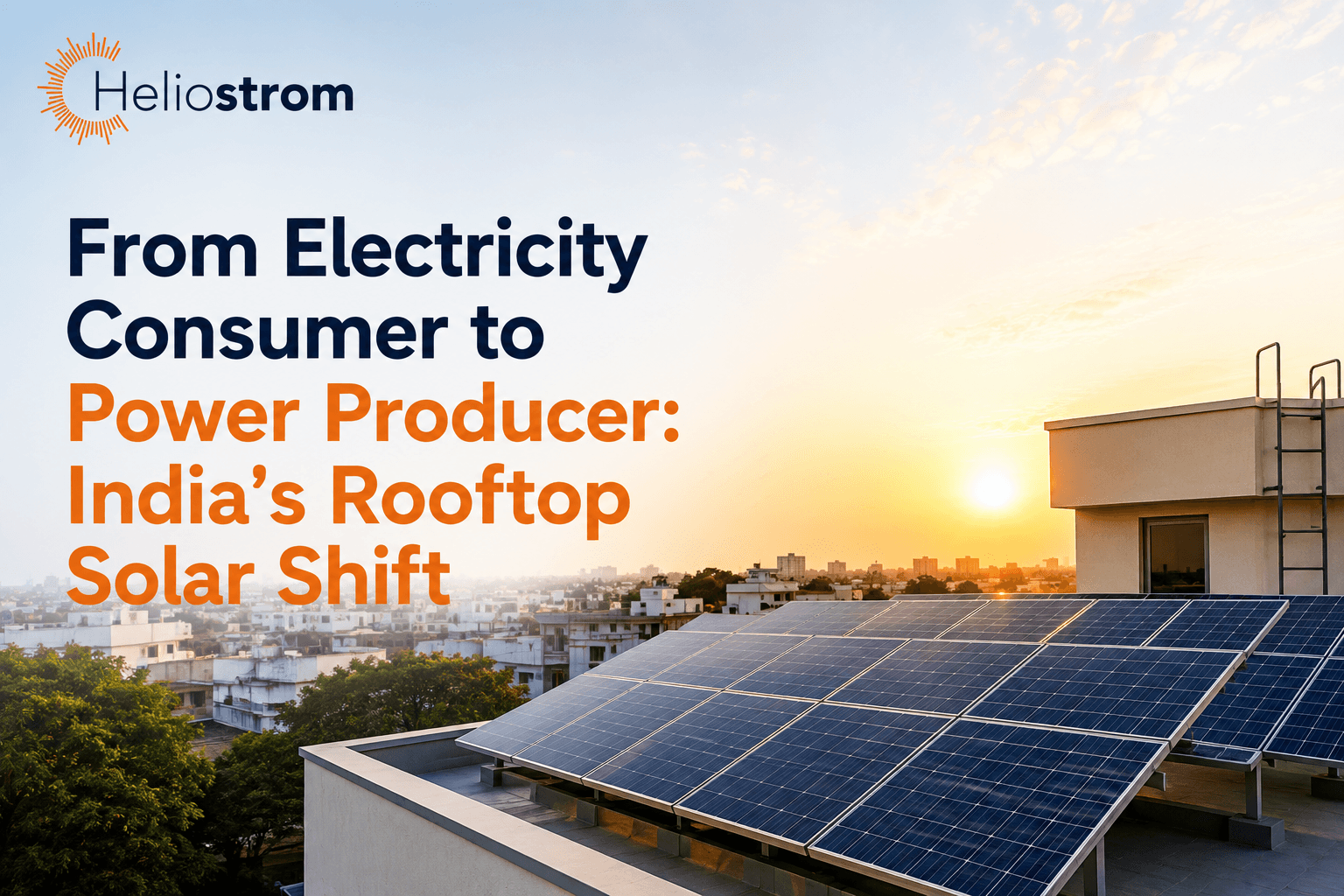
For most of India's modern history, homes and businesses have played only one role in the power system: that of a buyer. Electricity flowed one way, from the grid to the meter, and the bill followed every month without exception. That arrangement is now being rewritten on rooftops across the country. Families, factory owners and shopkeepers are no longer just drawing power. They are generating it, storing surplus credits with their local utility, and in many cases sending electricity back into the grid. This change from being a passive electricity buyer to an active energy generator is one of the more remarkable shifts happening in Indian infrastructure right now, and affordable solar panel installation options for homes have played a large part in making it possible.
What It Means to Become a Power Producer
The idea sounds technical, but it is fairly simple in practice. A household with a rooftop solar system generates electricity during daylight hours. Whatever is not consumed on site is exported to the grid through a net meter, and the utility credits that unit back to the owner's account. Over a billing cycle, the homeowner pays only for the net electricity actually drawn from the grid, and in many cases the bill drops close to zero. This model, often described as net metering, turns an ordinary rooftop into a small, distributed power plant. Multiply that across millions of homes, offices and factories, and the effect on the national grid becomes significant. Instead of a handful of large power stations supplying everyone, electricity generation becomes spread out across thousands of smaller sources, which also makes the grid more resilient during peak demand periods.
PM Surya Ghar Muft Bijli Yojana: The Numbers Behind the Movement
Much of this momentum can be traced back to a single government programme. Launched in February 2024 with an outlay of roughly seventy-five thousand crore rupees, the PM Surya Ghar Muft Bijli Yojana set out to bring rooftop solar to one crore households across the country. Progress has accelerated well beyond initial expectations. By mid-2026, the scheme had crossed 33 lakh rooftop installations and 12 GW of cumulative capacity, before picking up further pace through the following months. By early August 2026, the programme had surpassed 50 lakh beneficiary households, with more than 41 lakh individual systems installed and cumulative commissioned capacity reaching 14.8 GW, making it one of the fastest growing residential clean energy programmes anywhere in the world.
The pace of adoption tells its own story. Daily installations under the scheme rose from around five thousand a day in October 2025 to more than sixteen thousand a day by July 2026, a threefold jump in under a year. July 2026 alone added over five lakh new rooftop solar households, the highest monthly figure recorded since the scheme began. Government data also shows that nearly nineteen lakh households have already recorded a zero electricity bill in at least one billing cycle, a clear sign that the consumer to producer transition is delivering measurable savings, not just headline numbers. States like Gujarat, Maharashtra and Uttar Pradesh currently lead the installation tables, though southern states including Tamil Nadu are catching up steadily as awareness and financing options improve.
Why the Shift Is Gaining Ground in Chennai and Across Tamil Nadu
Tamil Nadu sits in a strong position to benefit from this transition. The state receives abundant sunshine through most of the year, commercial and industrial power tariffs remain comparatively high, and grid reliability during peak summer months can be inconsistent. Rooftop solar addresses all three concerns by reducing monthly electricity costs, lowering dependence on the grid, and giving property owners a hedge against future tariff hikes.
Homeowners Taking the First Step
For residential customers, the appeal is straightforward. A typical Chennai household with a rooftop system sized for its consumption pattern can offset a large share of its monthly bill and, with net metering in place, sell back any surplus generated during the day. Subsidy support through the central scheme has also lowered the upfront cost barrier considerably, making the payback period shorter than it was even two or three years ago.
Businesses and Industries Becoming Their Own Suppliers
Commercial and industrial rooftops tell an even bigger story. Factories, warehouses and IT campuses in and around the city have large, flat, unused roof areas that are ideal for solar arrays. Investing in solar power plants in Chennai allows manufacturing units to lock in predictable energy costs and reduce their exposure to fluctuating grid tariffs, which matters a great deal for energy-intensive operations. At the same time, a growing number of offices, retail chains and hospitality businesses are exploring commercial solar for Chennai properties to shrink their operating expenses and support sustainability targets that many corporate boards now track closely. For businesses, going solar is no longer just an environmental gesture. It is increasingly viewed as a straightforward cost-control decision.
Quality and Reliability Still Matter Most
As adoption accelerates, the market has also seen an influx of vendors offering rooftop solar at widely varying price points. This is where the choice of manufacturer and installer becomes important. Panel efficiency, warranty terms, after-sales service, and the quality of mounting structures all affect how much energy a system actually produces over its twenty-five-year lifespan. Buyers who research the manufacturing background and installation track record of a solar provider before signing a contract tend to see far fewer performance issues down the line, and their systems are more likely to deliver the savings promised at the time of purchase.
The Financial and Environmental Case for Going Solar
Beyond individual electricity bills, the wider impact of India's rooftop solar expansion is considerable. Based on the scheme's stated targets, government estimates suggest that rooftop solar installed across the full one crore households could generate around a thousand billion units of clean electricity over the systems' lifetimes, avoiding roughly seven hundred and twenty million tonnes of carbon dioxide equivalent emissions once the target is met. The programme is also expected to support close to seventeen lakh jobs across manufacturing, logistics, installation and maintenance, giving the rooftop solar sector an economic footprint well beyond the energy savings it delivers to individual households. For India, which is targeting five hundred gigawatts of non-fossil-fuel capacity by 2030, distributed rooftop generation is not a side project. It is becoming a core pillar of the country's energy transition, alongside utility-scale solar and wind parks.
Challenges That Still Need Addressing
The transition from consumer to producer is not without friction. Net metering policies and subsidy disbursement timelines still vary between states, which can slow down approvals in some regions. Rooftop space constraints in dense urban housing, financing access for lower income households, and the need for more trained technicians to keep pace with demand remain real hurdles. Battery storage integration is also still at an early stage for most residential systems, meaning households can rely on stored solar power during outages only if they invest separately in a battery backup. Even so, the direction of travel is clear, and policy support along with falling equipment costs continue to push adoption forward each quarter.
There is also a learning curve involved in becoming an energy producer rather than a pure consumer. Homeowners need to understand basic concepts like system sizing, expected generation on cloudy days, and how billing credits are adjusted at the end of each cycle. DISCOM processes for net-meter approval, although improving, still involve paperwork and site inspections that can take a few weeks in some districts. Awareness campaigns run by state nodal agencies, along with simplified online application portals, have helped shorten these timelines considerably compared to just a couple of years ago, but first-time applicants should still budget some patience into their installation timeline.
How Businesses Can Plan Their Transition
For a business owner weighing this decision, the starting point is usually an energy audit rather than a panel quote. Understanding actual daily and seasonal consumption patterns helps determine the right system size, whether the roof can support the required load, and how quickly the investment will pay for itself through reduced grid dependence. Facilities with high daytime consumption, such as manufacturing units running shifts or offices with heavy air conditioning load, typically see the fastest returns because most of the solar output is consumed directly rather than exported. Financing options, including capital purchase, lease models and power purchase agreements, have also expanded in recent years, giving businesses more flexibility in how they fund the transition without straining working capital.
What This Shift Means for the Future
India's rooftop solar story is really a story about control. Households and businesses that once had no say in how their electricity was generated now have the option to produce a meaningful share of it themselves, at a cost that keeps falling as technology improves and financing becomes more accessible. As more homes and commercial properties in Chennai make this switch, the city's power mix becomes a little cleaner and a little more resilient with every rooftop that gets fitted with panels. Whether the motivation is lower bills, energy independence or a genuine interest in reducing their carbon footprint, the underlying trend is the same: Indian electricity consumers are steadily becoming Indian electricity producers, one rooftop at a time.
If you are considering this shift for your own home, office or factory, it is helpful to work with a team that understands both the technology and the local regulatory process from start to finish. Contact us to get a site assessment and find out how much you could save by generating your own power.
Ready to claim your subsidy? home solar installation in Chennai or get a free solar quote.


