
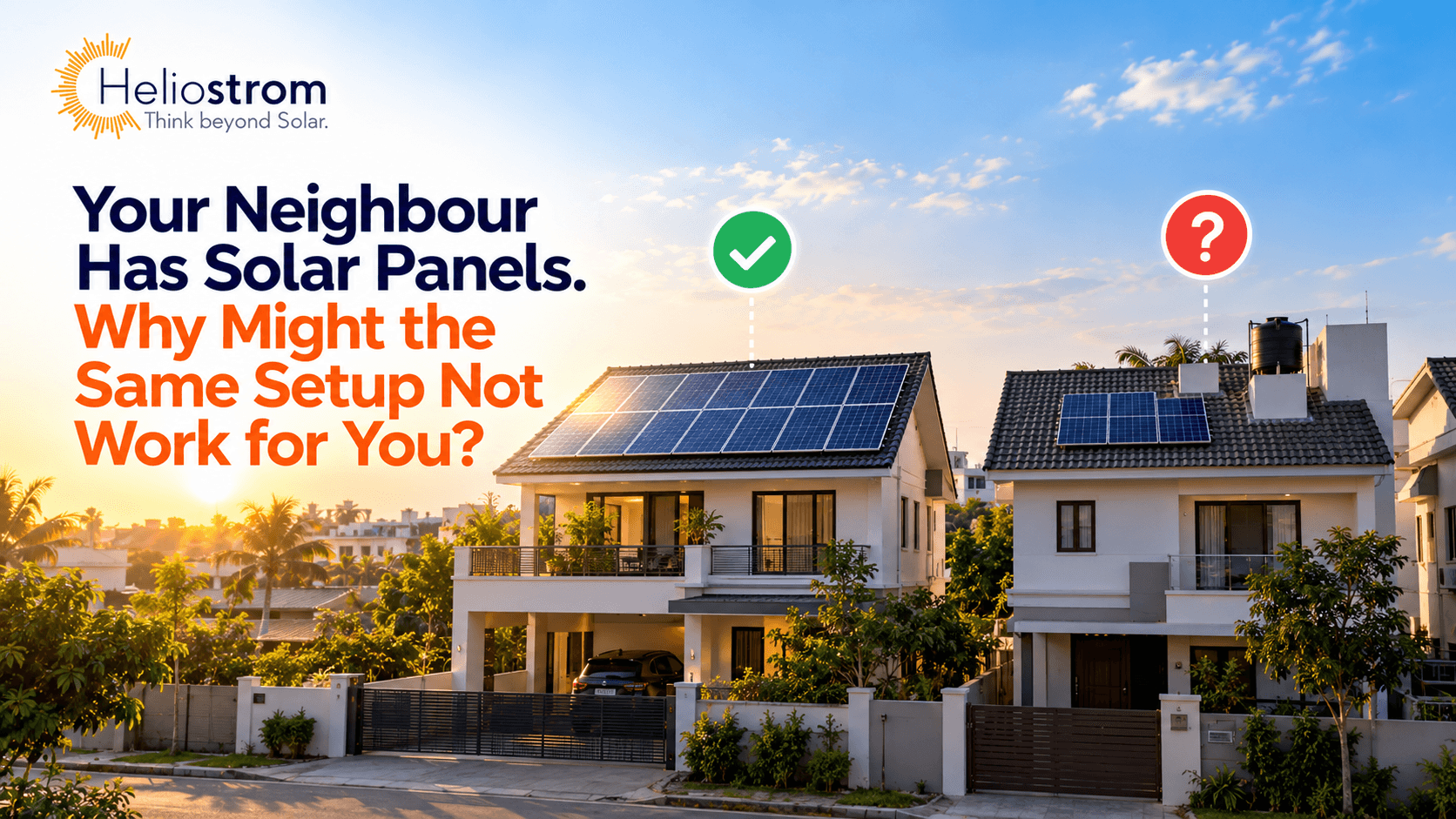
You have seen it happen on your own street. A neighbour gets solar installation in Chennai done, their bill drops noticeably, and within a few months you are tempted to call the same vendor and ask for the exact same system. It seems like the simplest shortcut: if it worked for them, it should work for you too. In reality, two houses standing next to each other can need completely different solar systems, and copying a neighbour's setup without a proper evaluation is one of the most common reasons homeowners end up with a system that underperforms or costs more than it should. This article looks at the specific factors that make every rooftop solar decision a personal one, even when the houses look nearly identical from the street.
The Temptation to Copy What Worked Next Door
There is nothing wrong with asking a neighbour about their experience, their installer, or roughly how much they paid. That kind of word-of-mouth recommendation is genuinely useful. The mistake happens when a homeowner treats the neighbour's exact system size, panel brand, and layout as a template to be copied rather than a starting point for their own evaluation. Solar sizing is a calculation based on your specific roof, your specific electricity usage, and your specific sanctioned load, not a fixed package that suits every house on the road.
Every Roof Tells a Different Story
Orientation and Tilt
Two adjoining houses can still have roofs that face different directions, especially in plotted layouts where corner houses, mid-row houses, and houses with an angled frontage all end up with slightly different roof geometry. A south-facing roof in Chennai typically receives more consistent sunlight through the day than a roof that faces east or west, which affects both the ideal panel placement and the expected generation from a given system size. East- or west-facing arrays generally produce about ten to eighteen percent less annually than a south-facing array of the same size. The tilt of the roof, or the mounting angle used on a flat roof, also changes how much energy the same panel count will produce. For Chennai, the optimal fixed tilt is roughly ten to fifteen degrees, close to the city's latitude of about thirteen degrees.
Shading Patterns Change House to House
A tree that shades your neighbour's roof for only an hour in the morning might fall across yours for most of the afternoon, depending on the exact position of your terrace relative to that tree. The same applies to water tanks, overhead cables, neighbouring buildings, and even satellite dishes or antennas that were never a factor for the house next door. Shading on even a small portion of an array can reduce output across an entire string of panels, though bypass diodes and modern inverter and string design can limit this impact in some cases. This is why a proper shading study for your specific roof matters far more than assuming your situation mirrors your neighbour's.
Your Roof's Structure and Material Matter More Than You Think
Older independent houses, newer concrete-frame constructions, and homes with asbestos or metal sheet roofing all call for different mounting approaches and different structural checks. A roof that comfortably supports a certain panel count and racking system next door might need reinforcement on your property if the slab thickness, age, or waterproofing condition is different. Flat concrete roofs generally offer more flexibility for panel placement, while sloped tile or sheet roofs require mounting hardware suited to that specific material. Skipping a structural check because the neighbour's installation went smoothly is a shortcut that can lead to leaks, cracks, or an unstable array later on.
Electricity Consumption Is Never Identical
Sanctioned Load and Phase Connection
Your sanctioned electrical load and whether your connection is single-phase or three-phase directly affect how large a system you can install and how it can be connected to the grid. Under TANGEDCO's net metering rules, solar system capacity generally cannot exceed your sanctioned load, or contract demand. Single-phase residential connections are typically limited to around four to six kW for solar, while three-phase connections can support larger systems, with the exact limit depending on the sanctioned load and local utility guidelines. Two houses of similar size can have different sanctioned loads depending on when the connection was taken, what appliances were declared, and whether the load was ever revised. A system sized for a neighbour's three-phase connection may not be technically approvable on your single-phase service without upgrading the connection first.
Usage Patterns Across the Day
A household that works from home and runs air conditioning through the afternoon has a very different consumption curve from one that is empty during the day and active mainly in the evening. Since rooftop solar generates power only during daylight hours, how well a system matches your actual usage window has a direct bearing on how much of that generation you consume directly versus export to the grid. Your neighbour's ideal system size, based on their consumption pattern, may be oversized or undersized for your household's routine.
System Sizing Is Personal, Not Universal
This is why a reliable solar panel installation in Chennai process always starts with a site visit and a review of past electricity bills rather than a standard package. A correctly sized system takes into account your roof area, your average monthly units consumed, your sanctioned load, and your budget together, not any single factor in isolation. As a rough guide, one kW of rooftop solar typically needs about one hundred square feet of shadow-free, south-facing roof area. Two neighbouring homes with similar square footage can end up with system sizes that differ by a kilowatt or more once these details are worked out properly.
Subsidy Eligibility Can Differ Between Two Homes
Central and state subsidy programmes for rooftop solar come with eligibility conditions tied to the type of consumer, the sanctioned load, and whether the connection is registered as residential. The PM Surya Ghar subsidy, for instance, is limited to residential or domestic connections held in the applicant's own name, with no existing rooftop solar system, and requires either an owned roof or written authorisation from the property owner. A neighbour who qualified for the full subsidy benefit may have a straightforward residential connection, while your property might be registered differently, be under a different ownership structure, or already have a sanctioned load that pushes your system into a different bracket. It is worth confirming your own eligibility directly rather than assuming the same benefit automatically applies to your household.
Budget, Financing, and Long-Term Plans
Even when two systems are technically similar in size, the final cost can vary based on the panel and inverter brands chosen, the length of cabling required for your specific roof layout, and whether any additional structural work is needed. Financing preferences also differ. Some homeowners prefer to pay upfront, while others look at loan options or phased installation where a smaller system is installed first with room to expand later. If you are planning renovations, a roof extension, or a change in household size in the next few years, your ideal system today should account for that, even if your neighbour's situation does not involve any of these plans.
Not All Installers Deliver the Same Quality
A system that performs well for your neighbour is also a reflection of the installer's workmanship, not just the equipment used. Cable routing, earthing quality, junction box placement, and how carefully the mounting structure is fixed to the roof all affect long-term reliability and safety. Two installers using the same brand of panels can still deliver very different results depending on their site assessment process and attention to detail during installation. Before assuming a setup will replicate your neighbour's results, it helps to check the installer's own track record rather than relying on the brand name alone.
What You Should Actually Compare With Your Neighbour
Rather than copying the exact system size or layout, it is more useful to compare notes on the installer's responsiveness, how long the approval and commissioning process took, what the actual generation has looked like across different seasons, and any issues they faced during or after installation. These details tell you more about what to expect from the process itself than the specific kilowatt rating on their system does. A neighbour's solar journey is a useful reference point for questions to ask, not a blueprint to copy without adjustment.
If your neighbour happens to run a business with a larger setup, such as a dedicated solar power plant in Tamil Nadu for their factory or commercial premises, the comparison matters even less for a residential decision. Industrial and commercial systems involve entirely different load calculations, approval processes, and financial structures than a home rooftop, so that kind of setup offers little useful guidance for sizing your own household system.
The safest way to move from curiosity to a confident decision is to get your own site assessed by Solar Panel Experts in Chennai who can walk your roof, review your bills, and recommend a system sized specifically for your home rather than one borrowed from the house next door.
Conclusion
Seeing a neighbour's solar panels working well is a good reason to explore solar for your own home, but it should prompt a conversation, not a copy-and-paste decision. Roof orientation, shading, structural condition, electricity consumption, sanctioned load, subsidy eligibility, and budget can all differ meaningfully between two houses on the same street. A system that was right for your neighbour may be oversized, undersized, or simply mismatched for your property. Getting your own site properly assessed is the only reliable way to know what will actually work for your home.
Contact Us
If you are curious whether your neighbour's solar setup would suit your home, the best next step is a proper site visit rather than a guess. Contact us for a consumption-based assessment and a system recommendation built around your own roof and usage.
Planning solar for your home? rooftop solar installation for homes in Chennai or get a free solar quote.


