
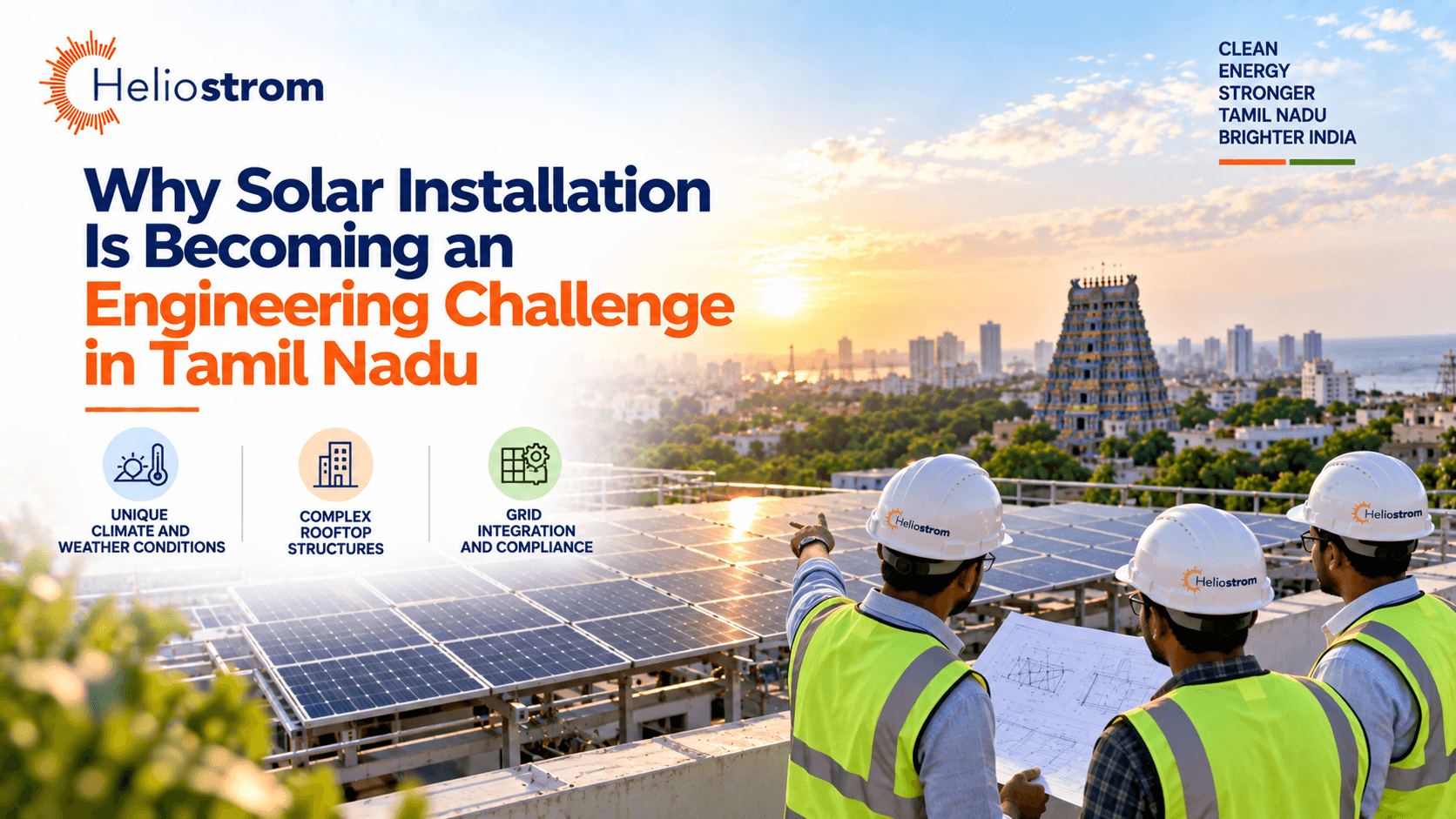
Ten years ago, putting solar panels on a rooftop in Chennai was a fairly simple job. A few panels, an inverter, some wiring, and the house had power backup for daytime use. That picture has changed completely. Today, solar installation in Chennai involves structural checks, load calculations, shading analysis, net metering paperwork, and coordination with the electricity board. What used to be a weekend project for a small electrician team has turned into a full engineering exercise, and the same shift is visible across every EPC project being built in Tamil Nadu right now.
This change is not accidental. It reflects how far the solar industry in the state has come, how dense the urban rooftop market has become, and how much more demanding large-scale solar projects are compared to a decade ago. This article looks at why solar work has become more technical, what that means for homeowners and businesses, and how the right partner can make the difference between a system that underperforms and one that pays for itself on schedule.
A Market That Has Outgrown Simple Rooftop Fittings
Tamil Nadu has consistently ranked among the top solar states in India, with total installed solar capacity, including utility-scale and rooftop, at around 13,800 to 15,300 MW as of early to mid 2026. Rooftop solar alone now accounts for over 1.7 to 2.4 GW of this capacity, with strong growth in both residential and commercial segments. The state's rooftop segment has also grown sharply under the PM Surya Ghar: Muft Bijli Yojana, with over 60,000 households in Tamil Nadu already installed as of early to mid 2026 and thousands more applications in process. The scheme remains open to new residential applicants, subject to portal guidelines and funding allocations. That kind of scale does not happen with informal, one-size-fits-all installation methods.
As more households, apartment complexes, factories, and commercial buildings switch to solar, the systems being installed have grown in size and complexity. A single 3 kW rooftop unit is a different engineering problem from a 500 kW rooftop array on a factory shed, and that in turn is different again from a multi-megawatt open access solar plant feeding several industrial connections. Each step up in scale brings new calculations, new approvals, and new risks if the design is not done correctly.
Why Solar Installation in Chennai Has Become More Technical
Roof Diversity in a Dense Urban Landscape
Chennai's building stock is a mix of old independent houses, modern apartment blocks, commercial complexes, and industrial sheds, all sitting close together. This creates two recurring engineering problems: shading from neighbouring structures and trees, and roofs that were never designed to carry the extra dead load of a solar array. A qualified team has to run a shading study, check the roof's structural capacity, and plan cable routing before a single panel is mounted. Skipping this step is one of the most common reasons rooftop systems underperform their promised output.
Grid Approvals and Net Metering Timelines
Every grid-connected solar system in the city needs approval from the local distribution utility before it can be commissioned. This includes technical feasibility checks, bi-directional meter installation, and inspection sign-off. Depending on the load applied for, the completeness of documentation, and local utility workload, this process can take anywhere from a few weeks to several months, with some applications in Tamil Nadu reported as pending beyond fifteen days during peak periods. A team that understands the paperwork and technical standards required by the utility can move an application through far faster than one that is learning the process for the first time.
From Household Rooftops to Utility-Scale EPC Projects
What Sets EPC Work Apart from Basic Installation
EPC stands for engineering, procurement, and construction, and it describes projects where a single contractor is responsible for designing the system, sourcing the equipment, and building the plant end to end. This is very different from a basic rooftop sale where panels and an inverter are simply supplied and fitted. An EPC contract typically covers detailed engineering drawings, structural and electrical design, procurement of panels, inverters, cabling and protection equipment, civil work where needed, commissioning, and often long-term operation and maintenance support.
This model has become the standard for factories, warehouses, educational campuses, hospitals, and commercial parks across the state because it puts accountability for the entire project, not just the equipment, in one place.
Engineering Checkpoints in Large Projects
A utility-scale or large commercial project involves several stages that a small rooftop job does not: a detailed site survey and energy yield simulation, single line diagrams and protection coordination studies, transformer and cabling sizing for the specific load, structural design for ground-mounted or elevated racking, and safety systems that meet fire and electrical codes. Getting any one of these wrong can mean lost generation, equipment damage, or delays in getting the plant connected to the grid. This is why serious clients now look for teams with proven EPC experience rather than assembling a project piecemeal.
This is also why the gap between a basic installer and established solar companies in Chennai with genuine design and engineering capability has widened so much in recent years. The market has effectively split into two tiers: vendors who can supply and fit panels, and firms who can design, engineer, and deliver a plant that performs reliably for 25 years.
Skills the Solar Workforce Needs Today
The engineering shift in solar has changed the kind of talent the industry needs. A modern solar team requires electrical design engineers who can size inverters and cabling correctly, structural engineers who can certify mounting systems for wind and load, project managers who can coordinate procurement and site execution, and liaison staff who understand utility and subsidy procedures. Skilled workers who can safely handle rooftop work, string configuration, and earthing are equally important, since a poorly executed installation can undo the benefit of an otherwise sound design.
This is very different from the early days of the industry, when solar work was treated as an extension of general electrical contracting. Training programmes, safety certifications, and design software proficiency are now standard expectations for anyone working on commercial or industrial solar projects.
Policy, Subsidy and Compliance Add Another Layer
Government support has been a major driver of solar growth in the state, but it also introduces procedural complexity. Residential rooftop buyers under the central subsidy scheme need to apply through the correct portal, use empanelled vendors, and complete inspection and net metering steps in the right order to receive their subsidy amount. Commercial and industrial buyers working under open access or group captive models face a separate set of regulatory filings with the state electricity regulator.
None of this is difficult for a team that handles it regularly, but it is easy for a first-time buyer or an inexperienced contractor to make mistakes that delay commissioning or affect eligibility for incentives. This regulatory layer is one more reason solar installation has moved from a simple product purchase to a project that benefits from professional handling.
How to Choose the Right Solar Partner
With so many solar companies in Tamil Nadu now active in the market, choosing the right one matters more than ever. A few questions are worth asking before signing a contract: does the company carry out a proper site survey and shading study, does it provide a detailed engineering design rather than a generic quotation, does it have documented experience with projects of a similar size, and does it offer after-installation monitoring and maintenance support.
For businesses planning factory rooftops, ground-mounted plants, or open access power purchase arrangements, working with established solar EPC companies in Tamil Nadu reduces the risk of design errors, procurement delays, and compliance gaps that can affect a project's returns. Experience across multiple project types, from residential rooftops to industrial-scale plants, is usually a good indicator of a team's ability to handle unexpected site conditions.
What This Means for the Future of Solar in Tamil Nadu
As the state moves toward its target of around 50% renewable energy share by 2030 to 2031 and more industries adopt open access solar and group captive models to manage rising power costs, the demand for engineering-grade solar delivery will only increase. Simple installation will remain relevant for small residential systems, but the bulk of new capacity, from commercial rooftops to utility-scale plants, will depend on firms that can manage design, procurement, and construction as a single coordinated process.
Buyers who understand this shift are already asking sharper questions before choosing a vendor, comparing engineering credentials rather than just price per watt. That trend is likely to strengthen, pushing the market further away from informal installation and toward proper project engineering.
Conclusion
Solar power in Tamil Nadu has moved well beyond its early days of small, informal rooftop fittings. Rising system sizes, denser urban rooftops, stricter grid requirements, and more sophisticated project structures have turned installation into a genuine engineering discipline. Whether it is a home in Chennai or a factory rooftop in an industrial cluster, the projects that perform well over their full lifespan are those built on proper design, qualified engineering, and disciplined execution, not just equipment supply.
Contact Us
If you are planning a rooftop solar system, a commercial installation, or a larger EPC project anywhere in Tamil Nadu, it helps to talk to a team that handles the engineering with the same care as the equipment. Contact us to discuss your site, your power requirements, and the right design approach for your project.
Thinking about your own installation? rooftop solar installation for homes in Chennai or book a free site survey.


