
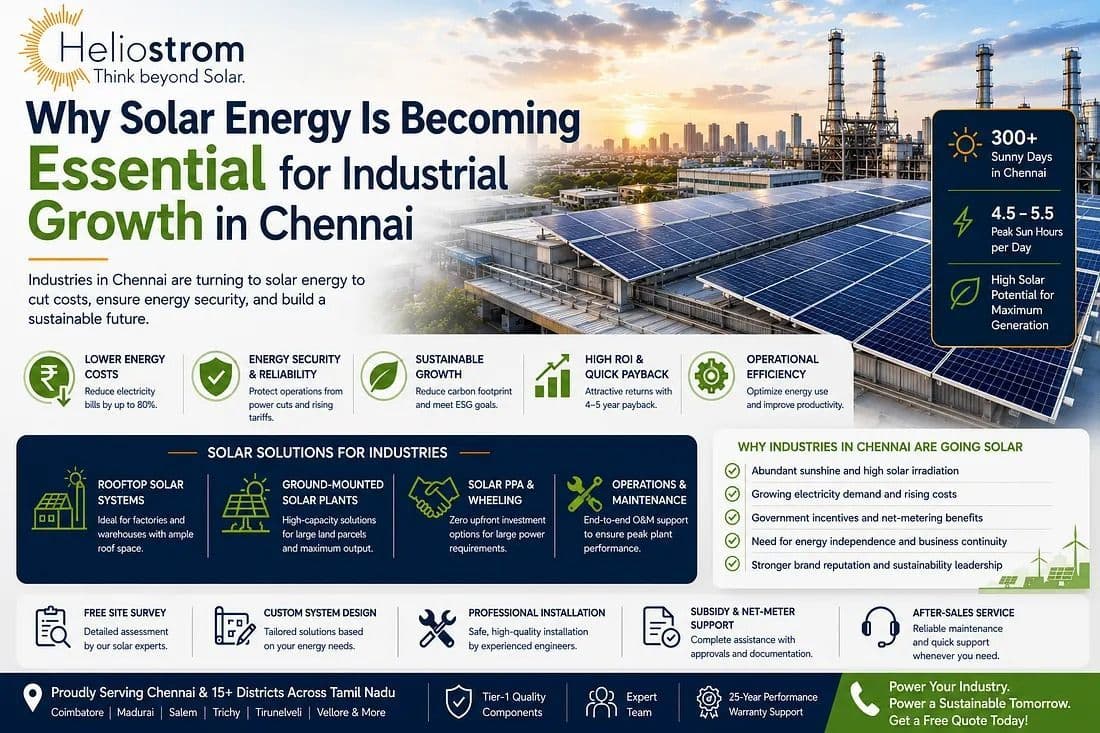
Chennai's factories, warehouses, and manufacturing hubs are consuming more power every year, and high-tension (HT) industrial electricity tariffs keep climbing alongside that demand. For businesses trying to protect margins while scaling production, generating power on-site has shifted from a cost-saving experiment to a core operating strategy. It's one reason interest in Solar Power Plants in Chennai has grown sharply among textile units, auto-component makers, IT parks, and SIPCOT-zone manufacturers. Instead of absorbing unpredictable grid costs, industrial operators are locking in stable, self-generated power -and reshaping how Chennai's industrial belt fuels its next phase of growth in the process.
Chennai's Industrial Power Problem: Rising Costs, Rising Demand
Industrial clusters around Sriperumbudur, Oragadam, Ambattur, and the wider SIPCOT network have expanded rapidly over the past few years, driven by auto manufacturing, electronics assembly, and export-oriented textile production. That growth has pushed HT industrial tariffs in Tamil Nadu into the upper end of India’s industrial tariff range, with HT consumers paying well above typical domestic rates. When demand charges, peak-load penalties, and fuel cost adjustments are added, grid power alone becomes an increasingly expensive and less predictable way to run a factory floor Add demand charges, peak-load penalties, and periodic voltage fluctuations during peak summer months, and grid power alone becomes an increasingly expensive and less predictable way to run a factory floor.
Why Grid Dependency No Longer Works for Growing Industries
For a manufacturing unit operating multiple shifts, a few paise per unit adds up fast across thousands of units consumed monthly. Rising tariffs, exposure to fuel-cost adjustments, and grid reliability concerns during peak demand periods mean that industries expanding capacity in Chennai are increasingly treating captive power generation -solar in particular -as a way to control one of their largest variable costs.
How Solar Energy Is Powering Chennai's Industrial Growth
Open Access and Captive Solar Models
Large industrial and commercial consumers on HT-1 (industrial) or HT-2 (commercial) tariffs can procure solar power through Tamil Nadu’s open access route instead of, or in addition to, rooftop systems. For renewable energy sources including solar, the current open access eligibility threshold in Tamil Nadu is a contract demand of 100 kW and above. Under a captive structure, the consumer (or a group of consumers) holds at least 26% equity in the solar plant and consumes at least 51% of its generation, which qualifies it as a captive power plant under the Electricity Act, 2003. LT consumers below 100 kW are generally not eligible for open access and typically rely on rooftop solar with net metering or feed-in arrangements instead. For eligible HT consumers, open access solar – especially in captive or group-captive mode – can deliver a meaningful discount against HT grid rates once wheeling, transmission charges and losses are accounted for Gross Metering Has Replaced Net Metering for Large Loads
A common point of confusion for factory owners: in Tamil Nadu, true net metering (energy-based settlement) is effectively limited to domestic LT consumers. Most non-domestic LT and all HT consumers are settled under net feed-in or other arrangements, where exported energy is credited at a feed-in tariff rather than being netted 1:1 against consumption. In practice, this means generation and export are metered separately and valued at regulated feed-in rates – a detail that changes how project economics and payback periods are calculated, and one every industrial buyer should confirm with their EPC partner and TANGEDCO before signing a contract.
ALMM Compliance and Module Sourcing Norms
From June 1, 2026, grid-connected solar projects (including net-metered and open-access renewable energy projects) commissioning in India are required to use solar modules from the government’s Approved List of Models and Manufacturers (ALMM List-I), with solar cells also required to be sourced from ALMM List-II. For industrial buyers in Chennai, this makes verified module and cell sourcing and documentation a standard part of project due diligence, not an optional extra Benefits of Industrial Solar for Chennai Businesses
Lower Energy Costs and a Faster Return on Investment
Industrial solar projects in Tamil Nadu typically cost in the range of roughly ₹3.5–4.5 crore per MW to build, depending on module quality, mounting structure, and site conditions. For HT industrial consumers paying high grid tariffs, well-designed rooftop and industrial solar power systems can often deliver payback periods in the three-to-four-year range, with long-term savings of 30–45% or more on the solar-generated portion of their electricity bill compared with standard grid rates. Energy Security During Peak Demand and Grid Outages
Manufacturing lines that run continuously can't easily absorb voltage dips or unplanned outages. On-site or open-access solar generation, paired with the right battery or hybrid setup, reduces a facility's exposure to grid stress during peak summer demand -a period when Tamil Nadu's grid is under its heaviest load.
ESG Compliance and Export Market Requirements
Chennai's export-oriented manufacturers-particularly in auto components, electronics, and textiles-increasingly face renewable-energy sourcing requirements from overseas buyers as part of ESG and sustainability scorecards. Demonstrating a verifiable share of renewable power in the manufacturing process is becoming a genuine commercial advantage, not just a compliance checkbox. If you're weighing which model fits your facility's load profile and budget, explore industrial solar power plants to understand the right solution for your site.
Government Policies Supporting Industrial Solar in Tamil Nadu (2026 Update)
TANGEDCO Open Access Rules and Wheeling Charges
Open access applications route through TANGEDCO’s designated nodal officer, and approved projects are subject to transmission and wheeling charges, cross-subsidy surcharge (where applicable), and banking charges that account for grid usage and losses. These charges factor directly into the final landed cost of solar power, so an accurate feasibility study is essential before committing to a project size or ownership structure. Recent TNERC regulations for green energy open access (2025) formalise these charges and banking arrangements for renewable consumers across the state.
ALMM Mandate and Quality Assurance
As noted above, ALMM-listed modules and cells are mandatory for projects commissioning from mid-2026 onward. This policy is designed to ensure long-term module reliability and reduce underperformance risk -an important consideration in Chennai's hot, humid coastal climate.
State and Central Incentive Schemes
While large industrial and open-access projects are governed primarily by TANGEDCO and TNERC regulations, Tamil Nadu Energy Development Agency (TEDA) continues to support renewable adoption at the state level. At the central level, the PM Surya Ghar: Muft Bijli Yojana supports grid-connected rooftop solar for residential consumers. Industrial buyers should confirm current eligibility for any state or central incentives directly with TEDA, TANGEDCO, or their solar partner, since scheme details and subsidy structures are updated periodically.
Coastal Chennai: Design Considerations for Industrial Solar Plants
Chennai's coastal location adds a few engineering considerations that inland industrial hubs don't face. Salt-laden air accelerates corrosion on standard galvanized steel mounting structures, so many industrial installations now specify marine-grade aluminium mounting and stainless-steel fasteners for longer service life. The city's hot, humid climate also causes higher soiling losses on panels -often cited in the range of 4–6% -which means a proper operations and maintenance plan, including more frequent panel cleaning, is essential to protect output over the system's lifetime.
How to Choose the Right Industrial Solar Partner in Chennai
Not every EPC provider is equipped to handle large industrial or open-access projects. Before signing a contract, it's worth checking for the following:
- A verifiable track record with industrial or commercial-scale installations, not just residential rooftops
- ALMM-compliant module and cell sourcing with documentation
- Corrosion-grade mounting design suited to coastal or industrial-zone conditions
- Clear guidance on open access, captive, or group-captive structuring based on your load and consumption profile
- A defined operations and maintenance (O&M) plan, including cleaning schedules and performance guarantees
- Transparent breakdown of wheeling, banking, and other regulatory charges in the project economics
Frequently Asked Questions
Is net metering still available for industrial solar in Chennai?
True net metering in Tamil Nadu is effectively limited to domestic LT consumers. Most industrial and commercial rooftop systems are settled under net feed-in or similar arrangements, where exported energy is credited at a regulated feed-in tariff rather than being netted 1:1 against consumption. Exact metering and settlement rules depend on your consumer category and sanctioned load, so it’s important to confirm the applicable mechanism with TANGEDCO before finalising a design.
What is the typical payback period for industrial solar in Tamil Nadu?
Most industrial solar projects in the state currently deliver payback in roughly three to three-and-a-half years under prevailing HT tariffs, though the exact figure depends on system size, ownership model, and site-specific factors like shading and roof condition.
Can a factory with a load under 100 kW install solar?
Yes. However, LT consumers below 100 kW contract demand are generally not eligible for Tamil Nadu’s green energy open access route and typically install rooftop solar under net metering or net feed-in arrangements instead. Facilities with 100 kW and above (especially HT consumers) usually have both rooftop and open-access options available, subject to TNERC and TANGEDCO rules.
What is the difference between captive and open access solar?
In a captive power plant structure, the consumer (or group of consumers) holds at least 26% equity in the solar plant and consumes at least 51% of its generation, which qualifies it as a captive plant under the Electricity Act, 2003 and can exempt it from certain surcharges. Open access is the broader framework that allows eligible consumers to procure power from a third-party solar plant through the grid, subject to TANGEDCO approval and applicable wheeling, transmission and other charges; this can be structured as captive, group-captive, or third-party PPA.
Do industrial solar plants in Chennai need special equipment because of the coastal climate?
It's strongly recommended. Standard galvanized steel mounting corrodes faster in Chennai's salt-laden coastal air, so marine-grade aluminium structures and stainless-steel fasteners are commonly used for industrial installations to protect the system's 25-year design life.
Conclusion: Solar Is Now a Growth Strategy, Not Just a Cost-Saving Measure
As HT tariffs rise and export customers ask harder questions about sustainability, industrial solar has moved from an optional upgrade to a practical necessity for manufacturers operating in and around Chennai. Whether your facility qualifies for open access, a captive arrangement, or a straightforward rooftop system, the right design and compliance approach can turn your energy bill into a long-term competitive advantage. Ready to explore what industrial solar could look like for your facility? contact us today for a free, site-specific feasibility assessment.
Running the numbers for your business? commercial solar installation in Chennai or request a solar quote.


