
Table of Contents
1. Why Chennai Businesses Are Turning to Commercial Solar
2. The Rising Cost of Electricity Is Changing Business Decisions
3. Why Commercial Solar Is Becoming a Competitive Advantage
4. Key Benefits of Commercial Solar for Chennai Businesses
5. Is Your Business Ready for Commercial Solar?
6. Common Mistakes Businesses Make Before Installing Solar
7. How to Choose the Right Commercial Solar Partner
8. What to Expect from a Commercial Solar Installation Project
9. Conclusion
Electricity costs continue to rise across Chennai, putting increasing pressure on operational expenses for factories, offices, warehouses, educational institutions, and commercial buildings. Businesses that once viewed solar energy as a future investment are now treating it as a strategic decision that delivers predictable savings and long-term value.
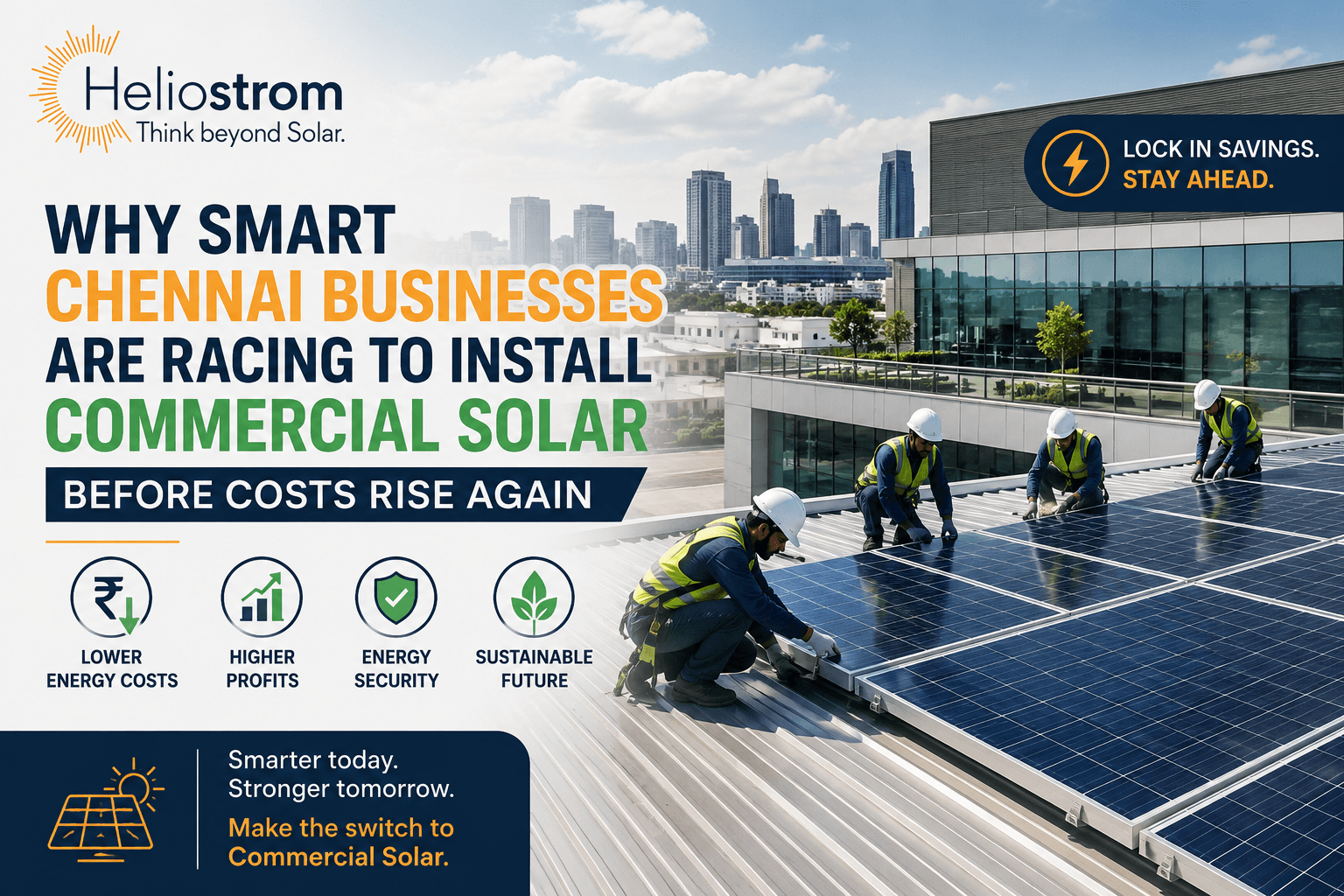
Commercial solar is no longer just about sustainability. Investing in Commercial Solar for Chennai has become a practical way to reduce energy costs, improve profitability, and strengthen business resilience against future tariff increases. This guide explains why more Chennai businesses are making the switch and what decision-makers should know before investing.
1. Why Chennai Businesses Are Turning to Commercial Solar
What is Commercial Solar?
Commercial solar refers to solar power systems designed for factories, offices, warehouses, hospitals, schools, and other business establishments rather than individual homes. These systems are typically larger in scale, engineered to match a facility's specific energy consumption pattern, and built to operate reliably for 25 years or more with minimal intervention.
Manufacturing units with high daytime power loads benefit the most, since solar generation peaks during working hours when production lines, HVAC systems, and machinery are running. Warehouses with large uninterrupted rooftops, hospitals with round-the-clock energy needs, and office complexes looking to cut fixed costs are also strong candidates for adoption.
Chennai's geography works in favour of solar generation. The city receives abundant sunlight through most months of the year, and its relatively flat terrain makes rooftop installations straightforward for most industrial and commercial buildings, which is why the city has become one of Tamil Nadu's most active markets for commercial and industrial solar adoption.
Why Adoption Is Accelerating
Electricity demand across Tamil Nadu's industrial corridors has grown steadily as manufacturing activity expands. At the same time, government support through net metering policies and simplified approval processes has made it easier for businesses to connect solar systems to the grid. Forward-looking companies are also factoring energy costs into multi-year business plans, recognising that a fixed, predictable power cost gives them an edge over competitors still tied entirely to EB tariffs.
2. The Rising Cost of Electricity Is Changing Business Decisions
The Impact of Increasing EB Tariffs
Commercial and industrial electricity tariffs have risen multiple times over the past several years, and this trend shows little sign of reversing. For manufacturing units running heavy machinery across extended shifts, even a modest tariff hike translates into a significant increase in monthly operating costs. Hospitals and office complexes face similar pressure, since power is often their second or third largest recurring expense after salaries and raw materials.
Why Waiting Can Become Expensive
Every month a business delays its solar transition is a month of savings left unclaimed. Beyond the immediate loss, delayed adoption pushes ROI further into the future, since the payback period only begins once the system is commissioned. There is also an opportunity cost: businesses that install solar early lock in lower generation costs for decades, while those that wait continue paying rising grid tariffs indefinitely.
3. Why Commercial Solar Is Becoming a Competitive Advantage
Lower operating costs directly improve profit margins, particularly for energy-intensive industries such as textiles, engineering, and food processing. Once a system is commissioned, the marginal cost of solar electricity is close to zero, giving businesses a cost structure that competitors relying solely on grid power struggle to match.
Solar also strengthens business sustainability credentials. Many domestic and international buyers now expect suppliers to demonstrate reduced carbon footprints, and a visible solar installation signals genuine commitment rather than a marketing claim.
From a financial planning perspective, solar converts a variable, unpredictable expense into a largely fixed one. This predictability makes budgeting easier and improves the accuracy of long-term financial forecasts.
Brand reputation benefits are real as well. Clients, investors, and employees increasingly view sustainable operations favourably, and a rooftop solar system is a visible, credible marker of that commitment, making solar a differentiator rather than just a cost reduction tool.
4. Key Benefits of Commercial Solar for Chennai Businesses
- Significant Reduction in Electricity Bills: Businesses typically see meaningful drops in their monthly EB costs, freeing up capital for core operations.
- Long-Term Return on Investment: With a typical payback period and a 25-year system lifespan, most of the system's operating life delivers pure savings.
- Low Maintenance Requirements: Rooftop solar systems need only periodic cleaning and routine inspection, keeping upkeep costs minimal.
- Reliable Energy Generation: Chennai's consistent sunlight ensures dependable output across most months of the year.
- Increased Property Value: Commercial properties with installed solar infrastructure are often viewed as more valuable and more efficient assets.
These advantages are why commercial solar energy has become one of the fastest-growing infrastructure investments among Chennai's manufacturing and institutional sectors, rather than a niche sustainability project reserved for large corporations.
5. Is Your Business Ready for Commercial Solar?
- Roof Space Assessment: Before committing, businesses should assess available rooftop or ground space, since system size directly determines how much of their consumption can be offset.
- Energy Consumption Analysis: Reviewing at least twelve months of EB bills helps determine the right system capacity and expected generation profile.
- Structural Considerations: Older roofs may need reinforcement before panels can be safely mounted, so a structural assessment should happen early in planning.
- Financial Planning: Account for upfront capital, available financing options, and expected subsidy or incentive eligibility before finalising a budget.
- ROI Expectations: Set realistic expectations based on actual energy usage rather than generic industry averages, since consumption profiles vary significantly between a warehouse, a hospital, and a manufacturing plant.
6. Common Mistakes Businesses Make Before Installing Solar
Choosing only the cheapest quote without evaluating equipment quality or workmanship often leads to underperforming systems and costly repairs later. Ignoring an EPC contractor's track record is another common error, since this is a technical project where experience matters as much as price.
Poor system design, including incorrect panel orientation or undersized inverters, reduces generation output over the system's lifetime. Businesses also frequently overlook future expansion planning, installing a system sized only for current consumption without room to scale as operations grow.
7. How to Choose the Right Commercial Solar Partner
Selecting the right partner is as important as the technology itself. Look for a partner with proven experience delivering commercial rooftop solar and industrial solar solutions across similar facility types. A strong portfolio of completed projects, particularly within Chennai's climate and regulatory environment, is a reliable indicator of capability.
Equipment quality matters just as much as installation standards, so ask about panel and inverter brands, warranties, and certifications. A capable partner should also offer remote monitoring, along with responsive after-sales support.
8. What to Expect from a Commercial Solar Installation Project
A well-run commercial solar installation project typically follows a clear sequence. It begins with a site survey to assess roof condition, shading, and available space, followed by a feasibility study that evaluates energy consumption and expected generation.
Next comes system design, where engineers finalise panel layout, wiring, and inverter capacity based on the site's requirements. Installation follows established safety standards, after which the system undergoes testing before commissioning.
Once commissioned and connected to the grid, ongoing maintenance ensures the system continues performing at its rated capacity, making it a dependable business solar solution for the long term.
9. Conclusion
Commercial solar has moved from a discretionary sustainability initiative to a core business decision. The combination of rising EB tariffs, predictable long-term savings, and growing brand value makes solar energy for commercial buildings one of the most sound infrastructure investments available to Chennai businesses today.
Acting early matters. Businesses that install now lock in current costs and begin their savings sooner, while those that wait face rising tariffs and delayed returns. If your business is ready to explore commercial solar, reach out to Heliostrom to begin with a professional site assessment and a system design tailored to your facility.
FAQs
1. How much can commercial solar reduce electricity bills?
Savings vary by consumption pattern and system size, but most businesses see a substantial and measurable drop in their monthly EB costs after installation.
2. How long does commercial solar installation take?
A typical commercial installation, from site survey to commissioning, takes a few weeks depending on system size and site complexity.
3. Is commercial solar suitable for every business?
Most businesses with adequate roof or ground space and consistent daytime energy use are strong candidates, though a site assessment is the best way to confirm suitability.
Running the numbers for your business? commercial solar installation in Chennai or request a solar quote.


