
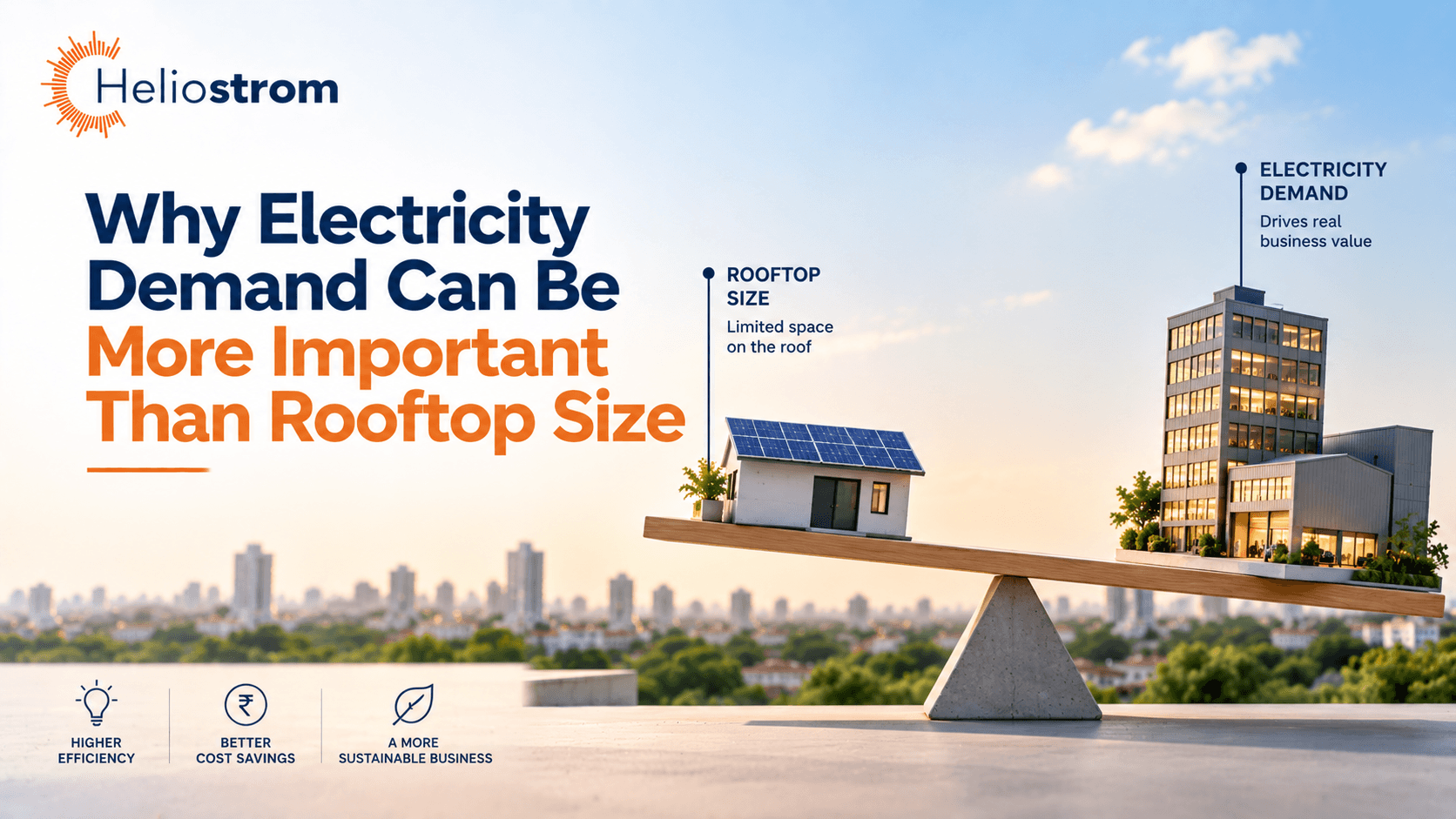
Most people planning a rooftop system start by looking up at their roof and asking how many panels will fit. It is a reasonable starting point, but it often leads to the wrong sized system. The factor that most directly influences system economics from Solar Panel Installation is not the available roof area, it is how much electricity your home or business actually consumes. A roof that looks generous can still be paired with an oversized system that produces more power than you use, while a modest roof can comfortably support a system sized correctly around real consumption. This article explains why demand should lead the sizing conversation, and where roof space genuinely becomes a limiting factor.
How Solar Sizing Actually Works
Sizing a solar system is essentially a matching exercise. On one side is your electricity consumption, usually measured in units or kilowatt hours over a billing cycle. On the other side is the system's expected output, which depends on panel wattage, the number of sun hours your location receives, and how efficiently the installation is designed. A correctly sized system brings these two numbers close together, so the electricity produced lines up with what is actually being used rather than sitting unused or falling short.
Two Numbers That Matter More Than Square Footage
Before roof area even enters the conversation, two inputs do most of the early work. The first is historical electricity consumption, taken from past electricity bills rather than a rough guess. The second is the site's expected solar resource, based on sun hours for your specific location, which helps estimate how much energy each kilowatt of installed capacity can generate, alongside system losses and site-specific conditions. The final system size also depends on factors such as shading, orientation, tilt, equipment characteristics, and the applicable grid and metering rules. Once consumption and expected generation are known, an installer can calculate a starting system capacity, and only then does it make sense to check whether the roof can physically accommodate it.
Why Bigger Roofs Don't Always Mean Bigger Systems
A large roof does not automatically call for a large system. If a household's consumption is modest, installing panels across the entire available roof can result in excess generation that may not provide the same economic value for every unit produced, depending on the applicable metering and settlement framework. This is why demand-first sizing tends to produce a more cost-effective outcome than simply filling available space, even when that space is generous. A smaller, well-matched system can offer a more attractive payback when a larger system would generate significant excess electricity with lower economic value.
Understanding Your Electricity Demand First
Getting sizing right starts with an honest picture of consumption, not an estimate based on the number of rooms or the size of the property.
Reading Your Electricity Bill Correctly
A single month's bill rarely tells the full story, since usage typically shifts with the seasons. Air conditioning load in the hotter months, for instance, can push consumption well above the annual average. Looking at twelve consecutive months of bills and averaging them gives a far more reliable baseline than relying on one particularly high or low month.
Peak Usage Versus Average Usage
Average consumption tells you how much power you need across a year, but peak usage tells you when you need it most. A home that runs heavy appliances mainly in the evening will draw less benefit from daytime solar generation unless it is paired with storage or a suitable net metering setup. Commercial spaces with daytime operating hours, on the other hand, are often well-matched to solar output, since their peak demand overlaps with peak generation.
Rooftop Space: A Constraint, Not the Starting Point
Roof area still matters, but its role is to confirm whether the system size that matches your demand can actually be installed, not to dictate that size in the first place. Shading from nearby structures or trees, roof orientation, and the tilt angle all affect how much usable capacity a given roof area can support, so two homes with identical roof dimensions can end up with different maximum system sizes.
When Roof Size Actually Becomes the Limiting Factor
There are situations where available space genuinely caps what can be installed, typically in smaller urban plots or buildings with significant shading for part of the day. In these cases, the practical approach is to install the maximum system the roof can reasonably support and treat any remaining demand as something the grid connection continues to cover, rather than leaving the roof underutilized while chasing a target that the space cannot physically hold. A site visit is usually the only reliable way to confirm this, since satellite images and rough measurements tend to miss obstructions like water tanks, staircases, and overhead cables that reduce usable area.
How This Plays Out Across Chennai's Homes and Businesses
Demand patterns differ quite a bit between a household and a factory floor, and sizing decisions usually reflect that difference.
Residential Rooftop Systems
Homes typically have more modest and more seasonal consumption, so residential systems are often sized to offset a meaningful share of electricity consumption rather than to operate independently of the grid. Matching the system to twelve months of billing history, rather than to the size of the terrace or roof, gives homeowners a system whose economics can be evaluated against their actual consumption and electricity costs.
Industrial and Commercial Installations
Businesses with steady daytime operations, such as manufacturing units, warehouses, and commercial buildings, often have higher and more predictable consumption, which changes the sizing math considerably. industrial solar installations in Chennai are usually sized around production schedules and machinery load rather than around available shed or terrace space, since that load profile is what determines the return on investment.
Choosing Between Rooftop and Ground Mounted Layouts
When a business has both rooftop and adjoining open land available, the decision on where to mount panels often comes down to structural load limits on the roof and how much space the ground layout can offer without disrupting operations. Shading patterns, drainage, access for maintenance, and broader land-use constraints also factor into this choice. A well-planned Commercial Solar for Chennai project usually weighs these options against the site's actual power draw before finalizing a layout, rather than assuming rooftop space is the only option.
Why the Source of Your Panels Still Matters
Sizing decides how much capacity you need, but panel specifications, installation quality, operating conditions, degradation characteristics, and warranty support all influence how reliably that capacity performs over the system's lifetime. Working with established solar installation experts in Chennai can help homeowners and businesses evaluate panel specifications, warranty terms, system design, and after-sales support. This matters just as much for a well-sized small residential system as it does for a large industrial installation, since even a correctly sized system will underdeliver over time if the underlying components degrade faster than expected or if service support is hard to reach when something needs attention.
Getting the Sizing Right Before You Invest
The most reliable way to avoid an oversized or undersized system is to treat consumption data as the starting point of every conversation with an installer, and roof assessment as the step that follows it. A short list of what to gather before that conversation helps keep the process efficient:
- Twelve months of electricity bills, or as many as are available
- Any planned changes in usage, such as an electric vehicle or new machinery
- Roof orientation and any visible shading through the day
- Sanctioned load and the type of net metering connection available
- Budget range and expected payback period
Working through this list before finalizing a quotation makes it far easier to compare proposals on a like-for-like basis, since each installer will be sizing against the same demand figures rather than against differing assumptions about your roof.
If you are unsure how your own consumption pattern translates into system size, it helps to walk through your bills with someone who designs these systems regularly. You can Contact Us to go over your usage history and roof details together before settling on a final capacity.
Frequently Asked Questions
Can a large roof lead to an oversized solar system?
Yes. A large roof can accommodate more panels than a household or business needs economically. System capacity should therefore be evaluated against consumption, expected generation, available export or storage options, and applicable grid rules rather than roof area alone.
What happens if my roof cannot fit the system size my consumption suggests?
In that case, the system is typically sized to the maximum the roof can support, and the remaining demand continues to be met through the regular grid connection. This still reduces the electricity bill meaningfully, even if it does not offset consumption completely.
How many months of electricity bills should I use to plan a system?
Twelve consecutive months is a useful baseline because it captures seasonal changes in consumption, such as higher air conditioning use in summer. A single month, especially an unusually high or low one, can lead to a system that is sized incorrectly.
Do commercial and residential systems get sized differently?
The underlying method is the same, matching capacity to consumption, but the inputs differ. Commercial sizing usually factors in operating hours and machinery load, while residential sizing leans more on monthly billing history and any planned changes in household usage.
Does panel brand affect how a system is sized?
Not directly, since sizing is based on required output rather than brand. However, panel wattage and efficiency do vary between manufacturers, which can slightly change the number of panels needed to reach the same system capacity.
Thinking about your own installation? rooftop solar installation for homes in Chennai or book a free site survey.


