
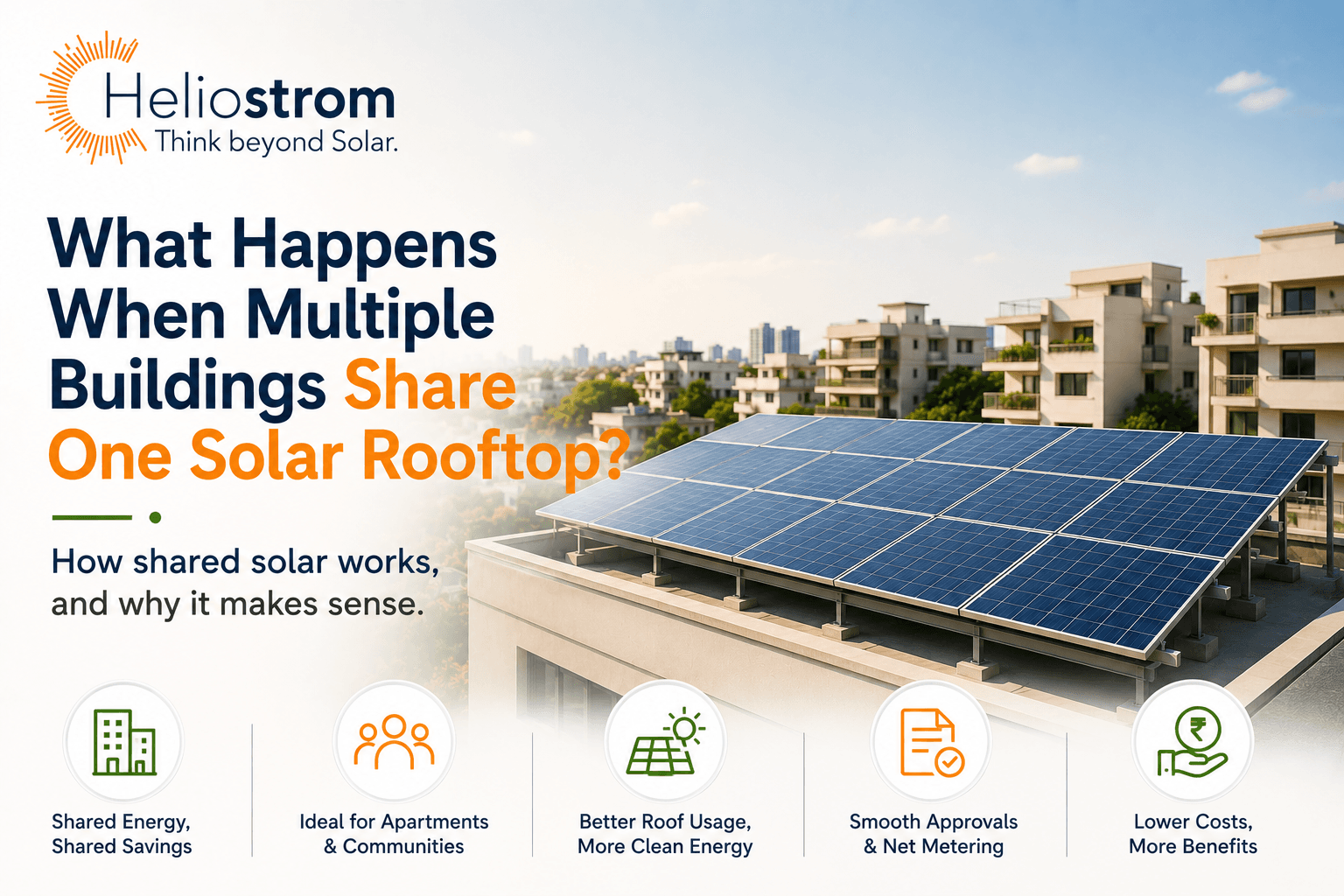
Not every building has a roof suited for solar. A shaded apartment block, a heritage structure, or a factory unit with a roof already crowded with equipment may never generate a single kilowatt on its own, even while the building right next to it has open, sun-facing space to spare. Shared rooftop solar solves exactly this mismatch, letting one property host the panels while several others draw the financial benefit. The regulatory frameworks needed to make this model practical vary considerably by state and consumer category, making eligibility an important question before any shared arrangement is planned. Understanding how this works has become far more relevant in Chennai as demand for solar power plant installations in Chennai grows across industrial parks, gated communities, and mixed-use commercial complexes where not every rooftop is created equal.
The Basic Idea Behind Shared Solar Rooftops
One Roof, Multiple Beneficiaries
A shared rooftop solar setup places a single solar installation on one suitable building and distributes the financial benefit of that generation across multiple electricity connections, sometimes within the same premises and sometimes across separate ones nearby. Instead of every building needing its own functional roof and its own system, one well-positioned rooftop can effectively serve several accounts at once. This is a meaningful shift from the assumption that solar has to be a one-building, one-system proposition, and it opens up options for properties that would otherwise be excluded from rooftop solar entirely due to physical constraints alone.
Why This Model Exists in the First Place
Rooftop solar depends heavily on unobstructed sun exposure, structural strength, and available area, three things that vary enormously even between buildings standing right next to each other. A shared model exists precisely because good rooftops and buildings that actually need the power are not always the same buildings, and forcing every property to solve its own solar problem independently leaves a lot of otherwise usable capacity sitting unclaimed.
The Regulatory Mechanisms That Make Sharing Possible
Group Net Metering Explained
Group net metering is a regulatory mechanism used in some Indian states that allows eligible consumers with multiple electricity connections to allocate solar generation or credits across those connections. Whether a particular shared arrangement is permitted depends on the applicable state regulations, consumer category, and distribution utility. This kind of mechanism directly addresses a gap that has existed for years, where a household or business with a strong roof had no formal way to share that advantage with a connected property that genuinely needed the offset more, in states where the framework has been introduced.
Virtual Net Metering as a Related but Distinct Option
Virtual net metering generally allows electricity generated at one solar installation to be virtually allocated among multiple eligible electricity connections without physically transferring the electricity between the premises. Eligibility, participating consumer categories, and allocation rules vary by state, so confirming current terms with the local distribution utility remains an essential step before committing to any shared arrangement.
What Other States Reveal About How This Typically Works
Several Indian states have introduced forms of group or virtual net metering, providing useful examples of how multi-connection solar allocation can work under state-specific rules. Any future Tamil Nadu framework would need to be assessed based on its final notified provisions, including eligible consumer categories, connection requirements, and capacity limits, rather than assumed in advance.
Where Shared Rooftop Solar Makes the Most Practical Sense
Industrial Parks and Multi-Unit Factory Complexes
Industrial complexes often include units with wildly different roof conditions, some with large, unobstructed sheds ideal for solar and others crowded with ventilation systems, water tanks, or structural additions that leave little usable space. A shared arrangement lets the units with strong roofs host generation capacity sized to also benefit neighboring units that physically cannot support a system of their own. This is particularly relevant in older industrial estates, where buildings were rarely designed with future solar installation in mind and roof suitability now varies enormously from one unit to the next within the same complex.
Housing Societies and Apartment Complexes
A large residential complex frequently has one clearly superior rooftop, often the tallest or least obstructed block, while shorter buildings nearby sit in partial shade for much of the day. Rather than installing an undersized, underperforming system on every block individually, concentrating capacity on the best available roof can improve roof utilization and may produce better overall economics than installing poorly positioned systems on several shaded blocks.
Mixed-Use Commercial Developments
Commercial developments that combine retail space, office floors, and shared common areas under different electricity connections are natural candidates for this model as well. Businesses exploring commercial solar solutions in Chennai increasingly ask about shared arrangements specifically because a mixed-use property rarely has uniform roof access or identical consumption patterns across every tenant.
What to Evaluate Before Committing to a Shared System
Structural and Site Assessment of the Host Rooftop
Before any shared system moves forward, the hosting rooftop needs a proper structural and shading assessment, since the entire arrangement depends on that single roof performing reliably for every connected beneficiary, not just the building it physically sits on. A rushed or informal survey here creates risk for every party relying on that generation later. Because the consequences of an inadequate assessment now extend beyond one building's own returns, this step deserves more rigor in a shared setup than it typically receives in a standalone, single-building installation.
Agreements Between Participating Parties
A clear, written agreement between the hosting property and every participating connection should define how generation credits are allocated, what happens if the system underperforms, and who is responsible for maintenance and repairs over the system's operating life. Verbal understandings between neighboring businesses or committee members rarely hold up once a real dispute over credits or costs actually arises.
Choosing Equipment Built for Long-Term Reliability
Since one rooftop is now responsible for multiple stakeholders' returns rather than just its own, component quality matters even more than usual. Working with an established solar installation company in Chennai that can document the origin, specifications, and warranty support of the selected modules reduces the risk of premature degradation or failure that would affect every connected beneficiary simultaneously, not just the property hosting the array.
How the Financial Benefit Could Be Allocated
In a shared solar arrangement, the way generation or financial credits are allocated depends on the applicable state regulations and the distribution utility's metering and billing framework. Where a group or virtual net metering mechanism is permitted, participating connections may receive predefined shares of the eligible generation or credits. The allocation method, settlement period, treatment of surplus generation, and transferability of credits should all be confirmed with the local distribution utility before the system is commissioned.
Frequently Asked Questions
Is shared rooftop solar legally available everywhere in India right now?
No. Shared rooftop arrangements are not governed by one uniform nationwide mechanism. Group net metering, virtual net metering, and related arrangements depend on state-level regulations, consumer category, and the applicable distribution utility. Confirming current status directly with the local electricity regulator or distribution company is essential before planning a shared installation.
Can a homeowner participate in a shared rooftop arrangement, or is this only for large properties?
Individual homeowners can potentially participate where local regulations allow it, particularly within housing societies or gated communities, though most current frameworks are still oriented toward connections under the same consumer category. For Tamil Nadu specifically, the applicable consumer category and current TANGEDCO rules should be confirmed before assuming that generation from one service connection can offset another. For a single home evaluating options independently, a standard rooftop solar panel setup remains the more straightforward starting point.
What happens if the hosting rooftop needs repairs or the building is sold?
This is exactly why a formal agreement matters before installation begins. A well-drafted agreement should address maintenance responsibilities, what happens during temporary outages, and how the arrangement transfers, or does not, if ownership of the hosting property changes.
How is credit typically split between participating buildings?
Credit allocation depends on the applicable regulatory framework and the arrangement approved by the distribution utility. Where allocation is permitted, the participating connections and their respective shares should be clearly documented before commissioning, and recorded with the distribution utility so billing adjustments happen automatically each cycle rather than requiring manual reconciliation.
Conclusion
Shared rooftop solar turns an uneven distribution of good roofs and real electricity demand into something workable for everyone involved, rather than leaving buildings with poor solar potential locked out of the benefit entirely. Getting the structural assessment, legal agreements, and metering framework right from the start is what determines whether that shared benefit holds up over the system's full operating life. If you are exploring whether a shared solar arrangement makes sense for your property or portfolio, reach out to our solar experts to walk through what a properly structured shared rooftop system could look like for your specific buildings.
Running the numbers for your business? commercial solar installation in Chennai or request a solar quote.


