
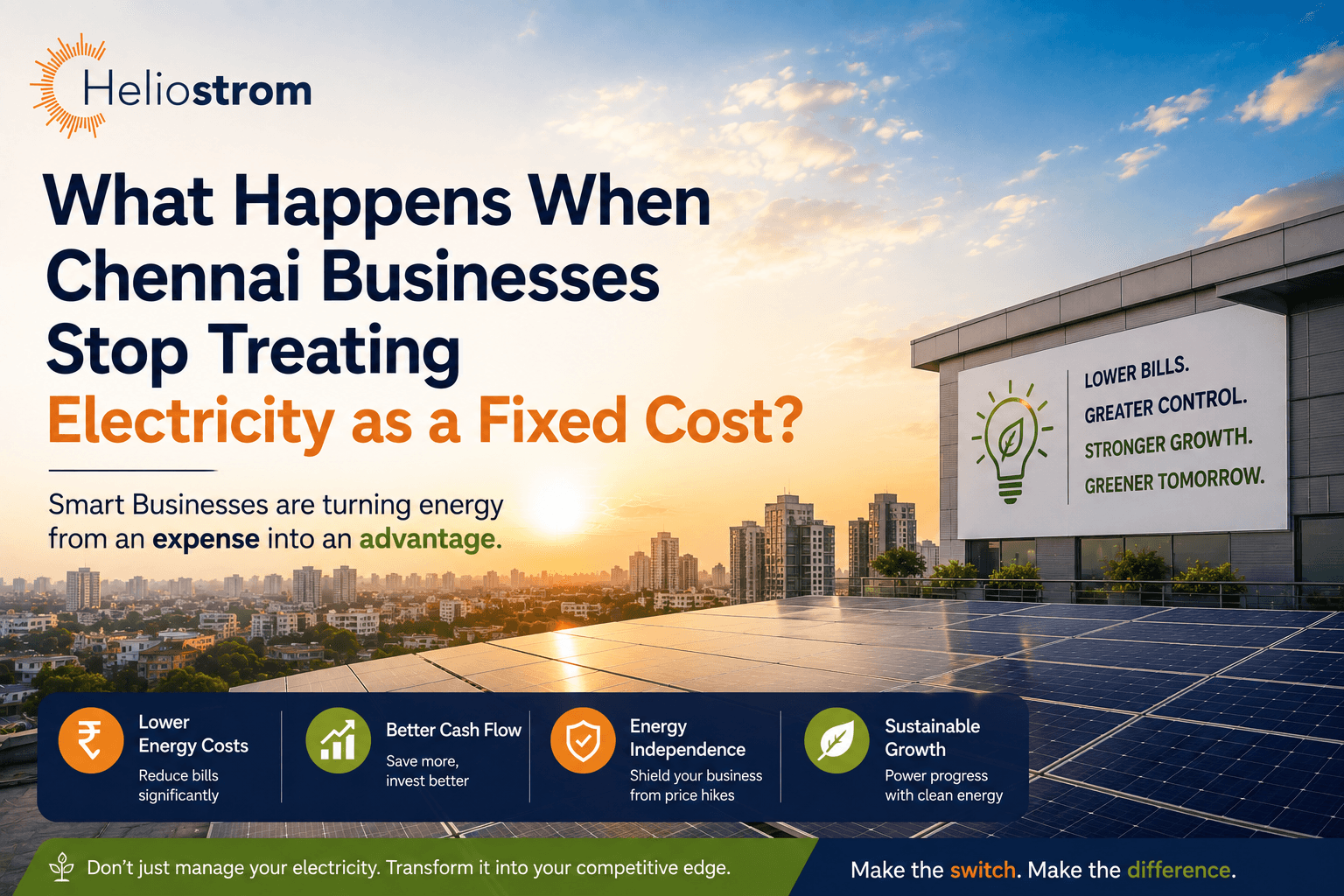
For most Chennai business owners, the electricity bill sits in the same mental drawer as rent or insurance, a monthly obligation that simply has to be paid. But that assumption is starting to crack. As electricity tariffs and regulatory policies evolve in Tamil Nadu, more commercial and industrial units across the city are looking at Solar Power Plants in Chennai as a way to convert part of a recurring electricity expense into a long-term capital asset. This shift in thinking, from paying for power to producing it, changes almost every financial decision a business makes.
The Hidden Assumption Behind Every Chennai Electricity Bill
Most companies budget for electricity the way they budget for a lease payment, as a line item that goes up slightly each year but never disappears. That mindset made sense when grid power was the only realistic option. It makes far less sense today, when rooftop solar has become bankable, well understood, and financially competitive within a reasonable number of years of installation.
How Electricity Tariffs Are Changing
Tamil Nadu's electricity tariffs are revised by the Tamil Nadu Electricity Regulatory Commission based on proposals from TANGEDCO, and rates have been adjusted at different points over the past decade across various consumer categories. For 2025-26, Tamil Nadu implemented tariff revisions across several consumer categories, with changes to both energy and demand-related charges, alongside periods where rates for certain categories have also been held steady or absorbed by the government. This means a business locked entirely into grid supply has limited scope to directly influence what it pays for its single largest energy-related overhead.
The Real Cost of Treating Power as Fixed
Treating electricity as fixed means accepting whatever TNERC approves for a given period, with limited ability to directly control the underlying grid tariff. Over a ten-year horizon, this passivity compounds. A showroom, a mid-sized factory, or a warehouse that consumes several thousand units a month is, in effect, remaining fully exposed to future changes in regulated electricity tariffs and other applicable charges. Businesses that recognize this early are the ones already exploring generation of their own power rather than continuing to absorb whatever the next tariff order brings.
What Changes When Businesses Reframe Electricity as a Controllable Expense
Once a business stops viewing power purely as a monthly bill and starts viewing it as an operational input it can influence, the decisions that follow look quite different. Instead of asking how to reduce consumption through smaller measures like efficient lighting, owners start asking how much of their own demand they can generate on-site.
From Consumption to Generation
Rooftop Capacity and Space Utilization
Chennai receives substantial solar irradiation throughout much of the year, and a large share of commercial and industrial buildings in the region have flat or shed-type rooftops that are otherwise unused. A Solar Panel Installation, whether for a home, an office, or a small commercial premises, needs to be sized correctly to the building's load profile so that generation offsets a meaningful share of daytime consumption, which often aligns well with periods of daytime business electricity consumption. Sizing depends on available roof area, shadow-free zones, and the structural load the roof can safely carry, which is why a proper site survey matters more than a generic quote.
Net Metering and Export Credits
Tamil Nadu has supported grid-connected rooftop solar through successive regulatory frameworks, including the TNERC Grid Interactive Solar PV Energy Generating Systems Regulations, 2021, which has updated and refined the state's original net metering arrangements introduced in 2012. Under the applicable framework, surplus electricity a business generates and does not use immediately may be exported to the distribution grid and settled or credited according to the applicable metering mechanism and regulatory conditions, including capacity limits tied to the local distribution transformer and the consumer's tariff category. For businesses with daytime-heavy operating hours, this can increase the value derived from available rooftop space by enabling additional renewable electricity generation, rather than functioning as a guaranteed income stream.
The Financial Shift: Solar as an Asset, Not an Expense
The clearest sign that a business has stopped treating electricity as fixed is a change in how the investment gets recorded. A rooftop system is not an operating expense that vanishes at year end, it is a capital asset that sits on the balance sheet, can generate electricity over a long operating period, commonly around 25 years for planning purposes, and can reduce a business's exposure to future tariff orders.
Payback Periods and Long-Term Generation Economics
Payback can often fall within several years, but the actual period depends on system cost, electricity tariffs, generation, self-consumption, financing, and the applicable regulatory framework, so a site-specific financial model is more reliable than any general estimate. After payback, the generation cost is effectively set at the price of installation, while future grid electricity costs remain subject to tariff revisions, regulatory decisions and applicable charges. This is the core argument for Commercial Solar for Chennai projects, a well-planned system tends to look more favourable, not less, as the years pass and grid conditions change.
Depreciation and Tax Benefits for Commercial Units
Businesses that install eligible solar power generating systems as capital assets may be able to claim depreciation under the applicable income-tax provisions. The Income-tax Rules, 2026 specify a 40 percent depreciation rate for solar power generating systems, subject to the applicable conditions. Combined with lower operating expenses, this can improve the project's after-tax economics for eligible businesses, which is one reason solar adoption among Chennai's commercial and industrial units has moved from a sustainability talking point to a straightforward line-item decision reviewed by finance teams rather than just facilities teams.
Industry-Specific Impacts Across Chennai
The calculation looks slightly different depending on the type of business, since load profiles, roof availability, and operating hours vary widely across sectors.
Manufacturing and Textile Units
Factories operating multiple shifts can have substantial and relatively consistent electricity demand, though a facility with significant night-time production may still depend heavily on grid supply unless paired with storage or other arrangements. Demand charges and the relationship between contracted demand, peak demand and solar generation can materially affect project economics for this segment. Large shed roofs common in industrial parks around Chennai also provide ample space for sizeable installations without competing for land.
IT Parks, Warehouses and Retail Outlets
Offices and retail spaces with daytime-only operating hours are generally a good fit for solar, since their daytime operating patterns can align well with solar generation. Warehouses with large flat roofs and comparatively modest electrical loads can offer attractive project economics where substantial roof space coincides with sufficient daytime electricity demand.
Choosing the Right Solar Panel Manufacturers in Chennai
Equipment quality has a direct bearing on how long these financial benefits actually last. Panel degradation rates, inverter warranties, and after-sales service response times all affect the real-world payback calculation, not just the headline price per watt. Businesses evaluating Solar Panel Manufacturers in Chennai should look at manufacturing history, whether the proposed modules meet applicable ALMM requirements where those requirements apply, and documented performance data rather than relying on quoted efficiency figures alone.
What This Shift Means for Chennai's Energy Future
As more commercial and industrial consumers in Chennai make this move, the broader effect is a gradual redistribution of who bears tariff risk. Businesses that continue treating electricity as fixed remain fully exposed to future changes in regulated electricity tariffs. Businesses that generate part of their own electricity can reduce their exposure to future grid electricity costs, while taking on the capital, operating and performance risks associated with the solar asset. Over a decade, that difference can contribute to improved cost predictability and operating resilience, particularly for sectors where energy is a significant share of operating cost.
This does not mean solar removes electricity costs entirely. Grid dependency for night-time load, monsoon variability, and battery storage economics all remain part of the equation. But the underlying question has changed. Instead of asking how to pay the next bill, a growing number of Chennai businesses are asking how much of their own power they can produce.
Frequently Asked Questions
1. How much can commercial solar realistically reduce a business's electricity bill in Chennai?
Payback varies by system cost, electricity tariff, solar generation, self-consumption and financing. A site-specific financial model is more reliable than applying a fixed payback range, though well-sized commercial installations commonly offset a substantial share of daytime grid consumption.
2. Does Tamil Nadu still offer net metering for commercial and industrial solar?
Tamil Nadu has regulatory provisions for grid-connected rooftop solar, including net metering and other applicable settlement mechanisms, subject to consumer category, system capacity and current TNERC rules, most recently under the Grid Interactive Solar PV Energy Generating Systems Regulations, 2021.
3. What size of rooftop solar system suits a mid-sized commercial building?
System size should be based on a site survey covering available shadow-free roof area, structural load capacity, and the building's historical consumption pattern, rather than a fixed formula, since these factors vary widely across warehouses, offices, and factory sheds.
4. Are there tax benefits available for businesses installing solar in Tamil Nadu?
Eligible businesses may claim depreciation on qualifying solar power generating assets under the applicable income-tax provisions. The Income-tax Rules, 2026 specify a 40 percent depreciation rate for solar power generating systems, subject to the applicable conditions.
5. How long do commercial solar systems typically last?
Commercial solar PV systems are commonly planned around a 25-year operating period, although individual components such as inverters may have shorter service lives. Module performance warranties can also extend over 25 years, depending on the manufacturer and product.
Conclusion
The businesses that manage energy costs effectively over the next decade are likely to be those that treat electricity as a strategic operating input rather than a completely fixed cost. By assessing their load profile, available roof space, financing options and applicable electricity regulations, businesses can determine whether solar can reduce their exposure to grid electricity costs and improve long-term energy predictability. If you are evaluating whether commercial solar makes sense for your building, Contact Us for a site assessment and a payback estimate based on your actual electricity consumption.
Want these savings on your own roof? get a free solar quote or explore home solar in Chennai.


