
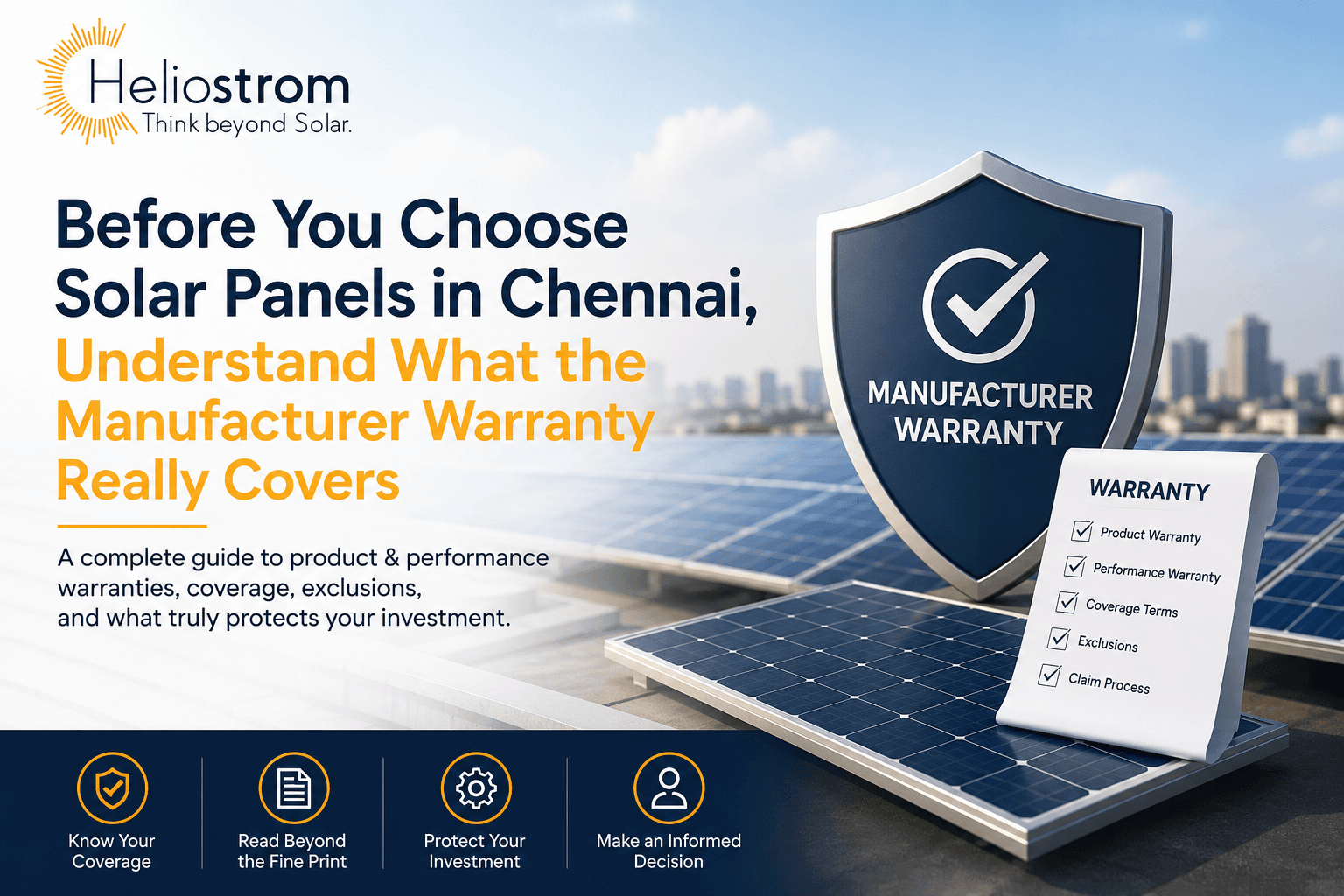
1. Why Solar Panel Warranties Deserve More Attention
When most people evaluate solar panel manufacturers in Chennai, the headline number that catches their attention is warranty length. A twenty five year warranty sounds like complete protection for a quarter century, but that assumption is rarely accurate. A warranty period tells you how long a manufacturer stands behind certain aspects of a product, not that the panel will perform flawlessly for that entire duration. Solar panels typically carry more than one type of warranty, each with its own conditions and exclusions. Before comparing brochures or quotes, it helps to actually read the solar panel manufacturer warranty documentation rather than relying on marketing summaries. This article is an educational guide to help buyers understand warranty structures, not a recommendation of any specific product or company.
2. The Two Main Types of Solar Panel Warranties
Solar panels are generally covered by two distinct warranties: a product warranty and a performance warranty. These terms are often mentioned together, but they address different concerns and should not be treated as interchangeable.
A product warranty relates to the physical panel itself. It generally addresses manufacturing defects, faulty materials, or workmanship issues that cause the panel to fail or malfunction. A performance warranty relates to how much electricity the panel is expected to generate over time, accounting for the fact that all solar panels lose a small amount of efficiency as they age.
For example, a panel could be structurally sound and free of manufacturing defects, yet still generate less electricity than it did in its first year because of normal degradation. Understanding both warranties together gives a fuller picture of what a buyer is actually protected against.
3. What a Product Warranty Usually Covers
A product warranty document typically addresses manufacturing defects, defective materials, faulty lamination, frame problems, and premature failure of internal components like junction boxes or connectors. The exact scope varies significantly between manufacturers, and buyers should not assume all product warranties are structured the same way.
Common exclusions found in many product warranties include damage from improper installation, unauthorized modification, extreme weather events beyond the panel's rated tolerance, physical damage from external objects, and failure to follow maintenance guidelines. Some manufacturers may also require installation by an approved or certified installer for the warranty to remain valid.
Because these conditions differ between manufacturers, marketing brochures alone are not sufficient. Buyers should request the actual warranty document, read the fine print, and clarify anything ambiguous before making a purchase decision.
4. Understanding the Performance Warranty
Solar panels lose efficiency gradually over their operating life, a process known as degradation. Performance warranties are designed to guarantee a minimum output level at specific points in time rather than promising unchanged performance forever.
Most performance warranty structures include an initial degradation figure, accounting for a slightly larger efficiency drop in the first year, followed by a smaller annual degradation rate for subsequent years. The warranty then specifies a guaranteed output percentage at the end of the term, such as a stated percentage of original rated capacity after a defined number of years.
As a purely illustrative example, and not a claim about any specific manufacturer, imagine a panel rated at 100 percent output in year one. If it degrades gradually each year, it might still be guaranteed to produce a defined percentage of its original output near the end of its performance warranty period. The actual figures depend on the specific manufacturer and product line, so buyers should confirm these numbers directly from the warranty document rather than assuming a standard rate applies industry wide.
Two panels with similar day one efficiency can end up with very different long term output if their degradation rates or guaranteed end of term performance differ. This is why performance warranty terms deserve as much attention as the headline efficiency rating.
5. Why Warranty Duration Alone Can Be Misleading
A statement like "twenty five year warranty" is often used as a shorthand for quality, but duration alone does not capture the full picture. Several other factors determine how much practical protection a warranty actually provides.
These include the panel's starting performance, its degradation rate over time, the guaranteed output level at the end of the warranty term, the separate duration of the product warranty covering physical defects, the specific exclusions that could void coverage, and how straightforward or difficult the claims process is in practice. A panel with a shorter but clearly documented warranty and a straightforward claims process may offer more practical value than one with a longer warranty burdened by restrictive conditions.
This is one of the reasons why understanding solar panel quality matters as much as comparing warranty length. A longer headline warranty does not automatically translate into stronger real world protection, particularly if the underlying terms are vague or difficult to act on when a problem arises.
6. What Warranty Conditions Buyers Should Check
Before finalising a purchase, buyers should ask practical questions about how the warranty works in practice, not just what it promises on paper.
It is worth confirming who provides the warranty, whether it is the manufacturer directly or a distributor, and where that entity is based, since this can affect how claims are processed. Buyers should also understand how a claim is initiated, what documentation is required, and realistic timelines for resolution.
Other considerations include who is responsible for transportation costs if a panel needs inspection or replacement, whether labour costs for removal and reinstallation are covered, and what circumstances might invalidate the warranty, such as improper installation or unauthorised repairs. It is also worth asking what happens to warranty obligations if the manufacturer changes ownership, restructures, or ceases operations.
There is a meaningful difference between having a warranty on paper and being able to practically use it when a problem occurs. Clarifying these details in advance can save considerable time and expense later.
7. How Chennai's Climate Makes Warranty Details Important
Chennai's climate includes high ambient temperatures for much of the year, significant humidity, heavy seasonal rainfall, and in some areas coastal exposure that brings salt laden air. Parts of the city also experience dust accumulation and air pollution, which can affect panel surfaces over time.
These conditions do not automatically void a manufacturer's warranty, but they make it important to understand the manufacturer's specified operating conditions. Panels are rated for certain temperature ranges and environmental tolerances, and installation practices suited to local conditions influence how well a panel performs and holds up over its warranty period.
Buyers should consider how a panel's temperature coefficient affects output during hot weather, what environmental resistance certifications it carries, and whether the manufacturer provides guidance for coastal or high humidity installations. Working with an installer familiar with Chennai's conditions, alongside understanding warranty terms, gives a fuller picture of long term reliability.
8. A Practical Warranty Checklist for Solar Panel Buyers
Before finalising a solar panel purchase, it is useful to review the following points against the actual warranty document:
- Product warranty duration
- Performance warranty duration
- Guaranteed output percentage at the end of the warranty period
- Annual degradation rate specified by the manufacturer
- Manufacturing defects explicitly covered
- Exclusions and limitations stated in the document
- Installation related conditions required to keep the warranty valid
- Step by step claim procedure
- Replacement or repair terms, including timelines
- Responsibility for labour and transportation costs
- Availability of manufacturer support and service centres
- The warranty document itself and its applicable jurisdiction
Reviewing this checklist against solar panel warranty coverage documentation, rather than relying on promotional claims, helps buyers make an informed decision. A panel should be evaluated on what its warranty actually guarantees, not simply because the headline figure reads twenty five or thirty years.
9. Frequently Asked Questions
What is the difference between a product warranty and a performance warranty?
A product warranty covers physical defects in materials or workmanship, such as faulty components or manufacturing errors. A performance warranty covers the panel's expected electricity output over time, accounting for gradual efficiency loss known as degradation. Both address different risks and should be reviewed separately.
Does a 25-year solar panel warranty mean the panel will work perfectly for 25 years?
Not necessarily. A twenty five year warranty typically refers to a performance warranty term, which usually guarantees a minimum output level rather than unchanged performance throughout that period. Panels experience gradual degradation each year, and the warranty specifies an expected output floor rather than promising the panel will perform exactly as it did on day one.
What should Chennai buyers check before accepting a solar panel warranty?
Buyers should review the product and performance warranty durations, the degradation terms and guaranteed end of term output, exclusions and conditions that could void coverage, environmental suitability for Chennai's climate, the claims procedure, replacement or repair terms, and who bears associated costs such as labour and transportation.
Conclusion
Choosing solar panels in Chennai involves more than comparing headline warranty numbers. A twenty five or thirty year warranty can sound reassuring, but its real value depends on the type of coverage, the degradation terms, the exclusions, and how practical the claims process is. Buyers who read the actual warranty documentation, ask the right questions, and understand how local conditions interact with a panel's specifications are better positioned to make a sound long term decision. For readers who want help evaluating warranty terms for their specific site, it can help to contact solar panel experts who can walk through the documentation in detail.
Planning solar for your home? rooftop solar installation for homes in Chennai or get a free solar quote.


