
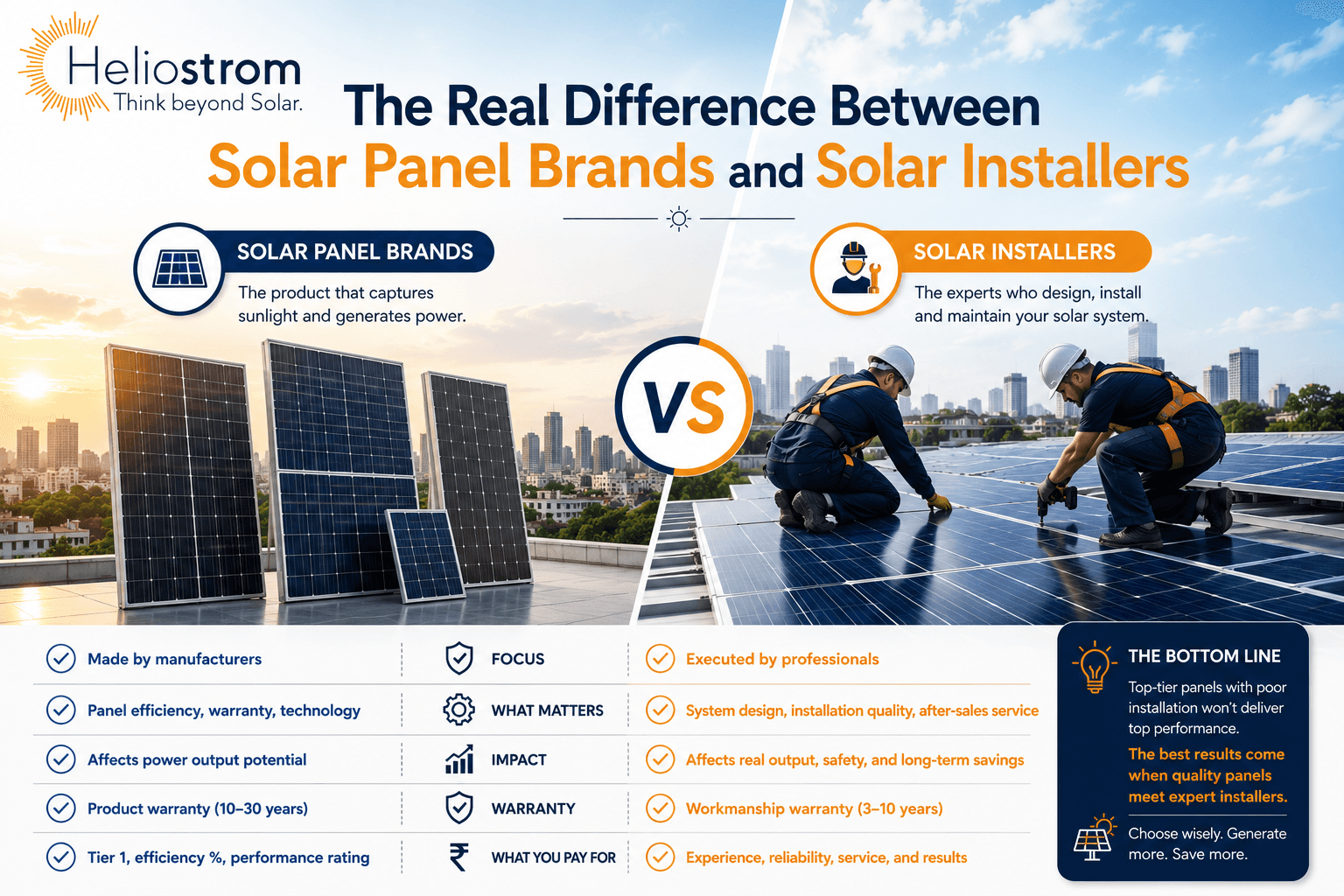
Ask a first-time buyer what makes a good solar system and most will name a panel brand. It is the visible part, the logo on the glass, the specification everyone compares. The brand on the panel affects only part of how a system performs over its life, and the installer’s work often matters just as much. The company that designs, installs and stands behind the system shapes the outcome just as much, and sometimes more. Confusing the two can lead buyers to overlook the factors that affect long-term performance, service, and warranty support.
Understanding who is responsible for what changes how you evaluate a quotation entirely. Before you weigh a solar panel installation in Chennai proposal, it is worth separating what a panel manufacturer controls from what an installer controls, because you depend on both for very different things.
What a Panel Brand Actually Controls
A panel manufacturer is responsible for the product that leaves the factory. That covers a specific and important set of things: the cell technology, the quality of the manufacturing, the durability of the materials and the product and performance warranties attached to the module. These are real and they matter. But notice what they do not cover. A manufacturer has no involvement in how the panel is wired, mounted, earthed or maintained on your roof. It ships an identical product to every buyer, and from that point its fate rests in other hands. Two customers can receive the same module and end up with systems performing years apart in output, purely because of what happened after delivery.
The specifications a brand is answerable for
When you compare panels, you are comparing the manufacturer's work. The temperature coefficient, which governs how much output falls as the cell heats, is a brand decision. So is the module's resistance to degradation, its frame strength, its behaviour in humid and salty coastal air, and whether it appears on the approved list of models and manufacturers. That listing has grown more consequential over time. Long tied to subsidised residential systems, the approved list requirement was extended to commercial solar projects in 2026, which makes a provider's familiarity with compliant components matter even more. In a hot climate these differences are meaningful. A module with a better temperature coefficient can perform better in hot conditions, which matters in a climate like Chennai’s. This is where brand selection earns its importance.
What a Product Warranty Really Promises
A panel carries two warranties: a product warranty against manufacturing defects and a performance warranty guaranteeing a minimum output over twenty-five years or more. Both are promises from the manufacturer. But a warranty is only as useful as your ability to claim it and claiming it years later is not something the manufacturer makes easy on its own. That is where the second party in the relationship becomes decisive.
What an Installer Actually Controls
The installer controls most of what happens between the factory and your electricity meter, and much of what affects the system after handover This is a far larger surface area than most buyers realise, and it is invisible on a specification sheet.
Design decides how the panels perform together
Identical panels can produce very different amounts of energy depending on how they are arranged. String design, orientation, tilt, shading analysis and inverter matching are all the installer's work, and a poor design leaves a good panel underperforming for its entire life. The manufacturer built the panel well; the installer decides whether that quality is ever realised on your roof.
Workmanship decides how long it lasts
Cable specification, connector crimping, earthing, structural fastening and waterproofing are all execution choices, and they are where most field failures actually originate. A tier one panel wired with the wrong cable or mounted on an undersized structure in a coastal wind zone will disappoint regardless of its brand. The panel is not always the first point of failure. Connections, structure, and water management are often where problems begin, which is why installation quality matters so much.
Service decides whether your warranty is worth anything
When a module underperforms in year 11, the manufacturer will ask precisely which unit, where it sits and what the test data shows. The installer who kept a serial number register, who commissioned the system properly and who is still in business to raise the claim is the one who makes that warranty real. A twenty-five-year warranty from a manufacturer means little without an installer prepared to chase it on your behalf.
The Manufacturer Versus Installer Confusion
Buyers frequently search for solar panel manufacturers in Chennai assuming the company installing their system also builds the panels. Most established providers in the state do not. They are engineering, procurement and construction firms, meaning they select components, design the system and construct it rather than fabricating modules themselves. This is not a shortcoming. It is the normal and sensible structure of the industry, because manufacturing panels and installing them well are entirely different competencies. What you want from such a firm is sound judgement in choosing components and genuine accountability over the life of the system, not a lamination line on the premises.
Why Brand Chasing Misleads Buyers
The instinct to fixate on brand is understandable. It is the one specification that is easy to compare, and comparison feels like diligence. But two installers can quote the identical panel and deliver systems with completely different life expectancies, because the panel is perhaps sixty percent of the outcome and the design, workmanship and service make up the rest. A superb panel installed carelessly is a worse investment than a good panel installed with discipline. The brand is a necessary check, not a sufficient one. It is also the check most easily gamed, because a quotation can name an impressive panel while quietly thinning the cable, the structure or the scope of commissioning, none of which appear beside the brand name in a comparison table. Comparing only logos misses the variables where systems actually diverge.
How to Evaluate Each One Properly
Because you depend on both, evaluate both, using different signals for each.
- For the panel: check the temperature coefficient, degradation rate, warranty terms and whether it is on the approved list
- For the installer: ask to see completed projects several years old, not several weeks old
- For the installer: ask whether the crew is in-house or subcontracted, and who supervises the work
- For the installer: ask how they handle warranty claims and what records they keep for serial numbers, commissioning, and service history
- For both: read the warranty document to see who is responsible for what, and for how long
- For the installer: ask what maintenance and monitoring they provide after handover
The Relationship That Outlasts the Sale
A panel brand fulfils its role the day the module is manufactured. An installer's role continues for as long as you own the system. That difference in duration is the heart of the matter. You buy a panel once and live with an installer's decisions for decades. This is why serious buyers, particularly for larger commercial solar for Chennai projects, scrutinise the installer at least as hard as the panel, knowing that the company that still provides support years later can matter as much as the logo printed on the glass. The larger the system, the more this holds, because a single overlooked fault on a big array can go unnoticed for a full year while quietly draining returns. The brand helps you buy a good product. The installer determines whether that product is designed, installed, and supported well enough to deliver its expected performance over time.
Frequently Asked Questions
Does the panel brand matter at all, then?
Yes, it matters. Cell technology, temperature response, durability and warranty are real brand differences worth checking. The point is that the brand is one of two things that decide your outcome, not the whole story.
If two quotes use the same panel, are the systems the same?
No. The same panel can be designed, wired, mounted and maintained very differently. Ask what differs in cable specification, structure, connectors and the scope of testing. The gap usually explains any price difference.
Who do I claim from if a panel fails?
The manufacturer honours the panel warranty, but your installer is the one who identifies the unit, provides the test data and raises the claim. A good installer makes a warranty easier to use by keeping records, coordinating testing, and supporting the claim process.
Should I insist on a specific well known panel brand?
Insist on a panel that meets the specifications that matter, including warranty terms and any approved listing required for your project. Then spend equal effort verifying the installer, because that is where most performance is won or lost.
What does EPC mean and why does it matter?
EPC stands for engineering, procurement and construction. It describes a firm that designs the system, sources the components and builds it, rather than manufacturing panels. Most credible providers work this way, and it is the normal structure of the industry.
How long should an installer stay involved after installation?
For the life of the system, ideally. Cleaning, monitoring, fault response and warranty support all continue for years. An installer who disappears after handover leaves you to manage a twenty five year asset alone.
Can a bad installation void my panel warranty?
Yes. Incorrect mounting, mismatched connectors, overtightened clamps and poor earthing appear in manufacturer exclusion clauses. Good workmanship protects the warranty as much as the warranty protects you, which again places the installer at the centre.
The panel you choose matters, but the company that designs, builds and supports the system decides whether that panel ever performs as promised. If you want a proposal where both the components and the workmanship are explained openly, contact us and ask for a walkthrough of who is responsible for what.
Thinking about your own installation? rooftop solar installation for homes in Chennai or book a free site survey.


