
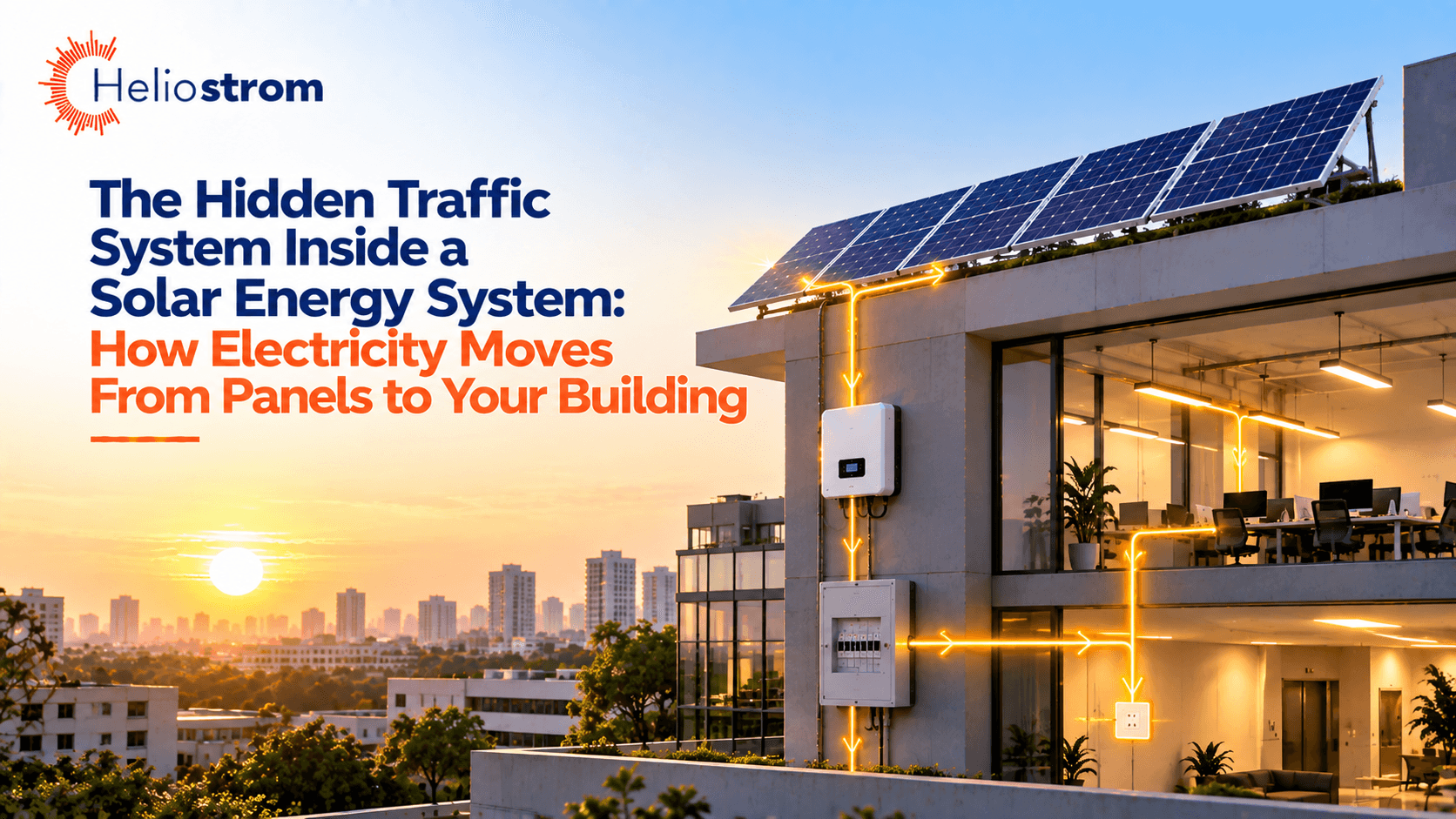
A solar rooftop looks quiet from the street, yet underneath the glass there is constant movement. Electrons set off from the panel, change form partway through the journey, and end up either lighting a room, charging a battery or heading out to the grid. Most of the solar companies in chennai will explain this in a single sentence, but the route electricity actually takes has several junctions worth understanding before you invest in a system. This guide follows that route step by step, from sunlight to switchboard.
Where the Journey Begins: Sunlight Into Current
The Photovoltaic Effect in Plain Terms
A solar panel is made of many photovoltaic cells, most commonly silicon. When sunlight strikes a cell, photons transfer energy to electrons in the silicon, giving some electrons enough energy to move and contribute to electrical current. That movement of electrons is an electric current, specifically direct current, or DC.
Why Panel Placement and Angle Matter
Not every roof produces the same output from an identical panel. Shading from a neighbouring building, the tilt of the roof and the direction it faces all change how much sunlight reaches the cells.
The First Junction: DC Current Collects and Travels
From Cells to Panel to Array
Individual cells are wired together inside a panel, and panels are then wired together into strings. Junction boxes on the back of each panel gather the current before it travels onward. At this stage, the electricity is still DC and cannot directly supply the standard AC circuits used by most household appliances.
Cabling and Safety Along the Way
DC cabling runs from the roof down to the inverter, usually through conduit that protects it from weather and physical damage. Isolators and fuses sit along this path so the circuit can be shut down safely during maintenance or in an emergency.
The Real Traffic Controller: The Inverter
Converting DC to Usable AC
Indian homes and the electricity grid run on alternating current, or AC, which is why the inverter is the single most important junction in the whole system. It converts the panels' DC electricity into AC electricity suitable for the building's electrical system and, in a grid-connected installation, synchronizes its output with the grid.
Staying in Step With the Grid
A grid-connected inverter does more than convert current. It continuously synchronizes its output with the grid's frequency, so solar electricity and grid electricity can mix seamlessly on the same wiring. This is also why a standard grid-tied system switches off automatically during a power cut, since feeding electricity into a grid that repair crews assume is dead would be dangerous.
String Inverters and Microinverters
A string inverter handles several panels together as one group, which keeps costs down. Shading on one or more panels can reduce the output of a string, although the extent of the impact depends on the system's design and inverter configuration. Microinverters attach to each panel individually, allowing each panel to operate more independently, which can reduce the impact of shading on other panels, though the hardware costs more upfront. Which approach suits a building depends on roof shape, shading patterns and budget, which is a conversation worth having with the installer rather than settling in advance.
After the Inverter: Where the Electricity Goes Next
Powering the Building First
Once converted to AC, electricity flows into the building's main distribution board, the same panel that grid electricity already reaches. From there it is drawn by whatever is running at that moment, lights, fans, pumps or air conditioning. Solar electricity is used as it is generated unless the system includes a battery or another storage mechanism. Appliances draw current in real time, and the system simply prioritises using what the panels are producing before pulling anything from outside.
When Production Does Not Match Demand
If the panels generate more than the building is using, the surplus has to go somewhere. If a battery is part of the system, it usually charges first. Without a battery, or once it is full, the extra electricity is exported to the grid. On the other side, if the building is drawing more than the panels are producing, such as on a cloudy afternoon, the grid quietly supplies the shortfall without any switching required on your part.
The Role of a Battery, If You Have One
A battery is not compulsory for a grid-connected system, but it changes what happens during outages and in the evening. Stored charge can run essential loads when the grid is down or when the sun has set, which matters in areas where power cuts are still a factor. Sizing a battery correctly needs real load data from the building, not a generic estimate.
The Meter and the Grid: Closing the Loop
How Net Metering Works in Tamil Nadu
For eligible rooftop systems in Tamil Nadu, a bidirectional meter records electricity imported from and exported to the distribution utility. The applicable settlement mechanism depends on the consumer category and the current regulatory framework, with net metering and net feed-in arrangements applying in different circumstances. The value of exported electricity is settled according to the applicable tariff and regulatory mechanism. Because eligibility, tariffs and settlement rules can change, consumers should check the latest TNERC order and TNPDCL requirements before installation.
Group and Virtual Net Metering
Tamil Nadu's solar regulations also provide different metering and settlement mechanisms depending on consumer category and system configuration. Eligibility should be confirmed under the latest applicable TNERC and TNPDCL rules rather than assumed from a general description.
Applying for a Net Metering Connection
The process runs through the national rooftop solar portal alongside the TNPDCL/Tamil Nadu Solar Portal process, and it typically involves an application, feasibility approval, installation, inspection and commissioning of the meter and grid connection. A well-prepared application with correct documentation tends to move faster than one that needs repeated correction, which is one reason working with an experienced solar epc companies in tamilnadu partner can save weeks.
What Determines the Quality of the Journey
Component Quality Along the Path
Every junction described above depends on the hardware installed there. Panel efficiency, inverter reliability, cable quality and connector standards all affect how much of the sunlight that hits your roof actually becomes usable electricity. Choosing among established solar panel manufacturers in chennai and asking for datasheets rather than marketing claims is a reasonable way to compare options.
Installation Workmanship
Correct cable routing, earthing, mounting and clean connections do not show up in a photo, but they can have a major influence on whether the system performs reliably over its expected operating life, commonly cited as around 25 years for a grid-connected rooftop plant. A careful solar panel installation in chennai process, can help prevent many problems that later appear as underperformance or maintenance issues.
Monitoring and Maintenance
Most modern inverters offer basic monitoring, showing daily generation and flagging faults. Regular cleaning, periodic checks of connections and prompt attention to any drop in output help the system continue producing electricity close to its expected output under the prevailing conditions. A sudden dip is usually worth investigating rather than ignoring, since small issues such as a loose connection are far cheaper to fix early.
A Note on Government Support
Under PM Surya Ghar: Muft Bijli Yojana, eligible residential rooftop systems can receive Central Financial Assistance of up to ₹78,000 for systems of 3 kW or more, calculated at ₹30,000 per kW for the first 2 kW and ₹18,000 for the next 1 kW, subject to scheme conditions. Tamil Nadu's Solar Homes Portal has also described an additional state subsidy for eligible residential systems, taking combined assistance higher in some cases. Consumers should verify current eligibility, slabs and application requirements through the official portal or their installer before finalising system size.
Final Thoughts
Electricity inside a solar system does not simply appear at the switchboard. It travels from cell to junction box, through cabling to an inverter that changes its very form, then out to appliances, a battery or the grid, all governed by metering rules that determine your final bill. Understanding that route helps you ask better questions when comparing quotes and components. If you want that route mapped out for your own roof, the Solar Panel Experts in Chennai team can walk through site conditions, sizing and paperwork in one conversation.
Frequently Asked Questions
Why can't solar panels power appliances directly?
Panels produce DC electricity, while household wiring and appliances run on AC. The inverter performs that conversion, so in a conventional grid-connected rooftop system, the DC output must first be converted to AC before it can supply the building's standard AC circuits.
What happens to solar power during a grid outage?
A standard grid-tied inverter shuts down automatically when the grid goes down, for safety reasons, unless the system includes battery backup or a specific off-grid changeover designed to keep essential loads running.
Do I need a battery with a rooftop solar system?
No, a battery is optional for a grid-connected system. Without one, surplus generation can be exported to the grid where the system is approved for grid export, and the building draws from the grid whenever solar production falls short.
How does net metering affect my electricity bill?
A bidirectional meter records electricity imported from and exported to the grid. How those quantities affect the final bill depends on the consumer category and the applicable metering and settlement mechanism under current Tamil Nadu regulations.
How long does a net metering connection take to get approved?
There is no single fixed timeline that applies to every installation, since it depends on the consumer category, application completeness, feasibility requirements, inspection and meter commissioning.
Thinking about your own installation? rooftop solar installation for homes in Chennai or book a free site survey.


