
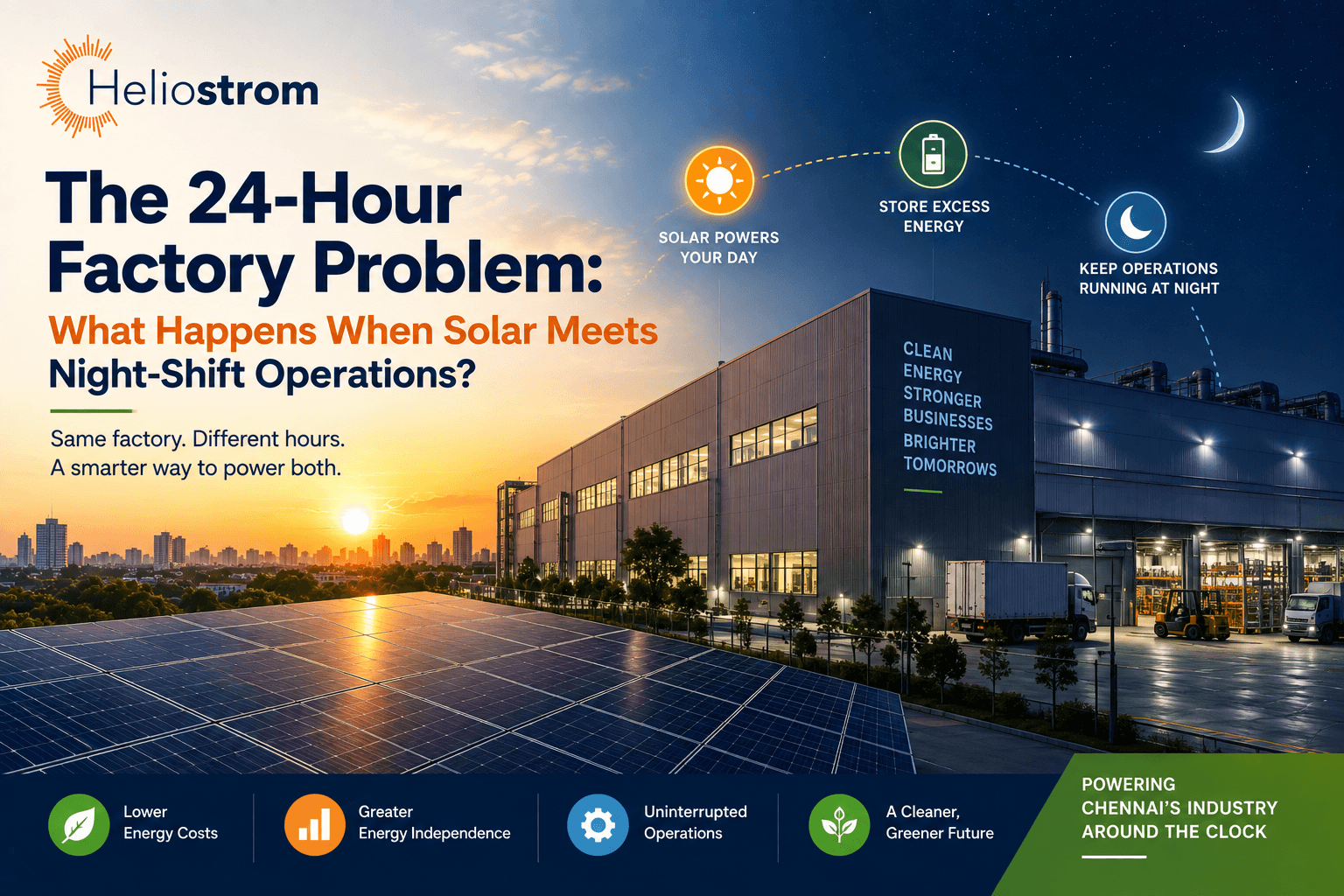
The 24-Hour Factory Problem: What Happens When Solar Meets Night-Shift Operations?
Manufacturing in Chennai rarely stops when the sun goes down. Textile units, auto component plants, and pharma facilities across the region often run two or three shifts, which means machines are pulling power at 2 a.m. almost as much as they are at 2 p.m. That creates a real design puzzle for anyone weighing solar power plants in Chennai for a factory that never switches off: panels only generate while the sun is up, yet a night shift needs electricity around the clock. Understanding how solar fits into continuous operations is less about the panels themselves and more about timing, storage, and how the plant is connected to the grid.
Why Round-the-Clock Manufacturing Changes the Solar Equation
The Mismatch Between Sunlight Hours and Shift Hours
Chennai has a strong solar resource, with useful generation concentrated during daylight hours. Actual output varies by season, weather, system orientation, shading, and equipment, so a site-specific solar assessment is far more reliable than relying on a fixed number of peak sun hours for planning. A single-shift office or a daytime retail unit tends to line up reasonably well with this daylight window. A factory running three shifts looks different. Once the sun sets, the night shift keeps drawing load from the grid no matter how large the rooftop array is, unless there is a clear plan for storing or exporting the surplus generated earlier in the day. This is really the heart of the 24-hour factory problem: a continuous plant does not have the same pronounced daytime-versus-nighttime consumption swing that many homes or offices see, so an oversized daytime system without storage or an export route can end up generating more than the site uses at that moment, offsetting less cost than it should.
Reading the Load Profile Before Sizing Anything
Before deciding on system size, it helps to break down consumption by shift rather than looking at a single average daily figure. A plant with a heavy first shift and a lighter night shift needs a different design than a continuous-process unit, such as cold storage or certain chemical operations, where the load barely changes between day and night. Interval or hourly billing data, where available, gives a far more accurate picture than a monthly total and prevents both undersizing and overspending on capacity that never gets used.
Battery Storage: Bridging the Day and Night Gap
Sizing Storage for Multi-Shift Plants
Battery storage is the most direct way to shift solar generated during the day into the hours after sunset. Adding storage can increase the share of solar generation a factory actually uses on site, since surplus daytime output that would otherwise flow to the grid at a lower rate can instead be discharged during the evening or night shift. The actual improvement depends on system size, load profile, battery capacity, and the site's export arrangement, so treat any general percentage figure as a rough estimate rather than a guarantee. Even a battery sized to bridge a few peak evening hours, rather than an entire night shift, can meaningfully change the economics.
Peak Shaving and Demand Charge Management
Industrial electricity tariffs can include demand-related charges tied to a consumer's recorded maximum demand, with the exact measurement, whether in kW or kVA, and the billing structure depending on the applicable tariff category and utility. A battery that discharges during the evening ramp, when a second shift often overlaps with rising residential demand on the grid, can lower that recorded peak and reduce the associated charge. For well-designed commercial and industrial battery systems, recent Indian market estimates often place payback in the roughly four to seven year range, though the actual result depends heavily on tariff structure, demand charges, battery utilization, solar integration, financing, and the site's operating profile.
Grid-Tied Options for 24-Hour Facilities in Tamil Nadu
Net Billing, Net Feed-In, and Gross Metering for Industrial Connections
This is an area worth confirming directly with an installer, since state policy has shifted more than once in recent years. Tamil Nadu's rooftop solar settlement mechanisms depend on the consumer category, system capacity, sanctioned load, and the regulatory framework in force at the time of application. Net billing, net feed-in, and gross metering arrangements each treat self-consumption and exported electricity differently, and the value assigned to exported solar power can differ from the value of electricity used directly on site. For a night-shift plant, that distinction changes how much the daytime surplus is actually worth, so it should be confirmed against current TNERC and TANGEDCO or TNPDCL requirements before a system is finalized rather than assumed from older information.
Open Access and Group Captive Structures
Larger continuous-process plants often look beyond rooftop-only systems toward open access or group captive arrangements, where a factory draws renewable power from an offsite solar park under a power purchase agreement while still using its own roof generation for the hours that line up with production. Choosing between rooftop, open access, and group captive depends on connected load, available roof area, and how many shifts the plant actually runs, which is why it's worth reviewing commercial solar solutions for Chennai businesses as a category before locking into a single structure. Eligibility, charges, and contractual terms vary by project and need to be verified individually.
Designing a Solar System Around Shift Patterns
Load Profiling Before Installation
A useful design starts with mapping the hourly load curve across a full week, including weekends, since many night-shift factories reduce or pause operations on Sundays while others run flat through the week. This is quite different from a typical household or small office scenario, where a standard solar system assumes a fairly predictable daytime bias in consumption. A continuous industrial load needs the system sized against the actual shift-by-shift pattern, not a generic daytime assumption carried over from residential design.
Power Conversion and Energy Management
For a plant balancing solar, battery, and grid supply across three shifts, a coordinated power conversion and energy management setup does most of the practical work. Depending on the size of the site, this can mean a single hybrid inverter, or separate PV inverters, battery power conversion equipment, and site-level controls for a larger installation. These systems decide, hour by hour, whether to draw from solar directly, pull from stored battery capacity, or fall back to grid power. When a system is specifically designed for backup operation, with the necessary islanding architecture and correctly configured critical-load circuits, site controls can also prioritize designated critical loads during a grid outage. Remote monitoring layered on top flags underperformance, such as a string not producing as expected, before it turns into a shift-disrupting problem.
Choosing the Right Solar Partner for Continuous Operations
Installation Quality and Long-Term Reliability
A facility that never shuts down has a lower tolerance for downtime than a home system that can go a day without full output. Equipment degradation rates, inverter uptime, and how quickly a fault gets diagnosed all matter more here. Working with solar experts in Chennai who maintain a documented track record and local technical support can shorten the time between a fault being reported and a technician or replacement part actually reaching the site, which matters far more for a three-shift plant than for a daytime-only installation.
After-Sales Support for Mission-Critical Facilities
Beyond the initial installation, an operations and maintenance contract with defined response times and remote monitoring access is worth negotiating upfront. For battery-integrated systems, warranty terms should clearly address cycle limits, operating conditions, and capacity retention, since these affect how the system performs after years of daily discharge. It is equally important to review equipment warranties and maintenance obligations for the broader solar system, rather than assuming a standard residential-style warranty covers continuous industrial use.
Frequently Asked Questions
Can solar power fully replace grid electricity for a factory that runs 24 hours a day?
A rooftop solar system without sufficient storage or another renewable power arrangement generally cannot match a factory's electricity demand around the clock on its own. Solar can cover a meaningful share of daytime consumption, while batteries, grid supply, or other generation sources typically cover the periods when solar production is insufficient.
How much battery storage does a night-shift factory actually need?
It depends on the size of the night-time load and how many peak evening hours need to be bridged. Most designs size storage to cover a defined block of high-demand night hours rather than the entire shift, based on an hourly load audit.
Is net metering available for industrial solar connections in Tamil Nadu?
Settlement options for industrial rooftop solar in Tamil Nadu, including net billing, net feed-in, and gross metering, depend on the consumer category, system capacity, and the regulatory framework in force at the time. These rules have changed before and may change again, so it is best confirmed directly with TANGEDCO, TNPDCL, or an experienced installer before finalizing a system.
Does solar still make sense for factories with irregular or rotating shift schedules?
Yes, but the design should come from an hourly load profile across a full week rather than a single average daily number, since averages tend to under-size or over-size both the panel array and any battery storage.
How long does a solar and battery system usually take to pay back for a continuous operation?
Payback can vary considerably. Recent Indian commercial and industrial estimates often place well-designed solar-plus-storage projects in roughly the four to seven year range, but the actual result depends on tariff structure, demand charges, solar utilization, battery cycling, project cost, financing, and the facility's specific load profile.
Should a 24-hour factory choose rooftop solar, open access, or group captive?
That depends on connected load, roof area, and sanctioned demand. Many continuous manufacturing units end up combining rooftop generation for direct daytime use with an open access or group captive agreement to cover the rest of the load, though eligibility, charges, and regulatory requirements for each option need to be verified for the specific project.
Getting the Design Right From the Start
A 24-hour production line has no natural downtime to absorb a poorly sized solar system, which is exactly why load profiling, storage sizing, and the correct grid arrangement need to be worked out before installation rather than adjusted afterward. If your facility runs multiple shifts and you want a design based on your actual hourly consumption rather than a generic template, it's worth speaking with a team that has handled similar continuous-operation sites. You can get in touch with the solar experts at Heliostrom to start with an honest load assessment before any equipment is quoted.
Running the numbers for your business? commercial solar installation in Chennai or request a solar quote.


