
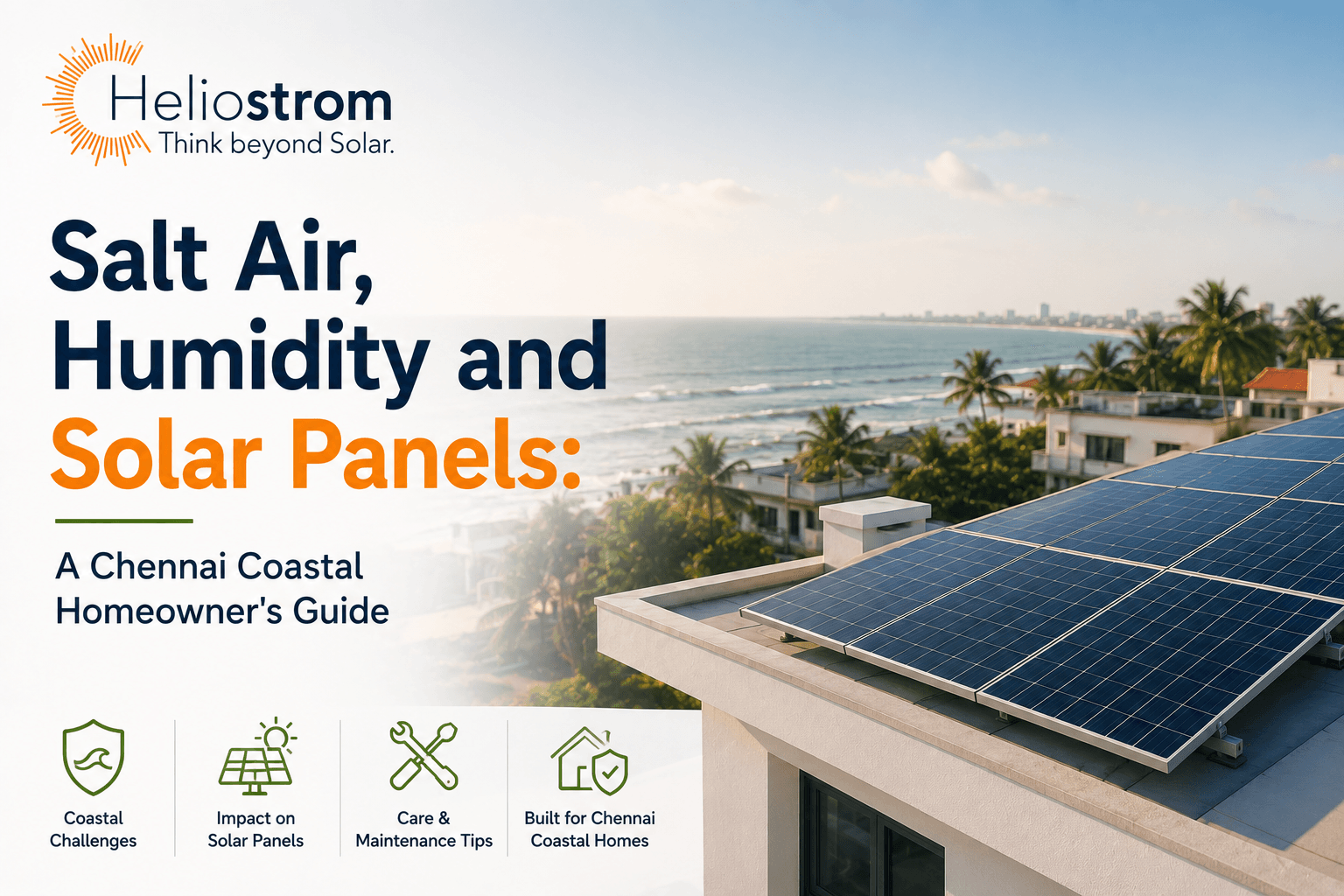
A home in Besant Nagar or along ECR gets the same sunshine as a home in Anna Nagar, but it does not get the same weather on its roof. Salt-laden air, near-constant humidity, and monsoon spray put real stress on a solar system that a generic installation guide rarely accounts for. None of this means coastal Chennai is a bad fit for solar. It means the panels, mounting hardware, and maintenance plan all need to be chosen differently. Anyone considering solar panel installation for their home should ask about corrosion protection specifically when comparing options for a coastal property, since it rarely comes up unless the homeowner raises it first.
Why Chennai's Coastline Is a Different Kind of Solar Environment
Salt, Humidity, and the Chemistry of Corrosion
Airborne salt is not just a nuisance that washes off in the rain. Chloride ions in sea spray settle on metal surfaces and, combined with Chennai's high humidity, accelerate oxidation far faster than a dry inland environment would allow. High humidity effectively acts as a catalyst for this process, keeping surfaces damp long enough for corrosive reactions to take hold rather than drying out between exposures the way they might further from the coast.
How Close to the Coast Is Actually a Risk
Properties very close to the shoreline generally face greater salt-spray exposure, but there is no single distance from the sea that defines a corrosion-risk zone. Actual exposure depends on wind direction, salt deposition patterns, terrain, elevation, surrounding buildings, vegetation, and local microclimate, not distance alone. A practical way to judge this without any special equipment is to look at existing metal fixtures on the property, fence posts, gate hinges, or an outdoor air conditioning unit. Visible rust on these is a reasonably reliable practical indicator that a property sits in an area with meaningful corrosion exposure.
What Salt Air Actually Does to a Solar System Over Time
Pitting and Crevice Corrosion in Panel Frames
Moisture containing salt contaminants can accumulate around joints, interfaces, and other vulnerable areas of a module, such as near the junction box or between the frame and the glass, increasing the potential for corrosion over prolonged exposure. In these oxygen-starved crevices, salt contaminants can attack protective coatings and the base metal underneath more aggressively than on an exposed surface, gradually contributing to pitting that weakens the frame's structure over years of exposure.
Connectors, Junction Boxes, and Mounting Structures Are the Weak Points
The panel glass itself is rarely the first thing to fail near the coast. Connectors, junction boxes, and the metal mounting structure holding everything to the roof tend to show damage first, since these components involve more seams, fasteners, and dissimilar metals in contact with each other, all of which give corrosion more places to start.
The Certification That Actually Matters: IEC 61701
What Salt Mist Testing Involves
IEC 61701:2020 is the relevant international standard for evaluating photovoltaic module resistance to salt-mist corrosion. It defines test sequences and provides guidance on selecting the appropriate test method according to the module's intended operating environment, with panels exposed to controlled salt spray cycles in a testing chamber to simulate years of coastal exposure in a compressed timeframe.
Not Every Tier-One Panel Is Automatically Coastal Rated
Being a well-known, tier-one manufacturer does not automatically mean a specific panel model carries IEC 61701 certification suited to a coastal environment. This is worth confirming directly on the panel's datasheet rather than assuming it, particularly for a property with meaningful salt or humidity exposure.
Choosing the Right Components for a Coastal Chennai Home
Panel Technology and Frame Material
For coastal installations, module selection should focus on documented salt-mist corrosion resistance, module construction, and manufacturer specifications rather than cell technology alone. N-type and TOPCon modules can offer other performance advantages, such as lower degradation over time, but their use does not by itself guarantee superior coastal corrosion resistance. On the frame and hardware side, appropriately specified anodised aluminium, hot-dip galvanised steel, or corrosion-resistant stainless-steel hardware tend to hold up better than generic hardware over a multi-decade installation lifespan, though the actual grade, coating thickness, and compatibility between dissimilar metals all matter.
Mounting Structure Warranties Often Exclude Coastal Zones
Mounting-structure warranty periods and exclusions vary by manufacturer and installer. Coastal exposure may be subject to specific material, corrosion, or geographic exclusions in the fine print, so homeowners should check the warranty terms before installation rather than assuming coverage applies uniformly across environments.
Humidity, Monsoon, and Ongoing System Performance
Monsoon Output Dips but Rarely Wipes Out Annual Savings
Solar panels continue generating electricity through the monsoon, though output can fall substantially during heavily overcast or rainy periods because available solar irradiance is lower. The size of that reduction varies considerably with cloud conditions and the duration of the weather event. Chennai's rainfall pattern is also worth keeping in mind, since the region receives much of its rainfall during the northeast monsoon, roughly October to December, rather than a single uniform monsoon period. Across a full year, this dip tends to matter far less than it initially sounds, since Chennai's clearer, high irradiance months help offset the reduction in total annual output.
Maintenance That Actually Fits Chennai's Coastal Neighborhoods
Cleaning Frequency by Distance From the Coast
In coastal Chennai, cleaning may need to be more frequent than in less exposed inland locations, since salt deposits and airborne dust can accumulate on the module surface. The appropriate interval depends on proximity to the sea, local dust levels, rainfall, roof conditions, and observed soiling, rather than a single fixed schedule applied uniformly across the city. Salt residue left to accumulate for extended periods can both reduce output and contribute to the corrosion building up underneath it.
Why Bore Well Water Needs Extra Care
High-TDS or hard water can leave mineral deposits on the module surface after cleaning. Over time, these deposits can reduce light transmission and make the modules harder to clean, an issue that often goes unnoticed until scaling becomes visible. A simple TDS meter can help confirm whether a property's water source is a concern, and a properly designed cleaning process, which may include a final rinse with lower mineral content water where practical, can help manage this without necessarily requiring RO water in every situation.
Where This Matters Beyond Individual Homes
The consequences of corrosion can become more significant as system size increases, because larger installations contain more modules, connectors, fasteners, and mounting components, which makes component selection and maintenance increasingly important. Facility managers evaluating solar installations across Chennai for factories and warehouses near the coast face the same salt and humidity exposure as a residential rooftop, just across a much larger array where a corrosion-related failure can be proportionally more expensive to fix. The same logic applies to commercial solar systems in Chennai, where office parks and retail spaces along the coastal corridor face similar coastal exposure considerations as a home, scaled up.
Working With the Right Installer and Manufacturer
A coastal installation is not the place to choose an installer purely on upfront price, since the components that actually protect against corrosion, certified panels, appropriately specified hardware, sealed connectors, tend to cost more than generic alternatives for good reason. Understanding the story behind Chennai's solar panel manufacturing can help homeowners ask sharper questions when comparing installers, particularly around where components are sourced and what corrosion testing they have actually passed.
Conclusion
Solar power works well along Chennai's coast, but treating a coastal installation exactly like an inland one is where problems tend to start. Choosing IEC 61701:2020 tested panels, appropriately specified mounting hardware, and a cleaning approach matched to actual local exposure protects the investment across the 25-year performance period commonly associated with modern solar modules. If you want a recommendation suited specifically to your property's exposure and location, speak with our solar experts before finalizing your component choices.
Frequently Asked Questions
Can solar panels be installed safely near the Chennai coastline?
Yes, provided the panels and mounting hardware are specifically selected and tested for coastal exposure. Standard, non-certified components are more likely to corrode prematurely near the coast, so choosing panels tested to IEC 61701 and appropriately specified hardware is a key factor in a durable coastal installation.
What is IEC 61701 certification?
IEC 61701:2020 is the international standard for evaluating how well solar panels resist salt-mist corrosion. Panels are exposed to controlled salt spray cycles in a testing chamber to simulate years of coastal exposure, and the standard provides guidance on selecting the appropriate test method for the module's intended operating environment.
How often should solar panels be cleaned in coastal Chennai?
Coastal homes may need more frequent cleaning than inland properties, since salt deposits and airborne dust can accumulate on the module surface. The appropriate interval depends on proximity to the sea, local dust levels, rainfall, and observed soiling, rather than a single fixed schedule applied to the whole city.
Does using bore well water to clean panels cause problems?
It can. High-TDS or hard bore well water can leave mineral deposits on panels after cleaning, which can reduce light transmission over time and make the modules harder to clean. A properly designed cleaning process using suitable water quality can help manage this.
Do solar panels still work well during Chennai's monsoon season?
Yes. Output can fall substantially during heavily overcast or rainy periods because available solar irradiance is lower, with the size of the reduction varying by cloud conditions and event duration. This generally has a modest effect on total annual output, since Chennai's clearer months help offset the reduction across the full year.
Are mounting structure warranties different for coastal solar installations?
Mounting-structure warranty periods and exclusions vary by manufacturer and installer, and coastal exposure may be subject to specific material, corrosion, or geographic exclusions. Checking these terms before installation, rather than assuming standard coverage applies, helps avoid warranty disputes later.
Planning solar for your home? rooftop solar installation for homes in Chennai or get a free solar quote.


