
Introduction
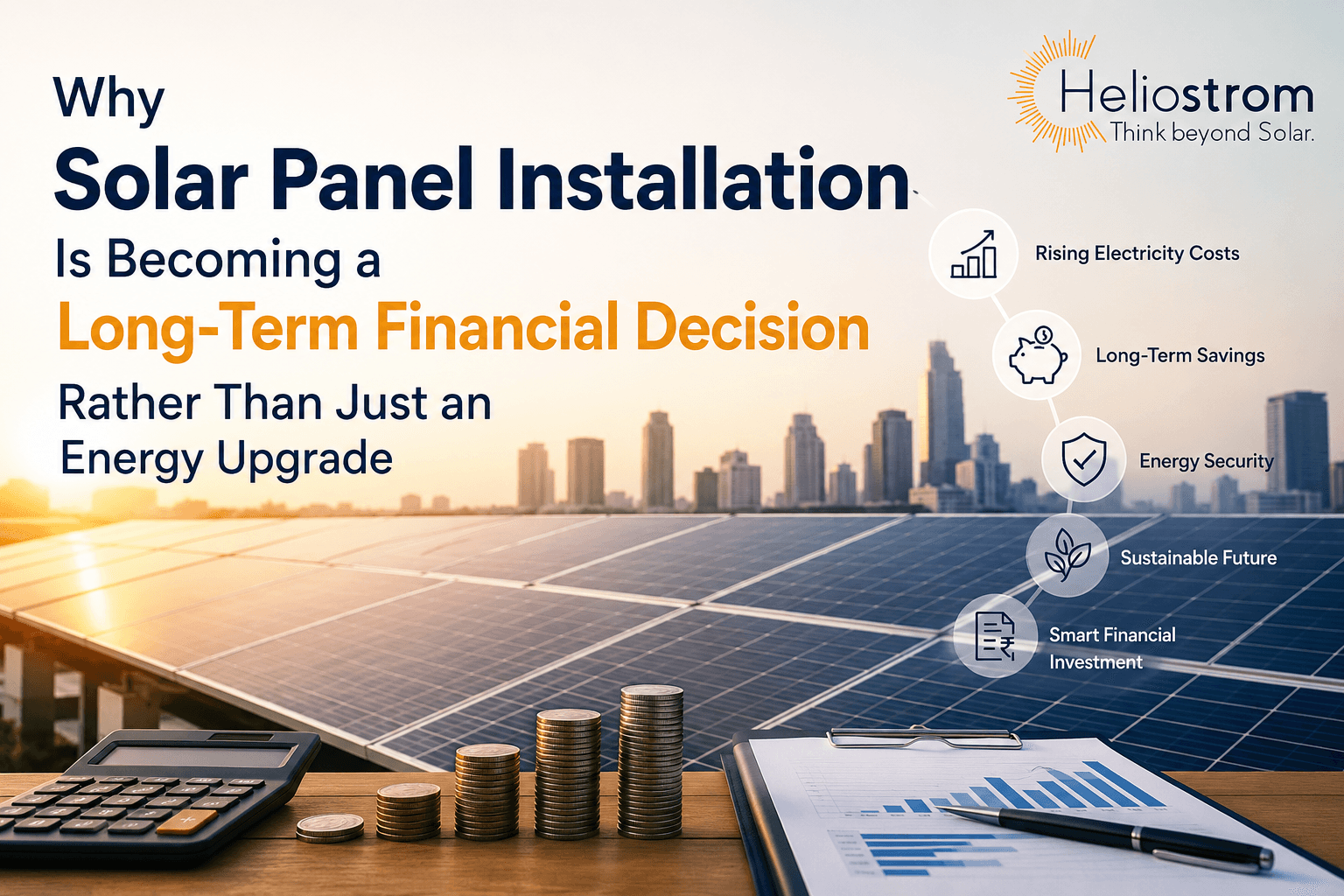
For years, solar was pitched mainly as a way to trim a monthly electricity bill. That framing no longer captures why people actually install it today. Rising electricity prices, more efficient panel technology, stronger performance warranties, and better government incentives have turned Solar Panel Installation into a long-term financial decision rather than a simple energy upgrade.
Homeowners and business owners increasingly think in terms of return on investment, payback period, lifecycle value, and long-term operating cost reduction rather than just this year's savings. Solar has, in effect, joined the same category of decision-making as insulation upgrades, energy-efficient equipment, or facility retrofits, investments evaluated on total value delivered over their useful life. Understanding that shift, and the financial reasoning behind it, helps explain why so many property owners are now evaluating solar the same way they would evaluate any major capital investment.
Why Solar Is No Longer Just About Lower Electricity Bills
Electricity costs have been rising steadily in most regions, and future pricing carries real uncertainty tied to fuel costs, infrastructure spending, and growing demand. A household or business that depends entirely on grid electricity has little control over how much it will pay five or ten years from now, which makes long-term budgeting harder than it needs to be.
A solar energy system changes that equation. Rather than functioning as a discretionary purchase, it behaves more like infrastructure, a fixed asset that generates a portion of your electricity needs at a largely predictable cost for decades. This shift toward long-term financial thinking is what separates today's buyers from those of a decade ago, who often viewed solar primarily as an environmental statement.
Operational cost stability matters especially for businesses. A manufacturing unit or retail facility that locks in part of its electricity cost through a photovoltaic system gains a measure of protection against tariff volatility, which supports more reliable budgeting across multi-year financial plans. Energy independence, in this sense, is not just a sustainability talking point, it is a financial advantage that shows up directly in operating margins.
The Financial Factors Homeowners and Businesses Are Evaluating
Buyers today look well beyond the upfront installation cost. Several factors typically shape the decision.
Return on investment measures the overall financial gain relative to what was spent. Payback period estimates how long it takes for cumulative savings to equal the initial investment. Lifetime savings account for electricity generated over the system's full operational life, not just the first few years.
Other considerations include the effective cost of electricity generation compared to grid tariffs, predictable operating expenses once the system is running, and total cost of ownership, which factors in maintenance and component replacement where relevant. Equipment lifespan also matters, since a system built with durable components continues delivering value long after payback.
Evaluating these factors together, rather than focusing on installation price alone, gives a far more accurate picture of long-term value.
Understanding the True Lifetime Value of a Solar System
Most quality solar panels are designed to perform for twenty-five years or longer, typically backed by manufacturer performance warranties that guarantee a minimum output level over that period.
This extended lifespan is central to understanding solar economics. In the early years, savings gradually offset the initial investment. Once payback is reached, the system continues generating electricity value for many more years at a relatively low ongoing cost, and this extended stretch is where the bulk of the cumulative financial benefit accumulates.
There is also a defensive value worth noting. A system installed today reduces dependency on whatever tariff increases occur over the next two decades, effectively locking in a portion of future electricity costs at today's investment level.
The Role of Electricity Price Inflation in Solar Economics
Electricity tariffs change for several interconnected reasons: fuel costs, infrastructure investment by utilities, regulatory adjustments, general inflation, and rising energy demand as populations and industries grow.
Because these pressures tend to push tariffs upward over time rather than downward, the cost of relying entirely on grid electricity tends to increase gradually year after year. A simple way to think about it: if your current tariff rises even modestly each year, the cumulative cost of doing nothing compounds over a twenty-five-year horizon.
Solar does not eliminate this uncertainty entirely, since consumption and export arrangements still matter, but it creates a more predictable long-term energy cost structure by generating a portion of your electricity at a fixed investment cost rather than a rising per-unit rate.
Government Policies and Incentives That Influence Investment Decisions
Government support has played a meaningful role in shifting solar toward a stronger financial proposition. This can include residential subsidy schemes, net metering arrangements that credit exported electricity, state-level renewable energy initiatives, and commercial tax benefits where applicable.
These policies directly affect payback timelines and overall returns, but they also evolve over time. Eligibility criteria, subsidy amounts, and net metering terms can change based on regional regulations and utility policy. Readers should verify current guidelines with their local electricity board or a qualified solar provider before finalizing any investment decision, rather than relying on older figures that may no longer apply.
Key Factors That Determine Whether Solar Delivers Strong Financial Returns
Two systems of similar size can produce very different financial outcomes depending on several variables.
Electricity consumption pattern determines how much generated power is used directly versus exported. Roof orientation and shading affect how much usable sunlight the system captures across the year. Proper system sizing avoids both underperformance and unnecessary oversizing, either of which weakens returns.
Quality of components and installation quality influence how reliably the system performs over its lifetime, while a professional site assessment, covering structural condition, electrical infrastructure, and shading analysis, ensures the design actually matches your property rather than a generic template. Routine maintenance, though modest for most systems, helps sustain generation efficiency over the years. Anyone comparing residential solar systems should ask how each factor was specifically assessed for their site, rather than accepting a generic proposal built on assumptions.
Common Financial Mistakes People Make Before Installing Solar
Several recurring mistakes reduce the financial value buyers actually receive.
Choosing solely based on the lowest price often means overlooking reduced component quality or incomplete scope of work. Ignoring future electricity demand, such as plans for electric vehicle charging or business expansion, can lead to a system that is undersized within a few years.
Thinking only about first-year savings, rather than lifetime value, gives an incomplete picture of the investment and can lead buyers to undervalue a slightly more expensive but better-engineered system. Not comparing lifecycle costs across providers makes it difficult to judge true value, since a slightly higher upfront quote may include better components and workmanship. Underestimating quality differences between panels, inverters, and installation practices is one of the most common reasons a system underperforms its projected savings, even when the projected numbers on paper looked similar to a competing proposal.
Careful home solar planning before signing a contract helps avoid each of these pitfalls and protects the long-term return on the investment.
Conclusion
Solar panel installation has moved well beyond being a simple energy-saving upgrade. Rising electricity costs, longer equipment lifespans, evolving government incentives, and a clearer understanding of lifecycle value have turned it into a genuine long-term financial decision. Buyers who evaluate ROI, payback period, and total cost of ownership, rather than focusing only on the initial price, are far better positioned to secure strong long-term returns.
If you are considering solar for your home or business, contact our solar experts to get a site-specific assessment before making your decision.
Frequently Asked Questions
Is solar panel installation really a financial investment, not just an energy decision?
Yes. While it does reduce electricity consumption from the grid, most buyers today evaluate solar based on payback period, lifetime savings, and return on investment, which places it firmly in the category of a long-term financial decision.
How long does it usually take to see a return on a solar investment?
Payback periods vary depending on system size, local electricity tariffs, consumption patterns, and available incentives. An accurate estimate requires a site-specific assessment rather than a general figure.
Do government incentives significantly affect the financial return of solar?
They can, particularly through subsidies and net metering arrangements that improve payback timelines. Since these policies change over time, it is important to verify current guidelines before finalizing an investment.
Planning solar for your home? rooftop solar installation for homes in Chennai or get a free solar quote.


