
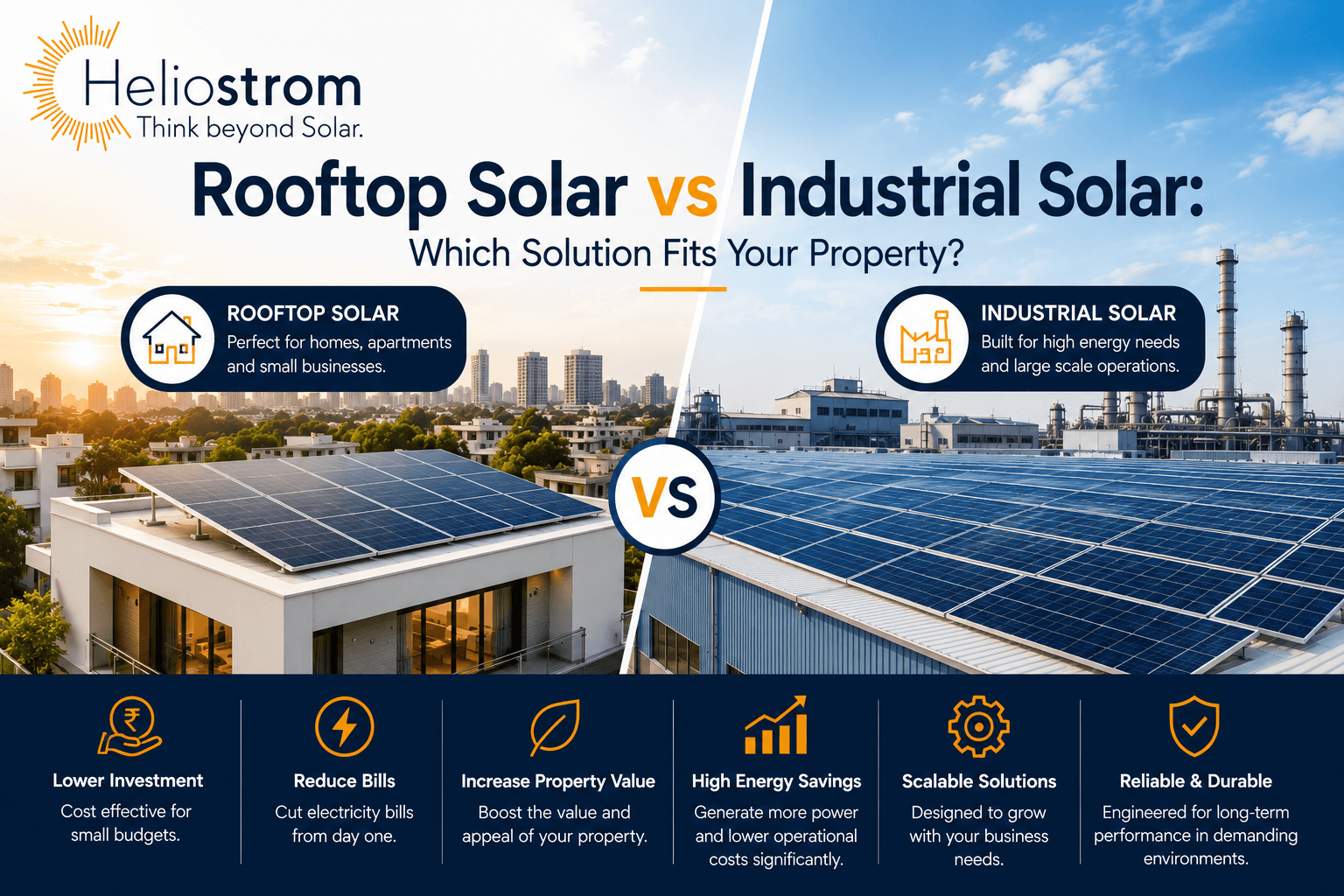
The term solar power covers two very different products. One sits on the roof of a house and quietly shaves an electricity bill. The other spreads across a factory rooftop or an adjacent field and behaves like a private power station. They are not two sizes of the same thing. They are two solutions with different economics, approval processes, connection types, and ownership models. Choosing wrongly between them wastes money in one direction or leaves savings on the table in the other.
The right choice is rarely about ambition and almost always about fit: what your property is, how much power it draws and how that power is billed. Before you weigh options among solar companies in Tamil Nadu, it helps to understand which of these two categories you’re building actually belongs to, because the answer reshapes every decision that follows.
What Rooftop Solar Actually Means
Rooftop solar describes systems mounted on the roof of a building and connected to the same low-tension supply that serves the premises. This is the familiar category for homes, small offices, shops and modest commercial establishments. Capacity typically ranges from a couple of kilowatts on a house to a few tens of kilowatts on a larger building. The defining trait is that generation is consumed by the same premises it sits on, with any surplus fed back through a net metering arrangement.
For most residential buyers, this is the entire conversation. A solar panel installation in Chennai home offsets daytime generation against evening consumption on the bill, qualifies for the residential subsidy, and connects with relatively straightforward approvals. The scale is manageable, the paperwork is straightforward, and the payback is measured against a household electricity bill.
What Industrial Solar Actually Means
Industrial solar operates at an entirely different scale and connects to the grid differently. These solar power plants in Chennai serve manufacturing units, large warehouses, cold storage facilities and energy intensive operations, often drawing power on high tension supply where demand charges form a large part of the bill. Capacity runs into hundreds of kilowatts or megawatts, and the array may extend beyond the roof onto the ground or into carport structures when roof area cannot meet the load.
At this scale the system stops being an appliance and becomes infrastructure. It is engineered against a continuous load, monitored section-by-section, and evaluated on financial metrics that a homeowner would never use. The purpose is not merely a lower bill but a structural reduction in the single largest controllable cost of running the operation. Where a household treats solar as a saving, an industrial owner treats it as a hedge against future tariff increases and a source of predictability that steadies long-term planning.
The Differences That Actually Decide the Fit
Available space and where the panels go
A home is constrained by terrace area, and a modern 3 kW system fits comfortably on 200 to 250 square feet. Industrial loads routinely exceed what any single roof can supply, which is why ground-mounted arrays, carports and open access arrangements enter the picture. If your load is large and your roof is small, the solution is not a bigger rooftop system but a different category of project altogether. Space is often the first indication of which side of the line a property falls on.
Connection type and billing structure
This is the most decisive difference and the one buyer overlook. Low tension consumers, typically homes and small businesses, are generally offered net metering, where exported units offset imported units on the bill. High tension consumers, typical of industry, frequently fall under net billing or net feed-in arrangements with demand charges that a rooftop household never encounters. Your connection type is not a detail. It fundamentally changes how solar saves you money and therefore which solution makes sense.
How the economics are judged
A homeowner asks a simple question: how many years until it pays for itself. An industrial buyer asks several harder ones about internal rate of return, levelised cost of energy and reduction in contracted demand. The residential case leans on the PM Surya Ghar subsidy, which pays up to Rs 78,000 for a home system but nothing to a business. The industrial case leans instead on accelerated depreciation under Section 32 of the Income Tax Act, which lets a business write down forty percent of the asset value in the first year. Same technology, entirely different financial language.
Where Commercial Solar Sits Between the Two
Many properties fall between the clean extremes of a house and a factory. A showroom, a hospital, a school or an office block consumes far more than a home but connects and operates differently from heavy industry. This middle ground is where commercial solar establishments live, and it borrows from both categories. Such buildings often use rooftop arrays like a home but at a larger scale, consume most of their generation during working hours like industry, and are judged on both payback and self-consumption. Recognising that your property sits in this middle band is itself useful, because it tells you to expect a hybrid of the two approaches rather than a pure version of either.
A Simple Way to Place Your Property
You can usually locate your property with a few honest answers. Ask what your connection type is, how large your daytime load runs, whether your roof can hold enough capacity to matter, and how your bill is structured. The pattern that emerges points clearly to one category or the other.
- Low tension connection, modest bill, roof large enough for your needs: rooftop solar
- High tension connection, large continuous load, roof too small for the requirement: industrial solar
- Large daytime commercial load on a sizeable roof: commercial rooftop, borrowing from both
- Subsidy eligibility present: residential rooftop; depreciation benefit relevant: commercial or industrial
- Backup during outages critical to operations: consider hybrid architecture in either category
Backup, Reliability and the Question of Storage
The two categories also differ in what they need when the grid fails, and this quietly shapes the design. A home can usually tolerate an outage, so most residential rooftop systems are grid-tied and simply shut down safely when supply is lost, keeping cost low. An industrial operation often cannot afford the same interruption, because a stalled production line or a warming cold store carries a cost far larger than the electricity itself. That difference in tolerance decides whether a battery or a hybrid architecture is worth its considerable expense. For a home it is usually optional and added only where backup is genuinely valued. For an industrial site it may be essential, and it belongs in the plan from the very beginning rather than as an afterthought once the system is running.
Why This Choice Is Worth Getting Right
The cost of misplacing your property is real. Size a home-style system onto a factory and you cover a fraction of the load while leaving the largest savings untouched. Approach a modest home as if it were an industrial project and you overspend on engineering the building never needed. The categories exist because the challenges are genuinely different, and the financial returns depend on matching the right solution to the right property. A property owner who understands which category they belong to walks into every quotation conversation already asking the right questions.
Frequently Asked Questions
Is industrial solar just a bigger rooftop system?
No. Beyond size, it usually involves a high-tension connection, demand charges, section-by-section monitoring and often ground mounted or open access components. The engineering and the financial evaluation are different disciplines, not scaled versions of a home system.
Can a factory use rooftop solar?
It can use its roof, but a large industrial load often exceeds what the roof alone can supply. In that case the rooftop is one part of a larger project that may include ground mounted arrays or open access power wheeled from another site.
Which solution has a better return?
Neither is universally better. Residential systems benefit from subsidy and net metering, while industrial and commercial systems benefit from high daytime consumption and depreciation. The stronger return depends entirely on your property, load and connection type.
How do I know if my property is commercial rather than industrial?
Look at your connection and load. Offices, schools, hospitals and retail premises with large daytime consumption but no heavy machinery usually fit the commercial band, borrowing rooftop methods at a larger scale rather than full industrial engineering.
Does the government subsidy apply to industrial solar?
No. The PM Surya Ghar subsidy applies only to residential rooftop systems. Businesses and industrial units rely instead on accelerated depreciation and, in some cases, state open access provisions.
What is open access solar?
It is an arrangement where power is generated at a separate site and delivered to a consumer through the grid, useful when a property's roof cannot meet a large load. It carries additional regulatory and commercial requirements beyond a rooftop installation.
Can my property grow from rooftop to industrial scale later?
Loads can grow, and a system can be designed with expansion in mind. But moving from a low-tension rooftop setup to a high tension industrial one is a significant change in connection and engineering, best planned rather than improvised.
Choosing between rooftop and industrial solar is about correctly reading your own property before anyone quotes you a system. If you would like help placing your building in the right category based on your load and connection, contact us and share your consumption details to get a clear recommendation.
Running the numbers for your business? commercial solar installation in Chennai or request a solar quote.


