
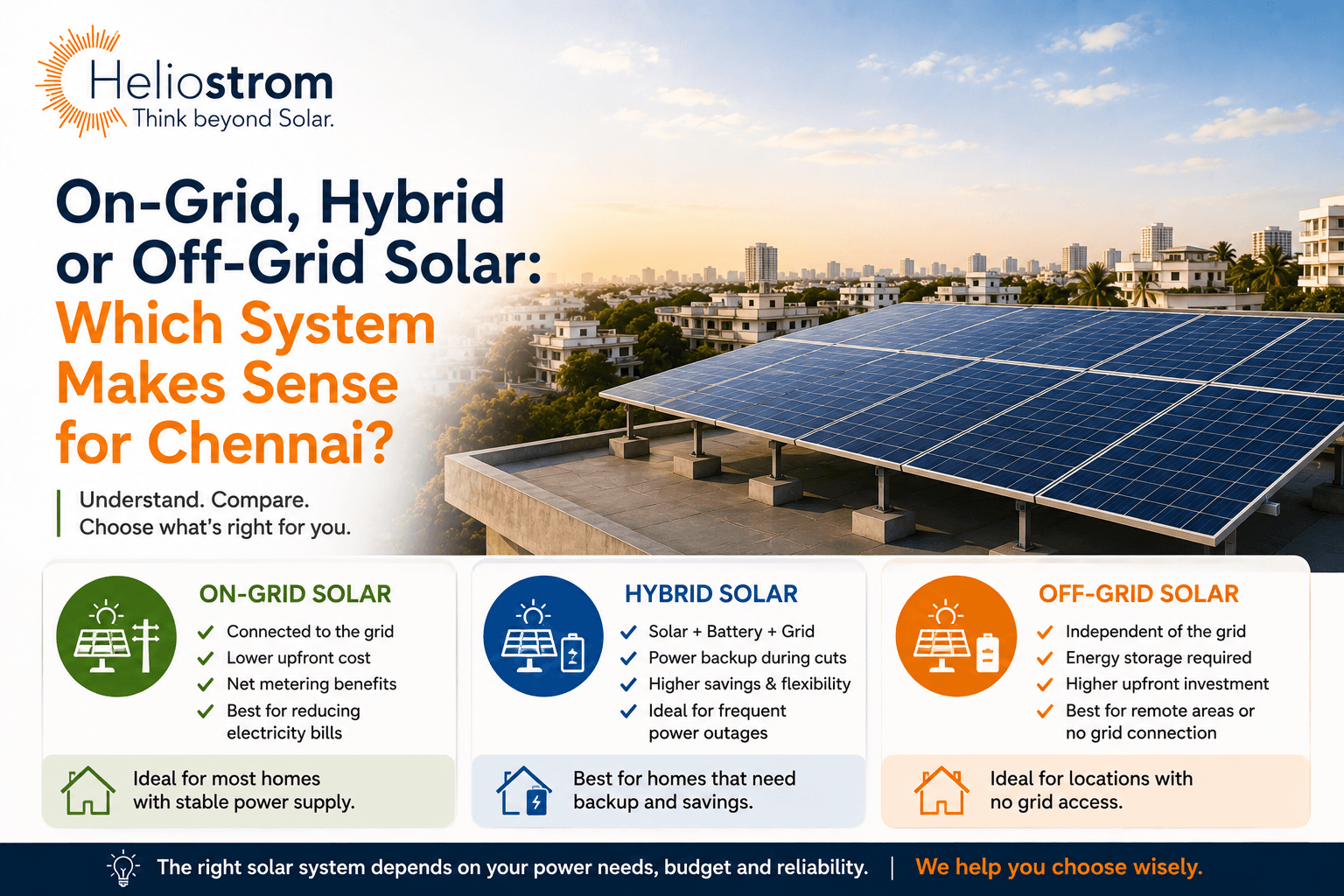
Chennai gets abundant sunlight and, for most localities, a reasonably stable grid connection, which makes the on-grid, hybrid, or off-grid decision less obvious than it might first appear. The right choice depends less on solar potential, since nearly every rooftop in the city has enough of that, and more on how often power outages occur in your specific area, your financial objective, and how much backup genuinely matters to your household or business. Each configuration trades cost against capability differently, and picking the wrong one usually shows up as either overspending on backup capacity you may rarely use or a system that leaves you without power at the exact moment you needed it most. Getting this decision right before committing to any rooftop solar installation for Chennai homes affects returns and reliability for the next two decades, which is exactly why it deserves more thought than picking whichever system a salesperson mentions first.
The Three System Types, Explained Simply
On-Grid Solar Works With the Grid, Not Instead of It
An on-grid system connects to Tamil Nadu's electricity distribution utility, TNPDCL (formerly TANGEDCO), and, under the state's current net feed-in arrangement for applicable new rooftop installations, allows surplus electricity exported to the grid to be credited according to the tariff and billing rules set by the regulator. There is no battery involved, which keeps the upfront cost lower and the system simpler to maintain, but it also means the system cannot power your home or business during a grid outage, since grid-tied inverters are required to shut down automatically for safety whenever the grid goes down. This safety mechanism, known as anti-islanding protection, prevents the solar system from continuing to energize the grid during an outage, protecting utility workers and equipment while the network is being repaired.
Off-Grid Solar Means Complete Independence From TNPDCL
An off-grid system operates entirely independently of the grid. Solar generation supplies loads directly when available, while excess generation charges the batteries for periods when solar production is insufficient or unavailable. This delivers genuine independence from TNPDCL and its billing entirely, but it also means sizing the battery bank and panel array to cover every bit of consumption yourself, without the grid available as a fallback during a cloudy stretch or an unusually high-demand day.
Hybrid Solar Combines Both Approaches
A hybrid system connects to the grid for net metering or net feed-in benefits while also including battery storage for backup during outages. A hybrid inverter can manage solar generation, battery storage, and grid power according to its configured operating modes, including providing backup power during a grid outage when the system is designed for backup operation, which means you get bill savings during normal operation and continued power during a cut, without needing to size the system for total, standalone self-sufficiency the way a true off-grid setup requires.
How Rooftop Solar Billing Works in Tamil Nadu
For rooftop solar applications registered on or after 25 March 2019, Tamil Nadu's current framework generally operates as a net feed-in arrangement rather than the older net metering model that applied to earlier registrations. Under this arrangement, energy settlement is typically done monthly, with self-consumption accounted for first, while excess energy exported to the grid is credited at a tariff fixed by the regulatory commission. Remaining monetary credit can generally be carried forward to subsequent billing periods. At the end of the applicable settlement period, any remaining surplus is settled according to the prevailing Tamil Nadu regulatory and billing framework. This makes it important to size the system around actual consumption rather than assuming that exporting large amounts of excess electricity will always provide the same value as directly offsetting your own consumption.
Matching the System to Your Actual Situation
If Your Area Rarely Loses Power
If your property experiences relatively few and short outages, an on-grid system is generally well suited to your situation. The lower upfront cost and simpler maintenance profile make sense when outages are infrequent enough that losing solar power during the rare cut is a minor inconvenience rather than a genuine problem.
If Outages Are a Regular Part of Life
Areas that see more frequent or longer outages benefit far more from a hybrid configuration, since the battery backup addresses the exact limitation that makes pure on-grid systems frustrating in these conditions. The added cost of batteries is the tradeoff, but for a household or business that genuinely cannot tolerate downtime, that tradeoff is usually worth making.
If You Need Complete Independence From the Grid
Off-grid systems make the most sense for remote sites with no practical grid access at all, or for specific loads where any dependency on TNPDCL is unacceptable regardless of cost. For most urban Chennai properties with an existing grid connection, a hybrid system can provide backup without requiring the larger battery and generation capacity that a fully off-grid system may need, since it still leans on the grid when it is available rather than requiring the battery bank to cover every possible scenario alone.
Considerations Specific to Businesses and Larger Properties
Why Commercial Loads Change the Calculation
Businesses evaluating commercial solar solutions in Chennai often have higher daytime consumption than residential properties, which changes the on-grid versus hybrid calculation meaningfully. A business running significant equipment or cooling load during business hours may find that on-grid savings alone justify the investment, while a business that cannot tolerate any downtime, such as one running sensitive equipment or continuous operations, usually needs the backup a hybrid system provides regardless of the additional cost. Retail spaces and offices with predictable daytime hours tend to align naturally with on-grid economics, while businesses like data centres, cold storage, or continuous manufacturing lines usually justify hybrid backup even at a higher upfront cost.
Industrial Sites With High and Continuous Loads
Larger industrial solar power plant installations often benefit from a more detailed load analysis before choosing a system type, since production downtime during an outage can cost far more than the price difference between on-grid and hybrid configurations. For these sites, the decision usually comes down to a direct cost comparison between the price of battery backup and the actual cost of downtime during a typical outage.
What to Check Before Choosing a System
Confirm Your Area's Actual Outage Frequency
Rather than relying on a general impression of how reliable the grid feels, tracking actual outage frequency and duration over a few months gives a far more accurate basis for choosing between on-grid and hybrid than intuition alone. A neighborhood that feels unreliable during monsoon season but is otherwise stable most of the year may not need the same level of backup as one with year-round outages.
Component Quality Matters More With Batteries Involved
A hybrid or off-grid system depends on battery performance holding up over years of daily charge and discharge cycles, which makes component sourcing more important than it is for a simple on-grid setup. Understanding how solar technology and component quality have evolved can help when comparing vendors, a subject covered in more detail on Heliostrom's page on solar technology. Battery quality, thermal management, warranty terms, and cycle life become particularly important in systems that rely on stored energy for backup.
For hybrid and off-grid systems, battery chemistry, usable capacity, cycle life, thermal conditions, warranty coverage, and replacement cost should be evaluated alongside the initial system price. Lithium iron phosphate, commonly abbreviated as LFP, batteries are widely used in modern energy storage applications because of their combination of safety, cycle life, and thermal stability, which makes chemistry a reasonable starting question when comparing battery options between vendors.
Frequently Asked Questions
Can an on-grid system be upgraded to hybrid later by adding a battery?
In many cases yes, particularly if a hybrid-capable inverter was installed from the start even without a battery connected initially. Confirming inverter compatibility with your installer before choosing an on-grid system keeps this upgrade path open if your needs change later.
Does a hybrid system eliminate the electricity bill completely?
Not necessarily. A hybrid system reduces reliance on grid electricity and provides backup during outages, but whether it eliminates the bill entirely depends on system size relative to consumption, battery capacity, and usage patterns, rather than being an automatic outcome of choosing hybrid over on-grid.
Is off-grid solar realistic for a typical home within Chennai city limits?
It is technically possible but rarely the most practical choice for a home with existing grid access, since it requires a larger battery bank and panel array to cover consumption entirely, at meaningfully higher cost than a hybrid system that can still lean on the grid when needed.
How long does installation typically take for a home in Chennai?
The physical installation of a typical residential rooftop system may take around one to two days, but the overall process, including site survey, approvals, installation, inspection where applicable, and TNPDCL approval and metering work, can take considerably longer. A straightforward residential solar panel setup without battery storage generally moves through this process faster than a hybrid installation, which involves additional equipment and configuration.
Conclusion
There is no universally correct answer between on-grid, hybrid, and off-grid solar, only the answer that fits your specific outage patterns, budget, and tolerance for downtime. On-grid remains the simplest and most cost-effective choice where the grid is genuinely reliable, hybrid earns its extra cost wherever outages are a regular disruption, and off-grid stays reserved for situations where grid independence is the actual goal rather than simply a nice-to-have. If you are still weighing which system fits your property, get in touch with our solar experts for a proper site assessment before making the decision.
Thinking about your own installation? rooftop solar installation for homes in Chennai or book a free site survey.


