
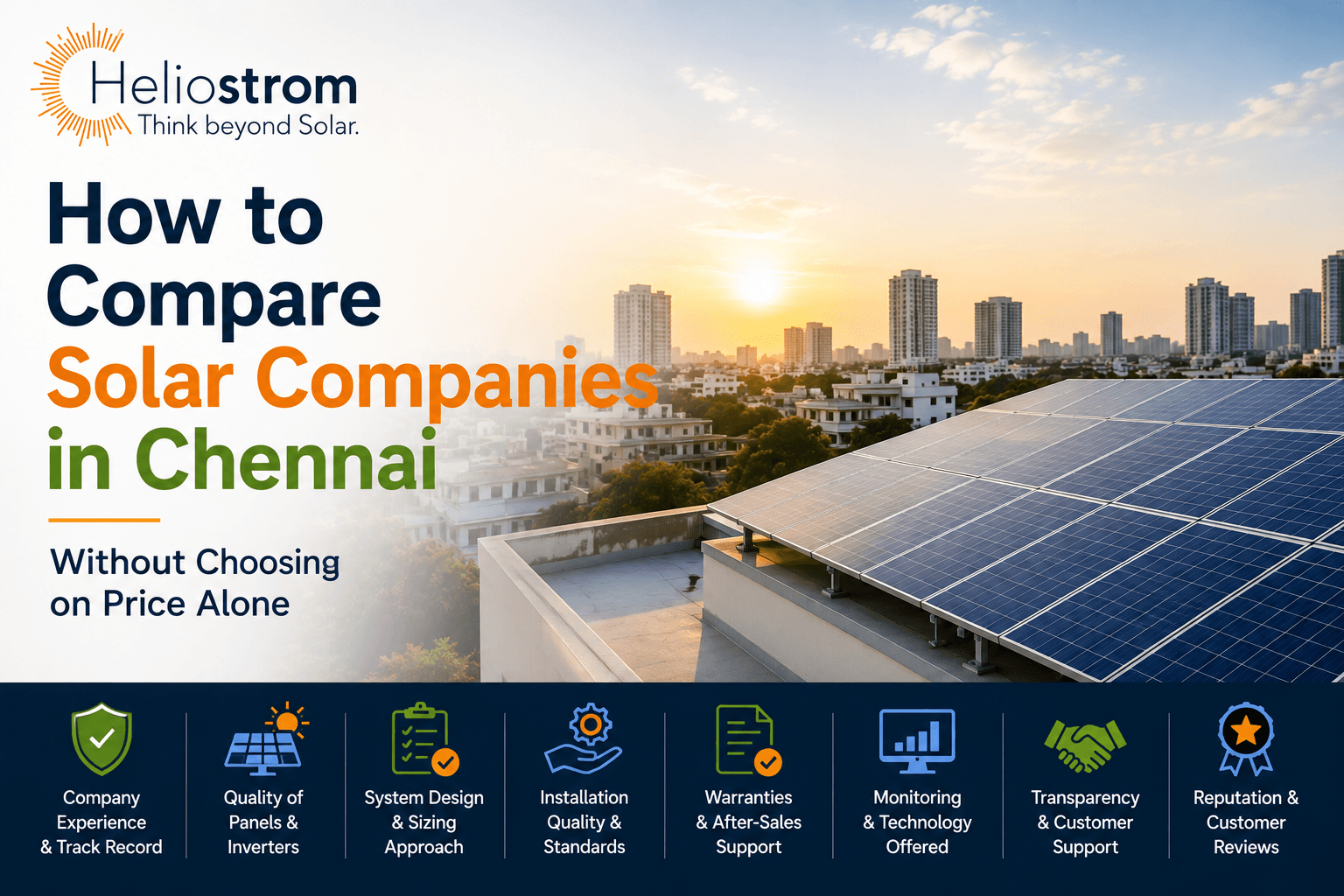
Chennai's rooftop solar market has grown rapidly over the last two years, and with that growth has come a flood of quotations, cold calls, and discount offers that all sound similar on paper. Once a homeowner starts requesting quotes from a few solar companies in Chennai, the temptation is to line up the numbers side by side and pick whichever one looks cheapest. That approach feels rational, but it often backfires within a few years, once panel output drops faster than expected or a service request goes unanswered. Price is one input in a much larger decision, and this guide walks through the other factors that actually determine whether a solar investment pays off or turns into a source of regret.
Why Price Alone Can Be a Misleading Filter
A low quotation usually means something was trimmed to reach that number. It could be a thinner gauge of DC cabling, a panel brand with a shorter track record, a mounting structure rated for less wind load than Chennai's coastal weather demands, or a labour team that subcontracts the actual fitting work. None of these shortcuts show up on the invoice, but they show up later as lower generation, rusted frames, or leaks around roof penetrations. Two quotes for the same 3 kW system can differ by tens of thousands of rupees, and the gap almost always traces back to what is included: the type of mounting structure, the inverter's build quality, the length of on-site supervision, and whether net metering paperwork is handled in-house or outsourced. Comparing only the bottom-line figure hides all of this.
A more useful comparison starts with matching specifications first, and price second. Once every vendor is quoting for the same panel wattage, the same inverter class, and the same scope of civil work, the price difference becomes meaningful instead of misleading.
Start with Installer Credentials and Track Record
MNRE Empanelment, TEDA Registration and TANGEDCO Approval
Any installer working on a subsidised residential system in Tamil Nadu needs to be empanelled with the Ministry of New and Renewable Energy and registered to work with TANGEDCO, the state distribution utility that handles feasibility approval, net meter installation, and grid connection. Applications for the central subsidy are registered on the national PM Surya Ghar portal, while TANGEDCO's own Unified Solar Rooftop Portal is used for net metering registration, though the feasibility check, site inspection, and final document verification are still carried out by the local TANGEDCO section or division office, so some physical follow-up should be expected even after the online steps are complete. Ask for the installer's empanelment certificate directly rather than taking a sales pitch at face value, and confirm they are also registered with TEDA (Tamil Nadu Energy Development Agency), since this is required for coordinating state-level incentives and smooth processing through TANGEDCO. A vendor who is not on the MNRE list cannot process the central government subsidy under the PM Surya Ghar Muft Bijli Yojana on your behalf, and that alone can delay or void a claim worth up to ₹78,000 for an eligible residential rooftop system. Tamil Nadu's 2026 state budget also introduced an additional rooftop solar incentive on top of this central amount, so it is worth asking your installer to confirm the current combined subsidy figure before you finalise a quote.
Years in Business and Project Portfolio
Solar equipment carries long warranty periods, often 25 years on panel performance and 5 to 10 years on inverters, so the company backing that warranty needs to still exist when a claim comes up. A firm that has been operating in Chennai for several years, with a visible history of residential and commercial projects across different neighbourhoods, is a safer bet than one that appeared only recently to chase subsidy-driven demand. Ask how many systems the company has commissioned locally, not nationally, since installation quality depends heavily on familiarity with local roof types, monsoon drainage patterns, and TANGEDCO's regional processes.
Evaluate the Quality of Components, Not Just the Quote
Solar Panel Brands and Efficiency Ratings
Panel brand and cell technology affect how much electricity a system produces over its lifetime. Mono PERC and the newer TOPCon panels generally offer better efficiency and stronger performance in high-temperature conditions, which matters in a city like Chennai where roof surfaces routinely run hot for much of the year. Ask each vendor which brand they are quoting, whether it is Tier 1-listed, and what the manufacturer's own performance warranty states. A cheaper, unfamiliar brand might still be reliable, but the burden is on the installer to prove it, not on the homeowner to assume it.
Inverter Technology and Warranty Terms
The inverter converts the direct current generated by the panels into usable alternating current, and it tends to be the component that fails first in a poorly specified system. String inverters are common for home-sized systems, while larger installations sometimes use microinverters or optimisers to reduce the impact of partial shading from nearby buildings or trees. Confirm the inverter's warranty period, whether it covers on-site replacement or only part replacement, and how quickly the company typically responds to inverter faults, since a downed inverter means zero generation until it is fixed.
Understand the Full Scope of Solar Panel Installation in Chennai
The quality of solar panel installation in Chennai depends on more than the equipment itself. Chennai receives roughly 5.3 peak sun hours a day on average, which is a strong solar resource, but only if the system is designed and installed correctly for the specific roof, shading pattern, and sanctioned electrical load of the home.
Site Survey and Load Assessment
A proper installer visits the property before quoting, checks the roof orientation and the available shadow-free area, reviews recent electricity bills to understand actual consumption, and calculates the sanctioned load against the transformer capacity in that locality. Companies that skip this step and quote based purely on a phone conversation are more likely to undersize or oversize the system, either wasting the subsidy ceiling or leaving the homeowner with a system that cannot fully offset their bill.
Net Metering and TANGEDCO Approval Process
Once the physical installation is complete, TANGEDCO still needs to conduct a technical inspection, install the bidirectional smart meter, and commission the connection before the system is officially live and the subsidy is released. This stage is where most delays happen, usually due to a mismatch between the consumer number on file and the one printed on the electricity bill, a single-line diagram that does not match TANGEDCO's format, or a vendor who is slow to follow up with the local section office once the online application has been submitted. Ask upfront whether the company manages this entire process for you, including the national PM Surya Ghar registration, the TANGEDCO portal submission, and any physical document follow-up at the section office, or whether that responsibility falls back on the homeowner.
Look Beyond the Upfront Cost: After-Sales Service and Warranty
A rooftop solar system is a two-decade commitment, and the value of a company often becomes most apparent in the third or fourth year, once the novelty has worn off and something inevitably needs attention, whether that is panel cleaning, a loose connector, or a monitoring app that stops updating. Before signing anything, find out:
- Whether annual maintenance or a service contract is included, and for how long
- The average response time for a service request in Chennai specifically
- Whether the company owns a local service team or routes requests through a third party
- What the generation or performance guarantee actually covers, in writing
A company that offers a marginally lower price but no local service presence can end up costing far more in lost generation and repeated follow-ups than one that charges slightly more but resolves issues within a day or two.
Check Reviews, References and Real Customer Experiences
Online ratings are a starting point, not the final word. Look for reviews that mention specific details, such as how quickly a fault was resolved, how the team handled the TANGEDCO approval, or how the system has performed across a full summer and monsoon cycle, rather than generic five-star comments posted right after installation. Where possible, ask the company for two or three references of customers who installed a similar-sized system at least a year ago, and actually call them. A short conversation about real generation numbers versus what was promised tells you more than any brochure.
How to Shortlist From the Top 10 Solar Companies in Chennai
Most homeowners eventually search for a list of the top 10 solar companies in Chennai to build a starting shortlist, which is a reasonable first step, but the ranking on any single list should not be the deciding factor. Use such a list to identify five or six companies, then apply the criteria covered above: empanelment status, component brands, installation process, and after-sales support. Narrow the list to two or three companies that match on specifications, and only then compare their pricing. At that point, a price difference actually tells you something useful, because you are comparing similar scopes of work rather than apples to oranges.
Questions to Ask Before Signing a Contract
A short list of direct questions can save months of frustration later:
- Is the quoted price inclusive of structural work, wiring, and net metering charges, or are these extra?
- What panel wattage, brand, and inverter model are being proposed, and can this be written into the contract?
- Who manages the PM Surya Ghar subsidy application and TANGEDCO net metering approval, and what is the expected timeline?
- What happens if the system underperforms the promised generation figure in its first year?
- Is the installation team in-house staff or a subcontracted crew, and who is accountable if something goes wrong?
Getting written answers to these questions, rather than verbal assurances, is what separates a well-informed buyer from one who finds out the hard way that a promise was never documented.
Final Thoughts: Making a Value-Based Decision
Choosing a solar provider in Chennai on price alone treats a 20-year investment like a one-time purchase, when in reality the ongoing relationship, from subsidy processing to after-sales support, is what determines the actual return. A slightly higher quote from a company with proper credentials, quality components, and a responsive local team will usually outperform the cheapest bid over the system's lifetime, both in electricity savings and in peace of mind.
If you are comparing options and want a clear, itemised quote with no vague inclusions, our team can walk you through the process step by step. Contact us to speak with a solar panel expert about your roof, your electricity usage, and what a fair, transparent quote should actually look like for your home.
Thinking about your own installation? rooftop solar installation for homes in Chennai or book a free site survey.


