
1. Introduction
Every month, thousands of Tamil Nadu households stare at an electricity bill they cannot fully explain. The numbers go up, the slabs shift, and the confusion around searches for a Tamil Nadu EB calculator increase. If you have ever wondered how TANGEDCO arrives at your total, why your bill jumped when you added an air conditioner, or whether there is a smarter path forward, this guide is written for you. You can also explore solar panel installation for your home as one of the most effective ways to take control of your electricity costs permanently.
Tamil Nadu electricity billing is built on a slab system. That sounds simple enough until you realise that the rate you pay on your first 100 units is completely different from what you pay on your 501st unit. Add fixed charges, fuel cost adjustments, and peak-hour surcharges on commercial connections, and a single bill becomes a financial puzzle.
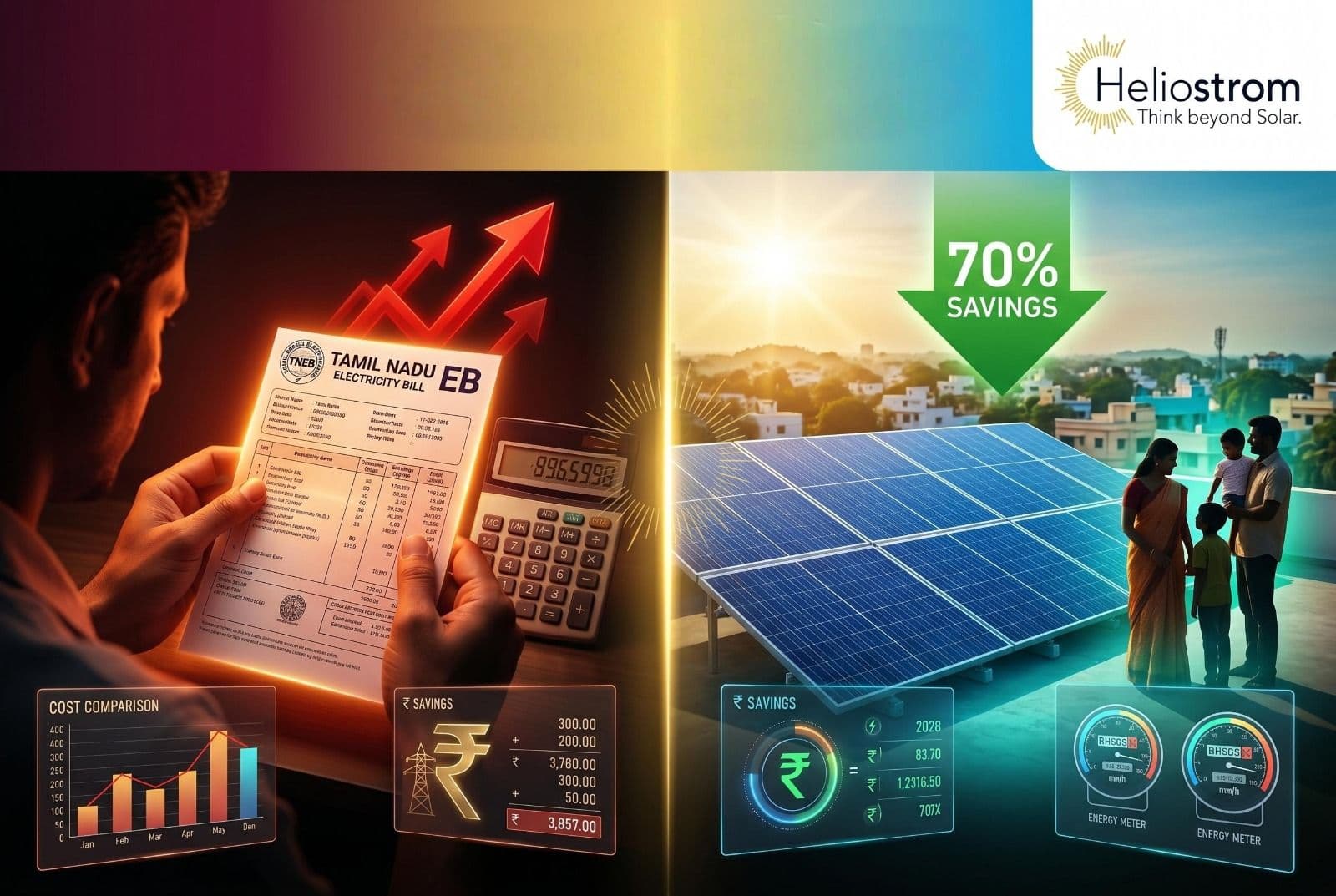
This article walks you through how TNEB calculates domestic and commercial bills, how to use an EB bill calculator Tamil Nadu effectively, why your costs keep rising, and how rooftop solar can realistically cut your annual electricity spend by 60 to 70 percent with numbers grounded in the 2026 TANGEDCO tariff structure.
2. Understanding Tamil Nadu EB Billing in 2026
TANGEDCO (Tamil Nadu Generation and Distribution Corporation) is the body responsible for electricity distribution across Tamil Nadu. Billing is governed by tariff orders issued by the Tamil Nadu Electricity Regulatory Commission (TNERC). The most recent tariff revision came into effect on 1 July 2024 under TNERC Tariff Order No. 6 of 2024, with the Tamil Nadu government absorbing a further rate adjustment for domestic consumers from July 2025.
Domestic Billing (LT-IA Category)
Domestic consumers fall under the LT-IA (Low Tension – Domestic) category. Tamil Nadu uses a telescopic pricing model, meaning each slab rate applies only to the units that fall inside that slab; the next slab rate kicks in only for units above the threshold.
Per TNERC Tariff Order No. 6 of 2024 (effective 1 July 2024), Tamil Nadu uses a two-tier free-supply subsidy based on bi-monthly consumption. In May 2026 (effective May 10, 2026), Chief Minister C. Vijay announced an enhanced subsidy: 200 units completely free per bi-monthly cycle for domestic consumers using up to 500 units. Those above 500 units retain the earlier 100 units free benefit. As of 2026, there are two subsidy tiers based on bi-monthly consumption:
| Tier | Bi-Monthly Consumption | Free Units | Units 1-100 | Units 101-200 | Units 201-400 | Units 401-500 |
|---|---|---|---|---|---|---|
| Tier 1 | Up to 500 units | 200 units free | FREE | FREE | ₹4.70/unit | ₹6.30/unit |
| Tier 2 | Above 500 units | 100 units free | FREE | ₹4.70/unit | ₹4.70/unit | ₹6.30/unit |
This two-tier structure means a household crossing 500 units bi-monthly loses the enhanced 200-unit free subsidy and is instead charged the higher upper slab rates across all units above 100. The jump in bills when crossing 500 units is one of the most common complaints raised by Tamil Nadu consumers.
Commercial Billing (LT-II Category)
Commercial consumers are billed under the LT3 category at significantly higher rates. Unlike domestic consumers, commercial tariff does not have the progressive slab structure; instead, it is a flat rate with demand-based charges.
As of 2026, typical commercial energy charges are around ₹8.00–₹10.50 per unit, plus fixed/demand charges of ₹80–₹120 per kW of sanctioned demand per month and a quarterly Fuel Cost Adjustment (FCA) of roughly ₹0.15–₹0.40 per unit. According to recent TNERC announcements, there was a 4.83% tariff hike announced for July 2024 based on CPI inflation. However, the May 2026 enhancement (200 units free) is a government subsidy, not a tariff reduction. Commercial consumers are billed monthly (unlike domestic bi-monthly).
cycles for TANGEDCO are typically bi-monthly for most domestic consumers and monthly for commercial and industrial connections, though this may vary by district and load category.
3. How to Calculate Your Tamil Nadu Electricity Bill
Calculating your Tamil Nadu electricity bill manually requires four inputs: your meter reading (units consumed), your consumer category, the applicable slab rates, and any fixed charges. Here is a step-by-step example for a domestic consumer using 350 units during a bi-monthly billing cycle.
Worked Example: Domestic Consumer, 350 Units Bi-Monthly
Since 350 units is below the 500-unit threshold, Tier 1 applies and you receive 200 free units.
- Units 1 to 200: Free (Rs.0)
- Units 201 to 350 (150 units): 150 x Rs.4.70 = Rs.705
- Fixed charge (750 W): ₹45 bi-monthly
- Electricity duty (5% on energy charges): 5% × ₹705 = ₹35.25
- FCA (illustrative, ~₹0.20/unit): 350 × ₹0.20 = ₹70
Total bi-monthly bill (illustrative): ₹705 + ₹45 + ₹35.25 + ₹70 = ₹855.25
Now compare to a consumer using 600 units bi-monthly. Tier 2 applies, so only 100 units are free:
- Units 1-100: FREE (₹0)
- Units 101-400 (300 units): 300 × ₹4.70 = ₹1,410
- Units 401-500 (100 units): 100 × ₹6.30 = ₹630
- Units 501-600 (100 units): 100 × ₹8.40 = ₹840
- Total energy charges: ₹2,880 bi-monthly
- Effective monthly cost: ₹1,440"
The difference between these examples shows why staying below 500 bi-monthly units can significantly reduce electricity costs before switching to solar.
4. Tamil Nadu EB Calculator Explained
A Tamil Nadu EB calculator is an online tool that automates the slab-based electricity bill calculation, so you do not have to do the arithmetic manually. You enter your meter reading or units consumed, select your consumer category (domestic or commercial), and the calculator applies the current TANGEDCO tariff slabs to produce your estimated bill instantly.
Common search terms people use when looking for this kind of tool include:
- EB bill calculator Tamil Nadu
- TNEB bill calculator
- electricity bill calculation Tamil Nadu
- current charge calculator Tamil Nadu
- Tamil Nadu power consumption calculator
- calculate Tamil Nadu EB bill
What makes a good electricity cost calculator Tamil Nadu is real-time accuracy. Tariff orders change, and subsidies shift (as seen in the 2024 and 2025 revisions), and any calculator relying on outdated slab rates will give you wrong numbers. Always verify the version of the tariff being used before trusting a result.
Beyond bill estimation, the more useful application of a Tamil Nadu EB calculator is understanding which slab you are sitting in and by how much. If your bi-monthly consumption is 490 units and a single appliance is pushing you over 500 units, switching to an energy-efficient alternative could save you Rs.400 to Rs.600 per cycle before you even consider solar.
5. Why Your EB Bill Keeps Increasing
Even without a tariff revision, many Tamil Nadu households see their electricity bills grow year after year. There are several structural reasons for this:
High-Consumption Appliances
A single 1.5-tonne split air conditioner running for 8 hours daily can consume 150 to 200 units per month on its own. Homes that add one or two ACs for the first time often cross the 500-unit threshold and move into Tier 2, where the effective per-unit rate rises sharply.
Seasonal Surge
Tamil Nadu summers are long and intense. Consumption spikes between March and June due to cooling loads. This seasonal spike is enough to push otherwise moderate consumers from Tier 1 into Tier 2 for several billing cycles, dramatically increasing the annual electricity spend.
Fuel Cost Adjustments (FCA)
TANGEDCO periodically passes through coal price increases to consumers through Fuel Cost Adjustments. These are additions to your base tariff and have increased in 2024 and 2025. FCA charges are not always visible at first glance and are a common source of confusion on the bill.
Phantom Energy and Standby Consumption
Devices left on standby, old refrigerators, motors, and power strips with multiple gadgets plugged in continuously add silent units to your meter. Households with older appliances often underestimate their actual base load by 30 to 50 units per month.
Commercial and Industrial Load Growth
For businesses, expansion in floor area, equipment, or operating hours directly multiplies the electricity bill. At Rs.8.55 to Rs.12.15 per unit, commercial consumers feel every percentage increase in consumption far more acutely than domestic users.
6. How Solar Reduces Your Tamil Nadu Electricity Bill by Up to 70%
The 70% figure is not a marketing claim. It reflects a well-understood dynamic in rooftop solar economics: the combination of Tamil Nadu's high solar irradiance, the steep upper slab rates under TANGEDCO tariff, and the availability of government subsidies creates one of the most financially compelling cases for solar adoption in India.
How Rooftop Solar Works with the TANGEDCO Grid
A grid-tied rooftop solar system generates electricity during daylight hours and feeds it into your home or business first. Any surplus generation is exported to the TANGEDCO grid under the net metering arrangement. At the end of the billing cycle, your consumption is netted against your generation, and you pay only for the balance, if any.
The levelised cost of solar generation from a quality rooftop system installed in 2026 works out to approximately Rs.2 to Rs.3 per unit over a 25-year lifespan. Every unit you generate and self-consume instead of drawing from TANGEDCO's grid saves you ₹0 to ₹6.30 on domestic connections (₹0 for first 200 units under free subsidy, ₹4.70-₹6.30 for 201-500 units, ₹8.40+ for above 500 units).
PM Surya Ghar Subsidy
The Government of India's PM Surya Ghar Muft Bijli Yojana scheme provides subsidies of up to Rs.78,000 for residential rooftop solar installations of 3 kW and above. This subsidy directly reduces the capital cost and shortens the payback period. Eligible Tamil Nadu households can apply through TANGEDCO or an empanelled installer.
For commercial establishments and manufacturing units, the case for solar is even stronger. At Rs.12 per unit in commercial tariff, a 50 kW system generating 6,000 units monthly saves over Rs.72,000 in electricity charges every month. Learn more about solar power plants in Chennai for industrial use to understand how larger installations are structured and priced.
A household consuming 550 units bi-monthly, a common level for Tamil Nadu homes running one air conditioner, can save approximately Rs.12,000 to Rs.15,000 per year by dropping back under the 500-unit threshold with a properly sized 2 to 3 kW system.
7. Solar vs Traditional EB Cost: A Real Comparison
The table below compares grid electricity against rooftop solar across key parameters relevant to Tamil Nadu consumers in 2026:
| Parameter | TANGEDCO Grid | Rooftop Solar | Solar Advantage |
|---|---|---|---|
| Cost per unit (domestic) | Rs.0 to Rs.6.30 | Rs.2 to Rs.3 (levelized) | Save 50-70% |
| Cost per unit (commercial) | Rs.8.55 to Rs.12.15 | Rs.2 to Rs.3 (levelized) | Save 65-75% |
| Bill predictability | Changes with tariff hikes | Fixed for 25 years | Full control |
| Monthly bill (300 units, domestic) | Approx Rs.705 | Near Rs.0 (post solar) | Rs.700+ saved |
| Monthly bill (commercial, 1500 units) | Rs.13,000-18,000+ | Rs.2,000-4,000 | Rs.11,000+ saved |
| Maintenance | None required | Minimal (annual wash) | Low effort |
| Government subsidy available | No | Yes (PM Surya Ghar) | Reduces cost further |
These figures assume a standard Chennai-region irradiance of 5.5 peak sun hours per day. Actual savings vary based on system size, shading, orientation, and consumption patterns.
8. When Is the Right Time to Switch to Solar?
There is rarely a wrong time to go solar in Tamil Nadu, but some situations make the case especially clear:
- Your domestic bi-monthly bill consistently exceeds Rs.800 to Rs.1,000
- Your commercial monthly bill is above Rs.10,000
- You have added or are planning to add air conditioning, a water heater, or a pool pump
- You own your premises and have at least 150 sq ft of unshaded roof space
- You are planning a business expansion and want to hedge against rising commercial tariffs
- You are setting up a new facility and want to lock in low energy costs from day one
For residential consumers who qualify under PM Surya Ghar, the payback period on a 3 kW system in Chennai ranges from 4 to 6 years depending on consumption. The system then generates effectively free electricity for the remaining 19 to 21 years of its warranted lifespan.
Shops, offices, hospitals, and educational institutions benefit from separately optimised commercial solar systems. Explore commercial solar options for Chennai businesses to find sizing guidelines and estimated savings specific to your consumption profile.
9. Frequently Asked Questions
How do I calculate my TANGEDCO EB bill for 2026?
Identify your bi-monthly units consumed. If you are below 500 units, apply the Tier 1 slab with 200 free units. If above 500 units, apply Tier 2 with 100 free units. Multiply units in each slab by the applicable rate: ₹4.70 for units 201 to 400, ₹6.30 for 401 to 500, and ₹8.40+ for units above 500. Add any applicable fixed charges to arrive at the total.
What is the Tamil Nadu electricity slab rate for domestic consumers in 2026?
For Tier 1 (≤500 units bi-monthly, new from May 2026):
- 1-200 units: FREE (enhanced subsidy from 100 to 200 units)
- 201-400 units: ₹4.70/unit
- 401-500 units: ₹6.30/unit
For Tier 2 (>500 units bi-monthly):
- 1-100 units: FREE
- 101-400 units: ₹4.70/unit
- 401-500 units: ₹6.30/unit
- 501-600 units: ₹8.40/unit
- 601-800 units: ₹9.45/unit
- 801-1000 units: ₹10.50/unit
- Above 1000 units: ₹11.55/unit
What is the TNEB commercial electricity rate per unit in 2026?
From July 2025, small commercial consumers pay Rs.8.55 to Rs.8.80 per unit. Larger commercial loads are billed between Rs.11.80 and Rs.12.15 per unit. Peak-hour surcharges of 25 percent apply between 6 AM to 10 AM and 6 PM to 10 PM on LT commercial connections.
How much can I realistically save with rooftop solar in Tamil Nadu?
Domestic savings typically range from 50 to 70 percent of your current annual electricity spend, depending on your consumption and system size. Commercial savings can be higher, often 65 to 75 percent, because the per-unit grid cost is much higher and the volumes involved are larger. A properly designed system matched to your consumption profile will provide the most accurate savings estimate.
Is net metering still available in Tamil Nadu in 2026?
Net metering continues to be available for eligible rooftop solar installations in Tamil Nadu through TANGEDCO. Under net metering, surplus units you generate and export to the grid are credited against your consumption. This makes a correctly sized solar system even more effective at eliminating your bill, particularly during low-consumption months.
What is the PM Surya Ghar subsidy and who qualifies in Tamil Nadu?
The PM Surya Ghar Muft Bijli Yojana is a central government scheme providing subsidies for residential rooftop solar installations. Tamil Nadu homeowners with their own premises and a valid TANGEDCO domestic connection are eligible. The subsidy amount depends on system capacity and is disbursed directly to the consumer's bank account after successful installation verification. Applications are processed through TANGEDCO and empanelled installers.
How long does rooftop solar installation take in Chennai?
A standard residential rooftop installation in Chennai typically takes 2 to 4 days for physical mounting and wiring, followed by a TANGEDCO net meter inspection and approval process that can take 2 to 6 weeks depending on workload. Your installer handles the paperwork and coordinates with TANGEDCO on your behalf.
Why does my Tamil Nadu EB bill jump sharply even for small increases in usage?
This happens because of the slab threshold effect in Tamil Nadu's electricity tariff structure. When you cross the 500-unit bi-monthly threshold, you move from Tier 1 to Tier 2. This does not only increase the rate for additional units. It can also reprice lower slab calculations and removes the 200-unit free subsidy, replacing it with only 100 free units. Even consuming 10 units extra over the threshold can increase your bill by several hundred rupees.
10. Conclusion
Understanding your Tamil Nadu electricity bill is not a passive exercise. The structure of the TANGEDCO tariff, with its two subsidy tiers, slab-based pricing, commercial peak surcharges, and fuel cost adjustments, creates a system where small changes in consumption can have outsized effects on your bill. Using a reliable Tamil Nadu EB calculator gives you better visibility into your electricity usage, helping you make informed decisions before the next billing cycle.
But the deeper insight is this: the same tariff structure that makes your EB bill unpredictable is exactly what makes rooftop solar so financially compelling. When the grid charges you ₹6.30 per unit for domestic high consumption (401-500 units) or ₹8.40+ for above 500 units or Rs.12 per unit for commercial use, and solar generation costs Rs.2 to Rs.3 per unit over its lifetime, the savings are structural, not incidental.
If you are ready to move from calculating your EB bill to eliminating most of it, start by understanding what a system sized to your consumption would cost and save. Learn about the Heliostrom solar journey to see how Tamil Nadu homeowners and businesses have made the switch, and what the process looks like from consultation to commissioning. Solar is no longer a future investment. In 2026, with current TANGEDCO tariffs and available subsidies, it has become one of the smartest long-term financial decisions for Tamil Nadu electricity consumers.
Want these savings on your own roof? get a free solar quote or explore home solar in Chennai.


