
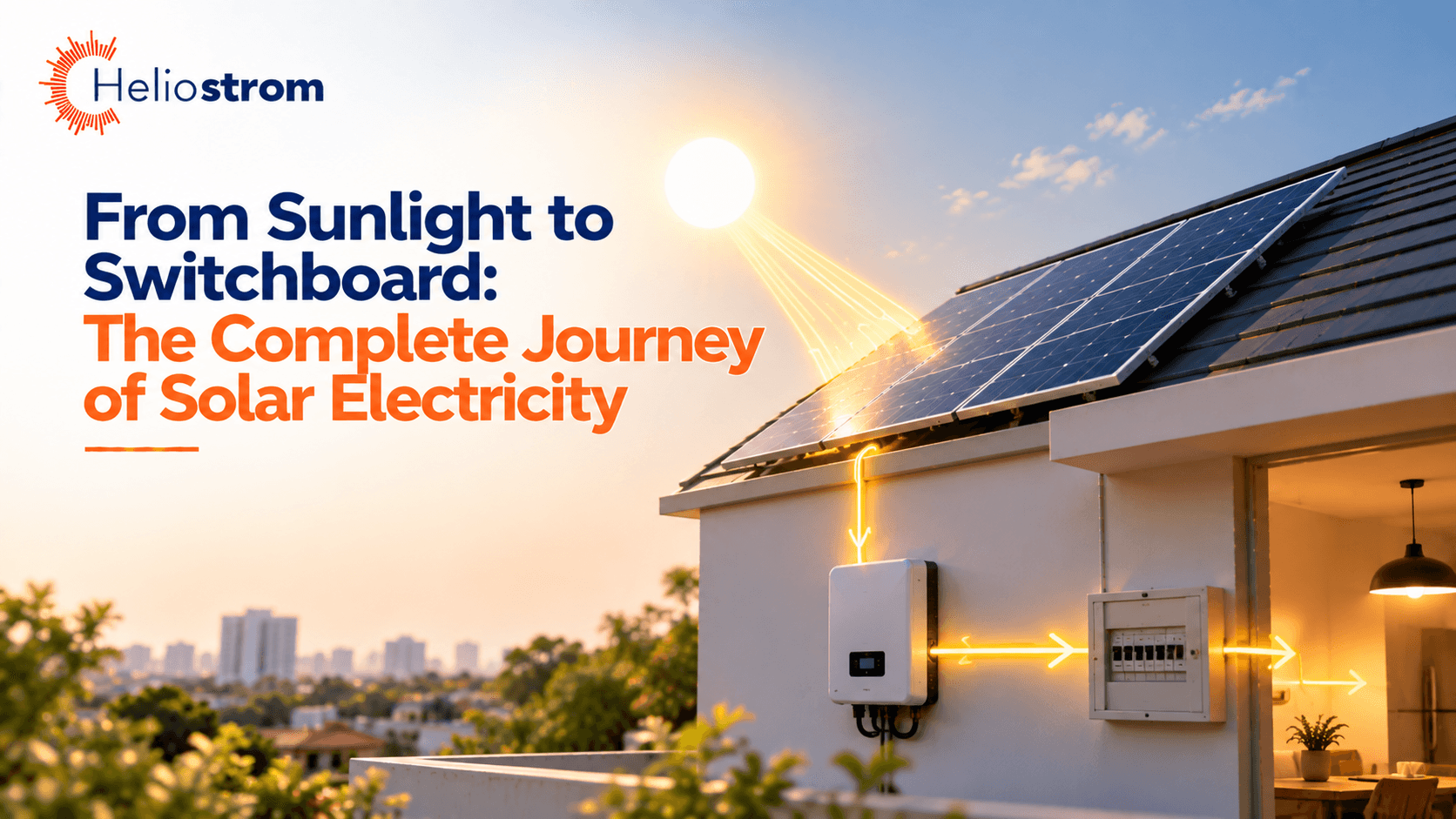
Most homeowners see a solar panel as a single object that somehow produces electricity, but the actual journey from sunlight to a working switchboard involves several distinct physical steps, each depending on the one before it. Understanding this process helps explain why panel quality, installation technique and site conditions all affect the electricity a rooftop system finally delivers to a home. For anyone comparing solar power companies in Chennai before installing a system, knowing what happens between the roof and the switchboard makes it far easier to ask the right questions and judge whether a quotation reflects a properly engineered system.
What Happens Before Sunlight Becomes Electricity
Long before a switchboard shows any change, sunlight travels roughly eight minutes from the sun and strikes a panel's surface as countless small packets of energy called photons. Not every photon does something useful. Some reflect off the glass, some pass through without being absorbed, and only a portion actually reaches the semiconductor layer where the real conversion begins.
Photons, Silicon and the Photovoltaic Effect
A typical silicon solar cell contains p-type and n-type semiconductor regions that form a p-n junction. When sunlight supplies enough energy at this junction, it dislodges electrons from their atoms and creates corresponding positive charges known as holes. This reaction, known as the photovoltaic effect, is what turns light into a flow of electrical charge rather than simply warming the panel's surface.
Why Silicon Is Still the Standard Material
Silicon remains dominant because it combines mature, low-cost manufacturing with strong performance and long operating lifetimes, with modern PV modules commonly designed to operate for 25 years or more. Newer materials are being researched for higher efficiency, but silicon-based panels still make up the large majority of solar installations worldwide, including residential rooftop systems.
Step by Step: How Solar Panels Turn Sunlight Into Power
Once sunlight reaches the silicon, the conversion happens in a fairly consistent sequence, regardless of the size of the installation.
Step One: Light Absorption at the Cell Level
The outer layer of a solar cell is designed to absorb as much usable light as possible while reflecting as little as possible. A thin anti reflective coating and a textured silicon surface both help more photons enter the cell rather than bouncing away.
Step Two: Electron Excitation and Current Formation
Once inside the cell, photons transfer their energy to electrons in the silicon, freeing them from their fixed positions and generating the electron-hole pairs described above. The p-n junction's internal electric field helps separate these generated charges and directs their movement through the electrical circuit, which is what creates a usable electrical current instead of scattered energy.
Step Three: Direct Current Generation Inside the Panel
As electrons continue moving through the cell, thin metal contacts on the surface collect them and route them into wiring that connects individual cells into a complete panel. At this stage, the electricity produced is direct current, meaning it flows steadily in one direction, similar to the power stored in a battery.
Step Four: The Inverter's Role in Making Power Usable
In a conventional grid-connected rooftop system, the DC electricity produced by the panels must be converted into AC electricity before it can supply the home's standard AC circuits or be synchronised with the grid. An inverter performs this conversion, producing alternating current at the correct voltage and frequency for the local grid.
Why Homes and the Grid Need Alternating Current
Alternating current became the global standard for electricity distribution because it can be transmitted efficiently over long distances at high voltage and then stepped down for safe household use. Most household wiring and grid-connected appliances are designed around AC distribution, which is why the inverter is a key component of a conventional grid-connected solar system.
From the Inverter to Your Switchboard
How Solar Electricity Enters a Home's Wiring
Once converted to AC and connected through the appropriate protection and switching equipment, the solar power can supply the home's electrical loads, with grid electricity making up any shortfall. From there, it flows to whichever circuits are drawing power at that moment, whether that is a refrigerator, lighting, or an air conditioner.
What Happens to Extra Electricity You Do Not Use
On a bright afternoon, a rooftop system often generates more electricity than a home is using at that exact moment. Where the system is approved for grid export, this surplus can be sent through the same connection back into the utility's distribution network rather than being wasted.
Net Metering and the Local Grid Connection
For eligible domestic rooftop systems in Tamil Nadu, surplus electricity can be exported to the grid under the applicable net-metering framework, with a bidirectional meter recording electricity imported from and exported to the grid. Other consumer categories can be subject to different metering arrangements, so the applicable rules published by TNPDCL and the Tamil Nadu Electricity Regulatory Commission should be checked before installation. The PM Surya Ghar: Muft Bijli Yojana also provides Central Financial Assistance to eligible residential consumers installing rooftop solar, subject to the scheme's current eligibility and implementation requirements.
Why the Journey Looks Different for Every Rooftop
The physics described above stays the same everywhere, but the amount of usable electricity a specific rooftop produces depends heavily on local conditions and design choices. This is one of the main reasons two homes with similar looking panels can see noticeably different output over a year. It is also why comparing solar EPC providers across Tamil Nadu on design quality, not only price per panel, tends to matter more once a system is actually installed and running.
Panel Orientation, Shading and Local Weather in Chennai
Chennai's coastal climate brings strong sunlight for much of the year, but also humidity, dust, and periods of cloud cover that briefly reduce output. Panel orientation, tilt angle, and shading from nearby buildings or trees all influence how much of that available sunlight is actually captured across a full day.
Dust and, in coastal environments, salt-related residue can accumulate on panel surfaces and reduce the amount of light reaching the cells. Routine cleaning and a periodic performance check help keep actual output closer to what the system was originally designed to produce.
System Sizing and Component Quality
A correctly sized system matches expected electricity generation to a household's actual consumption pattern, rather than simply filling available roof space. Component quality, including the panels, inverter, and wiring, also affects how consistently the system performs over its lifetime, which is why understanding the process behind solar panel installation for homes in Chennai is worth reviewing before signing off on a design.
Choosing the Right Partner for a Reliable Solar Journey
What to Look for in Local Installation Experience
Because so much of a system's real-world performance depends on site-specific design decisions, installation experience in the local climate and grid conditions matters as much as the panel specifications on paper. A team familiar with Chennai's rooftop layouts, TNPDCL's current application, inspection and approval process, and common shading issues in residential areas is generally better placed to design a system that performs closer to its expected energy yield under local operating conditions.
Why Panel Origin and Manufacturing Quality Matter
Not all panels marketed at a similar wattage perform the same way over ten or twenty years. Understanding how solar panels are manufactured in Chennai by the company behind the proposed equipment, including quality checks, warranty terms, and after-sales support, gives homeowners a clearer picture of what they are actually paying for beyond the headline price.
Frequently Asked Questions
How long does it take for sunlight to become usable electricity once it hits a panel?
The photovoltaic conversion itself occurs continuously as light reaches the cells. Any noticeable startup delay is more likely to come from the inverter's operating and grid-synchronisation process, not the underlying conversion.
Does solar electricity still get generated on a cloudy day?
Yes, though at a reduced level. Panels rely on daylight rather than direct heat, so they continue producing some electricity in overcast conditions, just less than on a clear, sunny day.
What is the difference between the electricity a panel produces and what powers my home?
Panels initially produce direct current, while homes and the grid run on alternating current. The inverter bridges this difference, which is why it is considered as important as the panels themselves.
Why do two homes with similar solar panels sometimes get different results?
Differences usually come down to orientation, shading, system sizing, and component quality, rather than the underlying physics, which is why professional design and installation make a measurable difference.
Is net metering the same across all of Tamil Nadu?
The basic principle of exporting eligible surplus electricity to the grid is established under Tamil Nadu's rooftop solar framework, but the applicable metering mechanism, eligibility, charges, documentation, and approval process can vary by consumer category and current regulatory requirements. It is worth confirming the applicable terms with TNPDCL before installation.
Conclusion
Following the path from a photon striking a rooftop panel to electricity reaching a switchboard shows that solar power is less about a single piece of technology and more about a chain of dependent steps, each of which needs to be designed and installed correctly. A well understood installation, matched to local weather, roof conditions, and household consumption, tends to deliver far more consistent results than one chosen purely on upfront price. If you are planning a system and want this journey explained for your specific rooftop, you can speak with solar panel experts based in Chennai to review your site before deciding on a design.
Thinking about your own installation? rooftop solar installation for homes in Chennai or book a free site survey.


