
Table of Contents
1. Introduction
2. Why Electricity Costs Are Becoming a Business Challenge in Chennai
3. Understanding Commercial Solar and How It Works
4. Why More Chennai Businesses Are Investing in Commercial Solar
5. Key Factors to Evaluate Before Installing a Commercial Solar System
6. The Long-Term Business Benefits Beyond Lower Electricity Bills
7. Common Misconceptions About Commercial Solar
8. The Future of Commercial Solar in Chennai
9. Frequently Asked Questions
Introduction
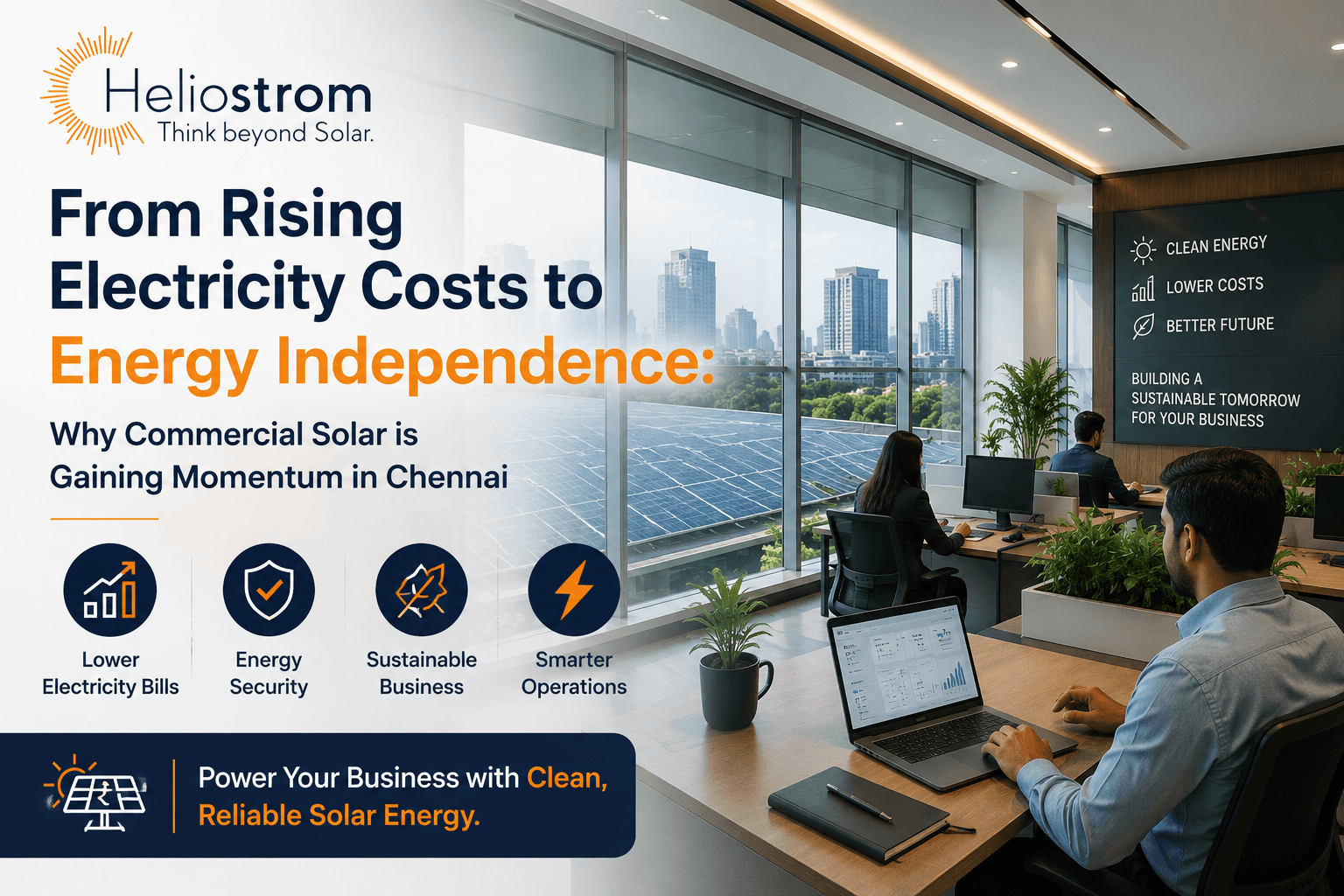
Electricity costs have quietly become one of the most pressing operational concerns for businesses across Chennai. Manufacturing units, commercial complexes, and industrial facilities are all feeling the pressure of rising tariffs and unpredictable grid charges. As a result, organizations are increasingly looking for predictable, long-term energy solutions rather than depending entirely on grid electricity. Commercial Solar for Chennai has emerged as a practical response to this challenge, offering businesses a way to control energy costs while building toward long-term sustainability. This article examines why commercial solar adoption is accelerating in the city and what businesses should consider before making the switch.
1. Why Electricity Costs Are Becoming a Business Challenge in Chennai
Operational costs for commercial and industrial businesses in Chennai have been climbing steadily, and electricity is a significant part of that increase. Rising demand from a growing industrial base, combined with periodic tariff revisions, has made energy budgeting harder to predict.
For manufacturing businesses in particular, electricity is often one of the largest recurring operational expenses after raw materials and labor. Even modest tariff increases can meaningfully affect margins when multiplied across a full production cycle. Commercial buildings with heavy cooling loads, such as offices, retail spaces, and warehouses, face similar pressure.
Volatile electricity tariffs also complicate long-term financial planning. Businesses budgeting for the next three to five years find it difficult to forecast energy costs with confidence when grid tariffs can shift with little warning. This uncertainty is a key reason many organizations are now looking at alternatives that offer more control over their energy expenses.
2. Understanding Commercial Solar and How It Works
Commercial solar refers to solar power systems designed and sized for the energy needs of businesses, typically installed on rooftops, open industrial land, or covered parking structures.
Grid-connected systems remain the most common choice for commercial solar installation in Chennai. These systems generate electricity during daylight hours and feed it directly into the building's internal electrical system, reducing the amount of power drawn from the grid.
On-grid systems allow excess generation to be exported to the grid under net metering arrangements, depending on local regulations and sanctioned load. Hybrid systems combine solar generation with battery storage, providing backup power and greater control over when stored energy is used.
The major components of a commercial solar system include solar panels, inverters that convert generated direct current into usable alternating current, mounting structures, and monitoring systems that track performance in real time. Together, these components form a system designed to operate reliably for decades with minimal manual intervention.
3. Why More Chennai Businesses Are Investing in Commercial Solar
Several factors are driving the shift toward commercial rooftop solar solutions across the city.
Long-term operational savings remain the primary motivator. Once a system is installed, the cost of generating solar electricity is largely fixed, offering protection against future tariff increases. Energy independence is another significant driver, particularly for facilities that experience frequent grid fluctuations or want greater control over their power supply.
Sustainability initiatives and ESG goals are increasingly influencing procurement and capital investment decisions, especially for businesses that supply larger corporations with their own environmental commitments. Corporate environmental responsibility has moved from a public relations consideration to a genuine business requirement in many sectors.
Government support for renewable energy adoption, including various state and central incentives, has also made commercial solar more financially accessible than it was a few years ago, encouraging more businesses to evaluate business solar energy systems as part of their operational strategy.
4. Key Factors to Evaluate Before Installing a Commercial Solar System
Before committing to a commercial solar project, businesses should evaluate several practical factors.
- Energy consumption analysis and load assessment: Understanding actual consumption patterns helps determine the right system size.
- Roof condition and available installation area: Structural capacity and available space directly affect system design.
- Future expansion: Facilities planning to grow should size systems, or design for expansion, accordingly.
- Financial planning, ROI, and payback period: Businesses should model expected savings against installation costs realistically.
- Installer experience: A track record of completed commercial projects reduces execution risk.
- Quality of components: Panel and inverter quality directly affect long-term output and reliability.
Working through these factors with an experienced partner helps avoid costly design mistakes later. Businesses that skip a proper load assessment, for instance, often end up with systems that are undersized relative to actual daytime consumption, which limits the savings the installation was meant to deliver. Similarly, overlooking roof condition can lead to structural issues or additional reinforcement costs discovered only after installation begins. A thorough evaluation upfront, even if it adds a few weeks to the planning process, tends to prevent far more expensive corrections later in the project.
5. The Long-Term Business Benefits Beyond Lower Electricity Bills
While reduced electricity bills are the most visible benefit, commercial solar offers advantages that extend well beyond monthly savings.
Operational resilience improves as businesses reduce their dependency on grid electricity, particularly valuable during periods of grid instability. Stable, predictable energy costs make budgeting more accurate, which matters for businesses operating on tight margins.
Sustainability reporting also becomes easier, as solar adoption provides measurable, verifiable data for ESG disclosures and environmental reporting requirements. Over time, a well-maintained commercial solar system also contributes to the long-term asset value of a facility, since energy efficiency is increasingly a factor in commercial property valuation.
For businesses competing in sectors where sustainability credentials matter to clients or partners, commercial solar adoption can also serve as a genuine competitive advantage rather than simply a cost-saving measure.
6. Common Misconceptions About Commercial Solar
Several misconceptions continue to influence how businesses think about commercial solar.
Solar is only for large companies: In reality, systems can be sized appropriately for small and medium businesses, with many mid-sized facilities finding attractive payback periods.
Solar does not work during monsoon: Panels continue generating electricity during cloudy and rainy conditions, though at reduced output compared to clear days. Chennai's overall solar irradiance across the year still supports strong annual generation.
Maintenance is expensive: Commercial solar systems generally require only periodic cleaning and routine inspection, which is modest compared to the cost of most industrial equipment.
Solar systems stop working after a few years: Quality systems are designed to operate reliably for 25 years or more, with gradual, well-documented performance decline rather than sudden failure.
7. The Future of Commercial Solar in Chennai
Commercial solar adoption in Chennai is expected to continue rising as more businesses recognize its financial and operational value.
Advances in solar technology are improving panel efficiency and durability, allowing more generation from the same rooftop area. Battery storage is becoming more affordable, giving businesses greater flexibility to use stored solar energy during peak tariff hours or grid outages.
Smart energy management and digital monitoring tools now allow facility managers to track generation and consumption in real time, while AI-enabled monitoring is beginning to help identify performance issues before they affect output. As these technologies mature, commercial solar systems are becoming easier to manage and more valuable as long-term infrastructure investments.
The growing role of renewable energy in Chennai's commercial and industrial landscape suggests that businesses evaluating industrial solar systems today are positioning themselves ahead of a broader shift already underway across the city. Facilities that adopt solar early also tend to build internal expertise in managing renewable assets, which becomes increasingly valuable as energy portfolios grow more complex with the addition of storage and demand management tools in the coming years.
8. Frequently Asked Questions
Is commercial solar suitable for small and medium businesses in Chennai?
Yes. Systems can be designed to match the specific energy consumption and budget of small and medium businesses, and many find reasonable payback periods based on their usage patterns.
How long does a commercial solar system last?
A well-designed and properly maintained commercial solar system typically operates for 25 years or more, with gradual performance decline over that period rather than abrupt failure.
What should businesses evaluate before installing commercial solar?
Businesses should assess their energy consumption, roof or land suitability, financial payback expectations, installer experience, and component quality before finalizing a commercial solar investment.
Conclusion
Rising and unpredictable electricity costs are pushing more Chennai businesses to reconsider how they power their operations. Commercial solar offers a practical path toward energy independence, predictable costs, and stronger sustainability credentials, but it works best when approached as a long-term investment rather than a short-term saving measure. Businesses considering the shift should evaluate their energy needs carefully and work with experienced partners to design a system suited to their facility. To explore what commercial solar could look like for your business, Contact our solar experts today.
Running the numbers for your business? commercial solar installation in Chennai or request a solar quote.


