Table of Contents
- 1Why More Properties in Chennai Are Adopting Solar Power
- 2Understanding Your Energy Requirement Before Planning Solar
- 3The Importance of a Professional Site Survey
- 4Designing a Solar Power Plant That Fits the Property
- 5Choosing the Right Components for Long-Term Performance
- 6Installation, Safety Standards and Quality Checks
- 7Grid Connection, Net Metering and System Commissioning
- 8Monitoring Performance After Installation
- 9Common Challenges During Solar Projects and How They Are Addressed
- 10Frequently Asked Questions
Introduction
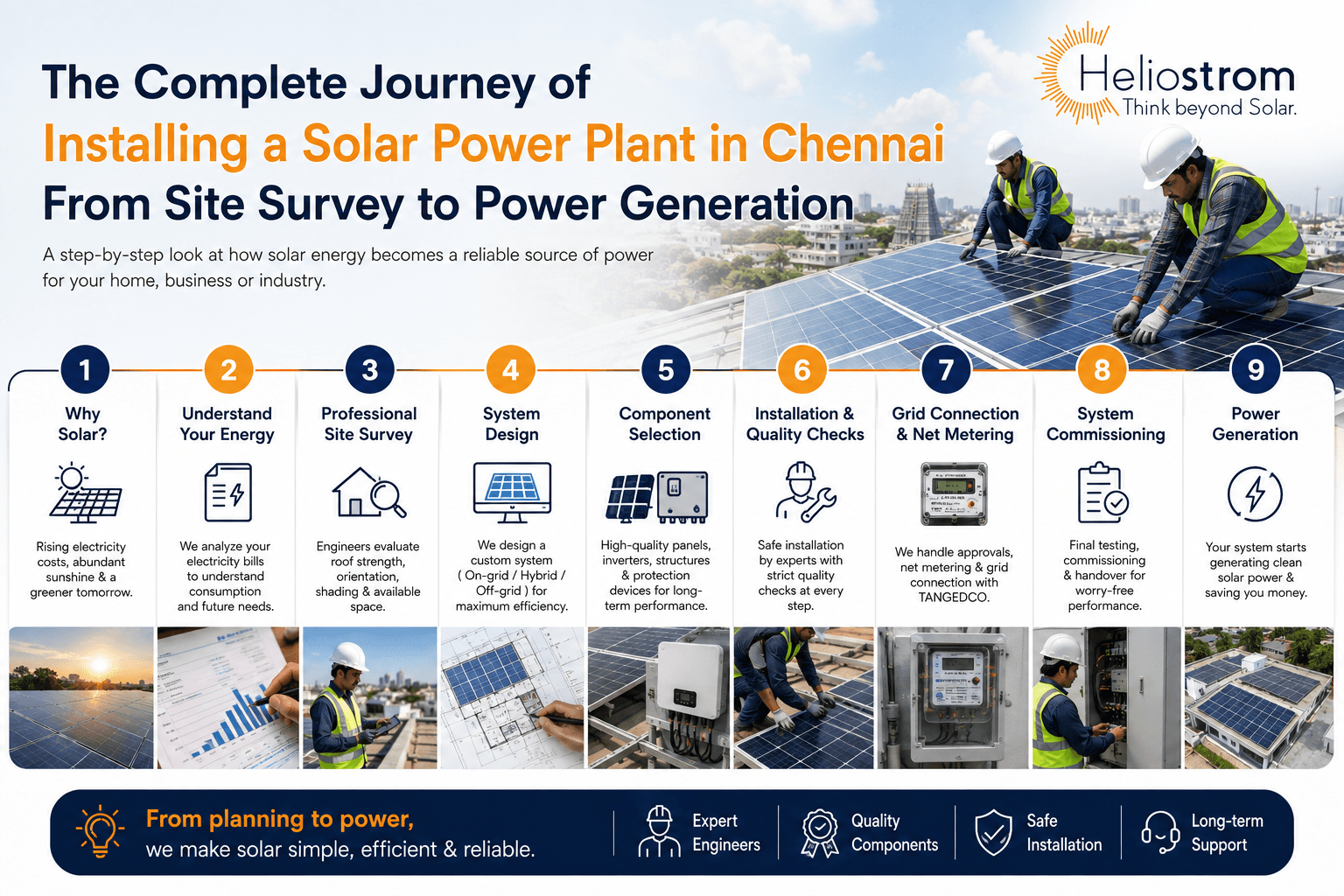
Chennai receives abundant sunshine through most of the year, and this advantage, combined with rising electricity tariffs, is pushing homeowners, businesses and factory owners to look seriously at solar energy. Installing a Solar Power Plant in Chennai is often assumed to be a simple matter of fixing panels on a rooftop, but the reality is far more technical. A dependable system is the outcome of careful planning, engineering evaluation, component selection and structured commissioning. Understanding this complete journey, from the first site assessment to the moment the plant begins generating power, helps property owners make informed decisions and avoid costly mistakes.
Why More Properties in Chennai Are Adopting Solar Power
Chennai lies in a region with high solar irradiance, typically receiving well over 300 sunny days annually, making it well suited for solar power generation. The city's electricity demand has grown alongside its expanding residential and industrial base, increasing dependence on grid power during peak hours. Awareness of sustainable energy practices has also grown among individuals and organizations.
These factors drive adoption across property types. Homeowners install rooftop systems to cut monthly bills. Commercial establishments such as offices and hotels use solar to manage operating costs. Industries with high consumption adopt larger installations to offset a share of their power requirement. Educational institutions, with large roof space and daytime usage, are also well suited.
Understanding Your Energy Requirement Before Planning Solar
Before any system is designed, it is essential to understand the property's actual energy requirement. This begins with a detailed review of past electricity bills, revealing average monthly consumption.
Seasonal variation matters, since consumption during summer months, when cooling loads increase, can differ meaningfully from other months. Peak load, the highest simultaneous demand a property draws from the grid, must also be identified, as it influences inverter sizing and system capacity.
Future requirements should be factored in too. A property planning to add machinery or expand operations needs a system sized with allowance for growth. This consumption analysis forms the engineering foundation for every subsequent decision, including panel count, inverter rating and layout.
The Importance of a Professional Site Survey
A professional site survey tests calculations against real conditions. Engineers visit the property to evaluate factors affecting long-term generation.
Roof orientation determines how much direct sunlight panels receive through the day, with south-facing roofs generally receiving more consistent exposure. Tilt angle affects how efficiently sunlight strikes the panel surface across seasons.
Shadow analysis matters too. A water tank, adjacent building or tree can shade part of an array during certain hours, reducing output if not accounted for in layout. Roof condition and structural strength are assessed to confirm the surface can safely bear the added load of panels and mounting structures. The available installation area is measured precisely to determine how many panels fit. Skipping this survey often leads to systems that miss projected generation figures.
Designing a Solar Power Plant That Fits the Property
Once site data is collected, plant design begins. System sizing is calculated from the energy requirement, matched against usable roof area and local irradiance data.
Three broad configurations are commonly used. An on-grid solar system connects directly to the utility grid and suits properties with consistent daytime consumption. A hybrid solar system combines generation with battery storage and grid connectivity, offering backup during outages. An off-grid system operates independently of the grid, though this is less common in urban Chennai given reliable grid access.
Panel layout is planned to maximize generation while minimizing shading losses and cable runs. Energy optimization considers string configuration and inverter placement to reduce losses. Good design also allows space for future expansion without redesigning the system. This stage often distinguishes a reliable Solar Power Company from one offering only basic installation.
Choosing the Right Components for Long-Term Performance
Component selection is where compatibility, not individual product quality alone, determines reliability. Solar panels convert sunlight into direct current electricity, and their efficiency rating and temperature coefficient influence output in Chennai's warm climate.
Inverters convert this direct current into usable alternating current and must be matched precisely to the array's voltage and current characteristics. Mounting structures must withstand wind loads and corrosion, particularly relevant in Chennai's coastal environment.
Earthing protects the system and personnel from electrical faults, while surge protection guards against voltage spikes from lightning or grid fluctuations, both common in this region. DC protection safeguards wiring between panels and inverter, and AC protection secures the link to the distribution board. A system built from mismatched components, even premium ones, can underperform or fail prematurely.
Installation, Safety Standards and Quality Checks
Installation follows a defined workflow. Mounting structures are fixed first, aligned to the tilt and orientation finalized during design. Panels are secured next, followed by DC wiring between panels and combiner boxes.
Electrical connections are completed in stages, with each junction checked for correct polarity and secure termination. Safety inspections run throughout, covering cable insulation, earthing continuity and structural fastening.
Testing before commissioning includes checks on insulation resistance, open circuit voltage and short circuit current for each string. Following recognised engineering practices and electrical codes at every stage separates a safely built plant from one carrying hidden risks.
Grid Connection, Net Metering and System Commissioning
Once installation and testing are complete, the system is connected to the utility grid through a formal approval process, typically involving submission of technical documentation to the local distribution authority.
Net Metering Tamil Nadu regulations allow eligible solar system owners to export surplus electricity generated during the day back to the grid, with the meter recording both import and export, allowing consumption to be offset against generated units.
Initial testing after grid connection verifies the inverter synchronizes correctly with grid voltage and frequency. Commissioning marks the formal handover, after which the system begins actual power generation, feeding the property's connected load and, where applicable, the grid.
Monitoring Performance After Installation
A solar plant's performance does not end at commissioning. Solar Performance Monitoring through dedicated software tracks generation data in real time, comparing actual output against expected values.
Regular panel cleaning is necessary, since dust accumulation, common in Chennai's climate, can reduce light absorption and lower generation. Preventive maintenance, including periodic inspection of connections and mounting hardware, helps identify wear before it causes failure.
Fault detection through monitoring platforms allows issues such as underperforming strings or inverter faults to be identified quickly. Ongoing optimization helps the system operate close to its designed capacity over its operational life, which for most components extends beyond two decades.
Common Challenges During Solar Projects and How They Are Addressed
Solar projects encounter practical challenges requiring experienced problem solving. Roof limitations, such as irregular shapes or limited area, sometimes require creative layouts to maximize capacity.
Structural constraints may require reinforcement before installation, particularly on older buildings. Shading from nearby structures or vegetation, if identified late, can force design adjustments. Weather delays during Chennai's monsoon months can affect schedules and require careful sequencing of work.
Utility approvals for grid connection and net metering can take time depending on documentation completeness. Future expansion needs, if not planned for initially, can complicate later additions. Experienced teams anticipate these challenges early, which is why working with specialists familiar with the complete Solar Installation Process in Chennai tends to produce more predictable outcomes.
Conclusion
Installing a solar power plant is a structured journey spanning energy assessment, professional site survey, engineering design, component selection, safety-compliant installation, grid commissioning and ongoing monitoring. Each stage builds on the one before it, and shortcuts at any point tend to surface as performance issues later. Property owners in Chennai considering solar are best served by understanding this full process rather than focusing only on the visible installation step. For guidance specific to your property's requirements, Contact our Solar Experts.
Frequently Asked Questions
How long does it usually take to install a solar power plant in Chennai?
Installation timelines vary based on system size and site complexity, but a typical rooftop project, from site survey to commissioning, generally takes a few weeks once approvals are in place.
Why is a site survey important before installation?
A site survey identifies roof orientation, shading, structural strength and available area, all of which directly affect system design and long-term generation performance. Skipping this step often leads to inaccurate sizing.
Can solar power plants generate electricity during cloudy weather?
Solar panels continue to generate electricity under cloudy conditions, though output is lower than on clear sunny days, since panels rely on available daylight rather than direct sunlight alone.
Thinking about your own installation? rooftop solar installation for homes in Chennai or book a free site survey.


