
Table of Contents
1. Why Chennai Businesses Are Rethinking Their Electricity Costs
2. How Commercial Solar Changes the Energy Cost Equation
3. What Makes a Business Suitable for Solar?
4. The Role of Electricity Consumption and Operating Hours
5. Roof Space, Structure and Site Conditions Matter
6. Understanding Solar Savings, Payback and Long-Term Value
7. When Commercial Solar May Not Be the Right Choice
8. How to Evaluate a Solar Proposal Before Deciding
9. Frequently Asked Questions
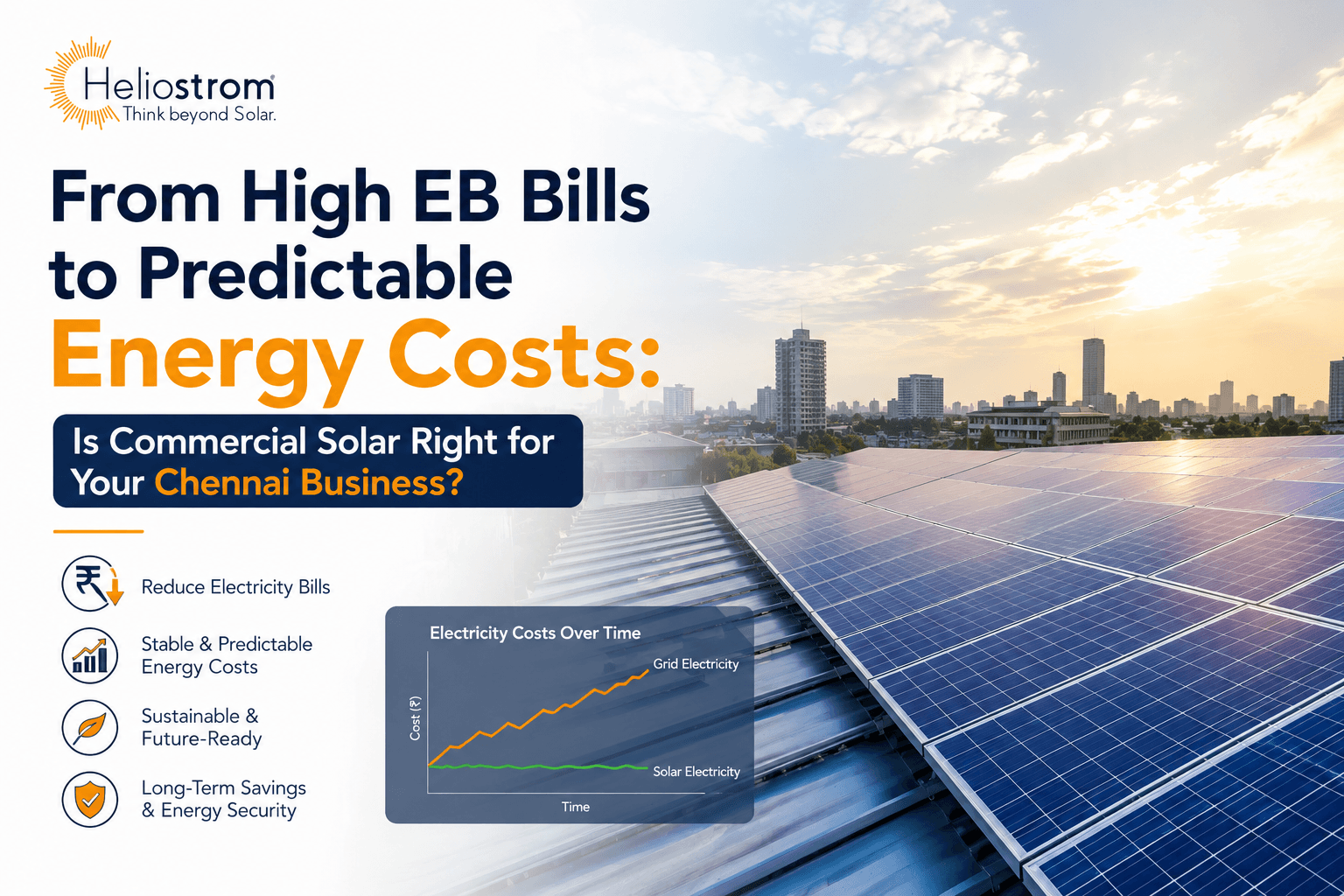
Most business owners in Chennai have, at some point, stared at an EB bill and asked why it keeps climbing regardless of how carefully operations are managed. Electricity repeats every month and quietly shapes budgets. This has pushed many owners toward commercial solar for Chennai businesses as a way of rethinking that expense, though it is worth being clear: solar is not simply mounting panels on a roof. A genuine evaluation accounts for consumption patterns, operating hours, roof area, correct sizing, realistic generation estimates, investment and how the numbers play out over years. The question that matters is narrower than "does solar work?" It is whether solar fits this particular business, at this particular site.
Why Chennai Businesses Are Rethinking Their Electricity Costs
Businesses that consume a meaningful amount of electricity feel its cost differently than a household. It is tied to production output, staffing patterns, seasonal swings and equipment running at any time, feeding directly into operating budgets. A factory floor drawing power all day has a very different profile from a hospital running critical equipment continuously, or a retail outlet whose load rises and falls with footfall. Offices, warehouses and hospitality businesses each look different on paper.
There is a useful distinction here: cutting consumption is not the same as cutting dependence on the grid. The first comes through efficiency and behaviour change. The second is what commercial solar targets, by producing a share of the needed electricity at the site itself.
Electricity pricing is also not identical for every business; it depends on the consumer category assigned, the applicable tariff structure, actual usage, and the regulatory framework in force. Any serious look at suitability starts from this variability rather than sweeping statements about tariffs always rising.
How Commercial Solar Changes the Energy Cost Equation
In simple terms, a grid-connected commercial solar system converts sunlight into electricity during the day and supplies that power into the building's existing electrical setup. Whenever the sun is generating enough power, on-site equipment draws from the solar system first, which is what actually lowers grid consumption.
What happens to electricity generated but not used immediately depends on the settlement mechanism that applies to that connection, governed by the relevant electricity authority and specific to consumer category and sanctioned load. This should be verified case by case rather than assumed.
A useful mental model:
Grid-only model: All electricity purchased from the grid at the applicable tariff.
Solar model: Solar generation used first, with the grid filling remaining demand.
The key takeaway: solar lowers reliance on the grid for the hours it can generate and the loads it can serve. It does not erase a bill outright, since almost every business still needs grid power at night or beyond what its system produces.
What Makes a Business Suitable for Solar?
Several factors combine to determine fit: how consistent electricity use is, whether the business operates mainly during daylight, how much roof or ground space is genuinely available, structural soundness, shading, existing electrical infrastructure, remaining roof life, and whether expansion is on the horizon.
A daytime-heavy operation with steady year-round demand and open, unshaded roof space is typically stronger positioned than one running mostly at night or dealing with a shaded, structurally weak roof.
Because these variables rarely point the same way for every site, no credible plan should be finalised without an actual site visit and energy review. Only a physical survey confirms shading angles, structural capacity and realistic cable routing. Not every business is a natural fit, and an honest assessment says so where relevant.
The Role of Electricity Consumption and Operating Hours
A single month of bills rarely tells the full story. Reviewing a full year, or close to it, exposes seasonal swings, demand peaks and usage trends a snapshot cannot capture, and that fuller picture is what sizing should be based on.
Because solar generation happens during daylight, operating hours are central to how much value a business gets from a system. A business running mostly between 9 a.m. and 6 p.m. can consume a larger share of its solar output directly, while one whose main load falls at night, as with shift-based manufacturing, gets comparatively less direct value from the same system size.
This is why sizing differs by business type, and why known future growth in demand should be discussed before a system is finalised, not after.
A practical checklist before sizing includes:
- Monthly electricity units consumed
- Sanctioned load
- Daily and weekly operating hours
- Major electrical loads and their timing
- Seasonal variation in usage
- Planned expansion
Roof Space, Structure and Site Conditions Matter
Total roof footage and the portion actually usable for panels are two different numbers. Overhead tanks, exhaust units, staircases and shadows from nearby structures cut into the usable footprint, while orientation and layout shape how efficiently panels can be arranged.
Structural soundness matters too: the roof must bear the added weight of panels and mounting frames for the system's full life. Planning should also cover maintenance access, cable routing, and inverter placement.
Local conditions play a role. Chennai's heat, humidity, dust and, in coastal pockets, salt exposure can affect which components are chosen and how often maintenance is needed. Anyone reviewing solar power for businesses should ask how a proposed design responds to these conditions, while keeping in mind their overall effect on performance is generally manageable rather than dramatic.
Understanding Solar Savings, Payback and Long-Term Value
Assessing the financial case means looking at several connected figures: upfront project cost, expected annual generation, the applicable tariff, how much generation is used on-site, the settlement or export terms, ongoing upkeep costs, the payback timeline, and the asset's long-run value.
There is no single payback figure that fits every business, and claims implying otherwise should raise a flag. What a business actually experiences depends on system cost, real generation at that site, its own consumption pattern, the applicable tariff, any financing used, the settlement mechanism, site conditions and maintenance needs over time.
Payback numbers should therefore always be framed as estimates built on stated assumptions, not fixed promises. A proposal worth trusting shows how it arrived at its figures.
When Commercial Solar May Not Be the Right Choice
Solar is fundamentally a site-specific infrastructure investment, not a one-size-fits-all answer, and there are real circumstances where it will not make sense for a business right now.
Among them: too little roof area, unavoidable shading, a roof needing costly reinforcement, low daytime consumption, a short lease, redevelopment plans, budget constraints, and grid or regulatory restrictions tied to that connection.
Being upfront about these limitations, instead of downplaying them, is part of giving a business an accurate picture before any money changes hands.
How to Evaluate a Solar Proposal Before Deciding
Judging proposals purely on cost per kilowatt tends to obscure real differences in what is offered. A sound evaluation covers system capacity, basis for annual generation figures, panel and inverter specifications, mounting quality, DC and AC cabling standards, earthing, surge protection, monitoring, warranty coverage, installation scope, grid documentation, maintenance and support, and any excluded items.
There is one question every business should put to a vendor directly: "What costs could appear after we approve this quotation?" A vendor confident in their pricing answers without hesitation, addressing items like civil work, extra cabling, structural reinforcement or documentation fees that sometimes surface later. For a starting reference on what a complete scope typically includes, solar solutions for businesses is a useful place to look.
Frequently Asked Questions
Is commercial solar suitable for every Chennai business?
No. It depends on available roof space, daytime consumption, structural condition, shading and a site's electrical infrastructure. A site survey and energy review are required to confirm fit.
Does commercial solar completely eliminate an EB bill?
No, not on its own. It reduces how much power a business draws from the grid during the hours it can generate, but most businesses still need grid electricity, so a bill usually continues at a lower level.
How should a business determine the right solar system size?
Sizing should be based on a full year of consumption data where possible, sanctioned load, operating hours, the timing of major loads, usable roof area and planned expansion, confirmed through a professional site assessment.
Whether commercial solar is right for a particular business comes down to specifics: how it consumes electricity, what its site can support, and its financial expectations. For a straightforward, site-specific evaluation, feel free to connect with our solar experts whenever you are ready.
Running the numbers for your business? commercial solar installation in Chennai or request a solar quote.


