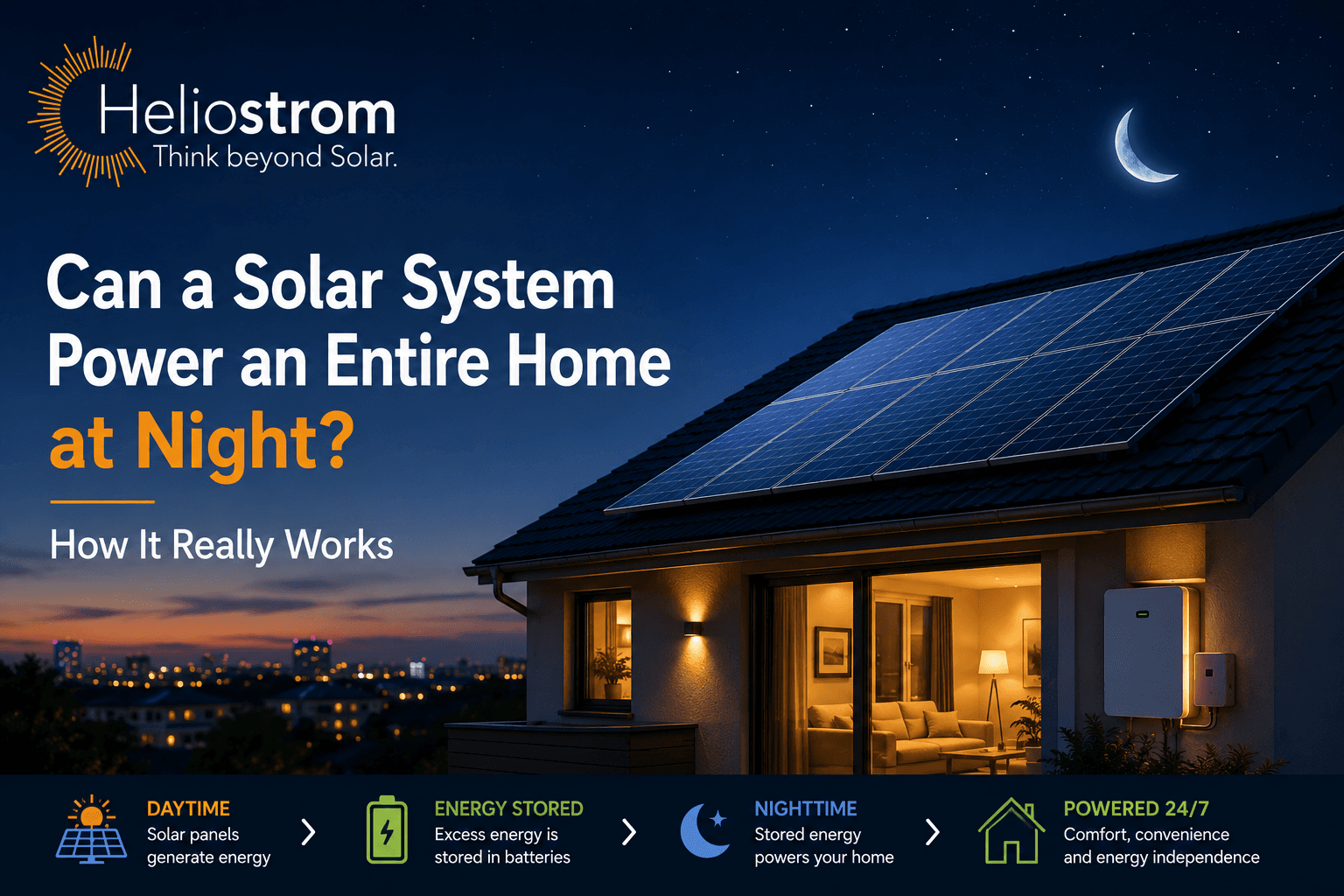
It is one of the first questions almost everyone asks before going solar: what happens once the sun sets? A solar panel converts sunlight into electricity through photovoltaic cells, so generation occurs only when sunlight reaches the panel, which means a home relying on solar panels alone would go dark every evening. Yet millions of solar homes across India run lights, fans, and appliances all night without issue. The answer lies not in the panels themselves but in how the rest of the system, the grid connection, the meter, and sometimes a battery, is designed around them. Anyone considering installing solar panels at their home in Chennai should understand this distinction clearly before comparing quotes, since it changes both the savings and the setup involved.
How Solar Panels Actually Work During the Day
Sunlight In, Electricity Out
A solar panel converts sunlight into electricity through photovoltaic cells, so generation occurs only when sunlight reaches the panel. Output rises through the morning, peaks around midday, and tapers off through the afternoon as the sun's angle changes. Chennai receives an average of approximately 5.3 peak sun hours a day, a figure commonly used by regional solar installers to estimate how much usable electricity a given system will generate. Cloud cover and dust accumulation on panels can also reduce output meaningfully, which is why regular cleaning is often recommended in Chennai's dustier months.
What Happens to the Extra Power You Generate
Most homes do not use all the electricity their panels produce at midday, since that is often when people are at work or school rather than running appliances at home. That surplus does not go to waste. Under Tamil Nadu's current billing mechanism, this exported electricity is credited at a regulator determined tariff, which helps offset the cost of electricity drawn back from the grid later, including at night. This export and import cycle happens automatically and requires no manual intervention from the homeowner once the system is commissioned.
What Happens When the Sun Goes Down
Solar Panels Alone Cannot Power a Home at Night
Without sunlight, a standard rooftop solar panel produces no electricity at all. This is simply how photovoltaic technology works, and no amount of panel quality or brand changes that basic physical limitation. Any claim that panels alone keep a home running after sunset is inaccurate. What actually keeps the lights on at night is a separate mechanism working alongside the panels.
The Grid Steps In Automatically
For the vast majority of grid connected solar homes, the electricity grid simply takes over once solar generation stops for the day. For a properly functioning grid-connected system, the home draws electricity from the grid when solar generation is unavailable or insufficient, whether that is at dusk, during a cloudy afternoon, or through the night.
Two Ways Homes in Chennai Actually Get Power at Night
Net Feed-In: Billing Credit for Your Daytime Exports
Grid-connected solar paired with Tamil Nadu's applicable billing mechanism is what actually makes most solar homes in Chennai run through the night without a battery. TANGEDCO's current rooftop framework applies a net feed-in mechanism to applications registered on or after 25 March 2019, which differs from the older net metering regime used before that date. Under net feed-in, the electricity a home generates is used by the consumer first, and any surplus exported to the grid is credited at a tariff set by the Tamil Nadu Electricity Regulatory Commission, while electricity imported back from the grid is billed at the applicable retail tariff.
How This Plays Out for a Typical Chennai Home
In practice, a bi-directional meter tracks both the electricity exported during the day and the electricity imported at night, and the two are settled through billing rather than treated as a simple one-for-one physical exchange. This is a more accurate description of the mechanism than describing the grid as free storage, since the exported and imported electricity are valued at different, regulator determined tariffs rather than swapped in equal amounts.
Battery Storage: Store the Power Yourself
The alternative approach is storing surplus solar power in an on-site battery instead of exporting it to the grid, which keeps a home running at night even during a grid outage. Tamil Nadu's 2025-26 Budget announced steps to develop a 4,000 MWh Battery Energy Storage System, highlighting the state's growing focus on storing renewable electricity beyond solar hours.
Why Most Homeowners Still Choose Grid-Tied Systems Over Batteries
Despite growing interest in storage, batteries remain a meaningfully more expensive addition than a grid-tied system alone, and for most Chennai homeowners today, a grid-tied system without a battery remains the more financially practical choice. Batteries make the most sense for homes that specifically want backup power during outages rather than purely for maximizing daily savings, since the grid-tied billing mechanism already offsets much of the cost difference at no extra hardware expense.
Why This Question Matters More for Chennai Right Now
Electricity tariffs in Chennai have been rising over recent years, which has kept solar economics attractive for many households. Eligible residential consumers can receive central financial assistance of up to ₹78,000 under PM Surya Ghar: Muft Bijli Yojana, calculated on a per-kilowatt basis up to the eligible system size, subject to the scheme's eligibility and capacity rules. This is prompting a fresh wave of interest in solar power installations across Chennai, as more households and facility managers reassess whether their existing setup still makes financial sense under the newer tariff structure.
Commercial and Industrial Buildings Face the Same Question
Offices, warehouses, and retail spaces that operate into the evening or overnight run into the exact same daytime versus nighttime question as homes, just at a larger scale. A well-planned commercial solar setup for Chennai businesses typically pairs daytime generation with either the applicable grid billing mechanism or targeted battery backup for critical after-hours loads, rather than assuming panels alone will cover overnight operations. Understanding how solar panel manufacturing has evolved in Chennai also helps businesses evaluate panel quality and durability claims more critically when comparing installers for a larger commercial rooftop.
So Can a Solar System Power a Home at Night?
The honest answer is yes, but not through the panels alone. A correctly designed solar system, whether through Tamil Nadu's applicable grid billing mechanism or battery storage, keeps a home powered continuously by pairing daytime generation with a mechanism that carries that value forward into the night. Understanding this distinction before installation helps set realistic expectations and avoids the common misconception that panels somehow work in the dark.
Conclusion
Solar panels generate electricity only in daylight, but a well-designed solar system does not stop working once the sun sets. Grid-connected solar paired with Tamil Nadu's applicable billing mechanism and battery storage address nighttime electricity in different ways, and the right choice depends on budget, outage frequency, and how a household or business actually uses electricity after dark. If you are weighing which approach fits your situation, get in touch with our solar experts for a system designed around your actual usage pattern rather than a generic estimate.
Frequently Asked Questions
Do solar panels generate electricity at night?
No. Solar panels require sunlight to generate electricity, so they produce no power after dark. TANGEDCO's own rooftop solar guidance confirms that when solar generation is unavailable, including at night or during monsoon conditions, power is supplied from the grid instead.
What is net feed-in and how does it help with nighttime electricity?
Under Tamil Nadu's net feed-in mechanism, electricity generated by a rooftop solar system is first used by the consumer. Surplus electricity exported to the grid is credited at a tariff determined by the Tamil Nadu Electricity Regulatory Commission, while electricity imported from the grid is valued at the applicable retail tariff. This allows daytime solar generation to reduce the cost of electricity consumed when the panels are not generating, including at night.
Is a battery necessary for a solar system to work at night?
Not necessarily. Most Chennai homes rely on the applicable grid billing mechanism rather than batteries for nighttime power, since it is generally more cost effective. A battery becomes more relevant for homes that specifically want backup power during grid outages rather than purely for standard overnight electricity use.
How many peak sun hours does Chennai typically get?
Chennai receives approximately 5.3 peak sun hours per day on average, based on regional solar radiation data. Installers use this figure to estimate how much electricity a given system size will realistically generate across a typical day.
What subsidies are currently available for home solar installations in Chennai?
Eligible residential consumers can receive central financial assistance of up to ₹78,000 under the PM Surya Ghar: Muft Bijli Yojana scheme, calculated on a per-kilowatt basis up to the eligible system size, alongside any additional state level incentives introduced through Tamil Nadu's ongoing rooftop solar programs. Exact eligibility depends on system size and consumer category.
Will a solar system still work during a power cut at night?
A standard grid-tied solar system typically shuts down during a grid outage for safety reasons, regardless of the time of day. Homes that want power during outages, including at night, generally need a battery storage setup or a hybrid inverter configured specifically for backup use.
Planning solar for your home? rooftop solar installation for homes in Chennai or get a free solar quote.


