
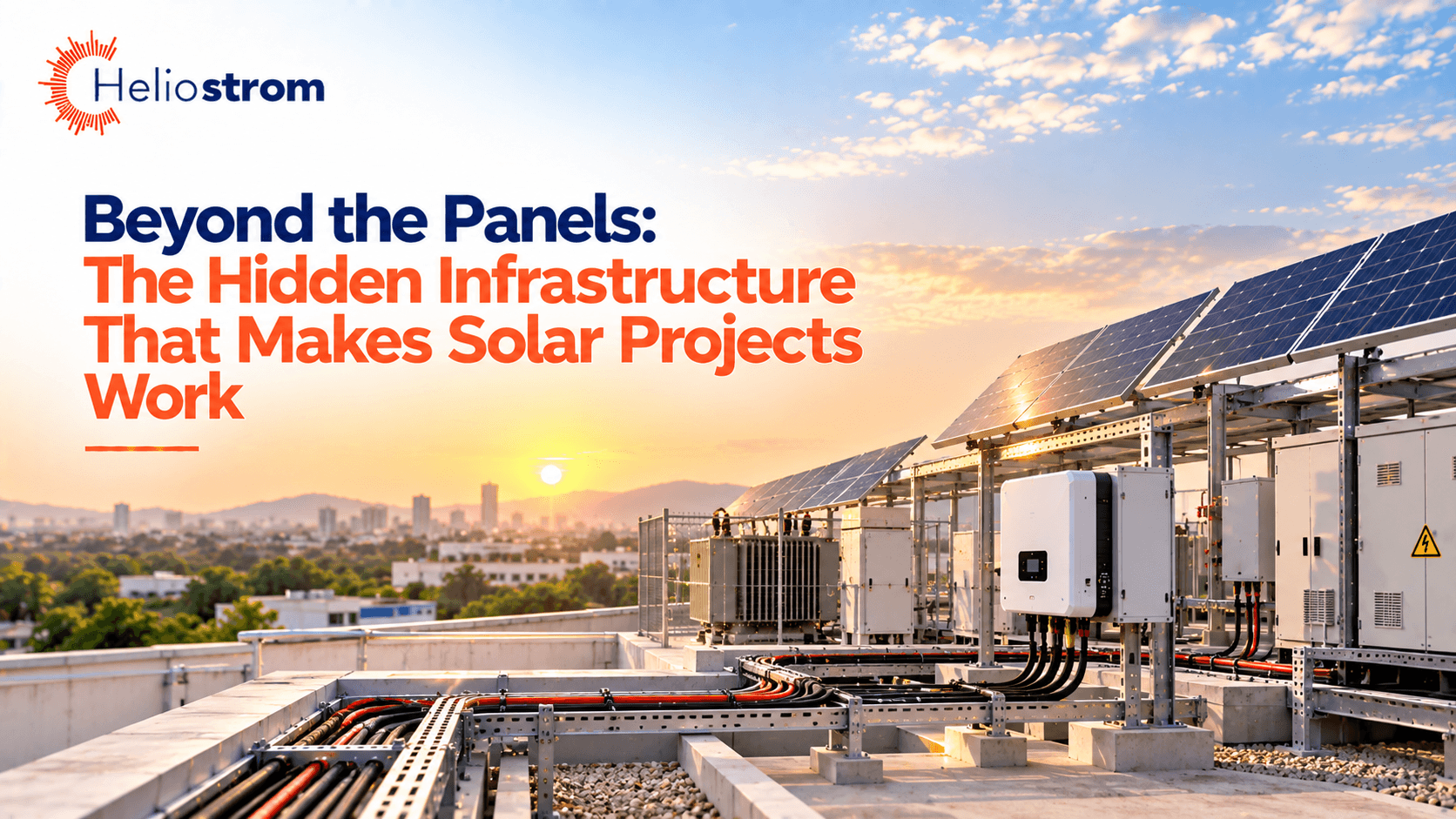
Most people picture rows of glossy panels when they imagine a solar project. The panels get the attention, yet they depend on supporting components that can significantly influence how reliably a plant performs over its operating life. Experienced solar firms in Chennai spend as much design effort on steel, copper, and protective devices as they do on modules. This guide walks through that supporting layer, explains what each part does, and lists what to ask before you sign a contract.
What Sits Behind the Panels? Understanding the Balance of System
Engineers group everything in a photovoltaic plant other than the modules under one label: balance of system, or BOS. It covers mounting structures, DC and AC cables, combiner boxes, switchgear, earthing, lightning protection, and monitoring equipment. Some sources place inverters inside this group while others list them separately, so it helps to confirm how a quotation defines the term.
Why the Supporting Layer Deserves Attention
BOS can represent a significant share of a project's capital cost, although the exact proportion varies with project size, technology, location, and which components a source includes. A premium module connected through undersized cable or installed on an inadequately designed structure can still deliver poor results. Small hardware failures, such as a loose connector or corroded clamp, can take an entire string offline. That is why a sound design starts with the parts nobody photographs.
Mounting Structures: The Foundation That Faces Every Storm
A mounting structure holds modules at a fixed tilt, keeps them clear of shade, and carries wind, dead weight, and maintenance loads into the roof or ground. Once the modules are in place, the frame is hard to reach without scaffolding, so mistakes made early tend to stay for decades.
Designing for Wind Along the Coast
Wind is one of the most important design loads for mounting structures, particularly in exposed and coastal locations. In India a common reference is IS 875 Part 3, which calculates design wind pressure from the square of the design wind speed, adjusted for height, terrain, and the importance of the structure. Tamil Nadu is counted among the cyclone-prone coastal states, so basic wind speeds here are higher than in many inland regions. A frame copied from a design meant for a calmer city may be under-built for this coastline.
What to Request From Your Installer
Ask for the wind load calculation and the foundation or ballast details for your specific roof or plot. The installer should be able to provide these calculations and details for review.
Corrosion and Material Choice
Hot dip galvanizing is widely used to protect steel from corrosion, and IS 4759 is a relevant Indian standard. The zinc coating thickness should be specified according to the applicable standard, steel thickness, environmental exposure, and project requirements. Coastal sites may need enhanced protection because of salt-laden air, including fasteners that will not become the weak link.
Galvanized Steel Versus Aluminium
Galvanized steel offers strength at a moderate price. Aluminium is lighter and naturally forms a protective oxide layer, which gives good corrosion resistance and makes it popular near the sea, although it usually costs more per kilowatt and needs careful design for stiffness. Mixing metals without isolation can trigger galvanic corrosion, so the detail at each joint matters as much as the frame material itself.
Roof Type and Household Considerations
Flat RCC roofs, tin sheds, and elevated structures each call for a different design. If you are comparing offers for rooftop solar installation across Chennai, check that the structure suits your roof, leaves room for cleaning access, and avoids drilling that could compromise waterproofing.
Cabling: The Circulatory System of the Plant
Choosing DC Cables That Survive the Sun
DC cables spend their whole working life outdoors, exposed to ultraviolet light, heat, and rain. Purpose-made photovoltaic cable, with tinned copper conductors and cross-linked insulation, is built for that abuse, and IEC 62930 is one of the standards that covers it. Ordinary household wire is not designed for such exposure, and its insulation can crack long before the modules wear out.
Keeping Voltage Drop Under Control
Every metre of conductor wastes a little energy as heat. Designers therefore size cables to keep voltage drop within the limits set by applicable standards, design criteria, and project requirements. Longer runs generally need larger conductors to limit losses.
Connectors, Routing, and Labelling
Poor crimps and mismatched connectors are a familiar source of hot spots. Cables should be clipped off sharp surfaces, shielded in conduit or trays where needed, and labelled clearly so a technician can trace any string within minutes.
Inverters: Where Raw Power Becomes Usable Power
Modules produce direct current. The inverter converts it into alternating current that matches grid voltage and frequency, and it also uses maximum power point tracking (MPPT) to extract power efficiently from the array as sunlight and operating conditions change.
String, Central, and Micro Options
String inverters suit most homes and mid-sized commercial roofs because they balance price and simplicity. Central inverters handle large plants with many strings, while microinverters sit at individual modules and help on roofs with partial shade or mixed orientations. Each choice changes the cost, the ease of repair, and how much of the plant goes quiet if one unit fails.
Sizing the Inverter Against the Array
Array capacity is often set slightly above the inverter rating, a practice known as DC to AC oversizing. Modest oversizing can improve energy harvest in the morning and evening, but pushing it too far causes clipping at midday. The right ratio depends on tilt, temperature, and the inverter's input limits.
Monitoring and Performance Data
Most modern inverters report generation and faults through an app or web portal. That data can help owners identify unusual drops in generation, faults, or string-level issues early, instead of discovering them on the next electricity bill.
Protection Systems: Limiting Electrical and Lightning Risks
Surge Protection and Lightning
Voltage spikes from nearby lightning or grid disturbances can destroy inverter electronics. Where required by the system design and applicable standards, surge protective devices can be installed on the DC and AC sides to limit transient overvoltages. Lightning protection for larger sites is commonly designed around IEC 62305.
Earthing That Actually Works
Earthing gives fault current a safe path and steadies voltage during a surge. IS 3043 is the Indian code of practice for it. The design depends on the electrical system, the soil, and applicable requirements. Soil moisture changes through the year, so earth resistance should be measured after installation and rechecked from time to time.
Isolators, Fuses, and Breakers
DC isolators, fuses, and circuit breakers must be rated for the maximum system voltage and the expected fault current. They allow technicians to isolate sections of the system and help limit the consequences of electrical faults. Combiner boxes gather several strings into one output and house much of this protection, so the enclosure rating against dust and water deserves a look.
Scaling Up: What Changes for Commercial and Utility Projects
As capacity grows, the supporting layer grows with it. Transformers, medium voltage switchgear, protection coordination, SCADA monitoring, and civil works enter the picture, and soil type and drainage begin to drive foundation design. Developers planning solar power plants across Tamil Nadu must comply with applicable grid interconnection requirements, including those set by the relevant electricity authorities and the distribution or transmission utility. Protection settings and interconnection equipment should be designed and approved accordingly.
Documentation Is Part of the Infrastructure
Equipment is only half of a well-delivered project. Owners should also receive structural or mounting calculations, an electrical single-line diagram, datasheets for cables and inverters, protection settings, earthing and lightning protection details, commissioning test records, warranty papers, maintenance procedures, and as-built drawings.
What to Ask Before You Sign
A few direct questions reveal a lot about a proposal. Which standards do the structure, cables, and protective devices meet? What coating thickness is specified for the frame, and were wind calculations done for my location? Which inverter make and rating are included, and what warranty applies? Who handles maintenance, and how often? Vague answers are a warning sign, while clear documentation suggests the installer has planned well beyond the module count.
Conclusion
Panels earn the headlines, but structures, cables, inverters, and protection devices decide whether a system delivers year after year. Attention to coating thickness, cable quality, inverter fit, and earthing costs little at the design stage and saves a great deal later. If you want a second opinion on a quote or a site assessment, reach out to experienced solar specialists in Chennai and ask them to walk you through each component in your proposal.
What does balance of system mean in a solar project?
It refers to every component other than the modules themselves, including mounting hardware, cables, combiner boxes, switchgear, earthing, and monitoring. Some definitions also include the inverter.
Why does a coastal location change the choice of mounting structure?
Salt-laden air speeds up corrosion, and coastal regions face stronger winds and cyclone exposure. That calls for enhanced corrosion protection, suitable fasteners, and a wind load calculation based on IS 875 Part 3.
Can I use regular electrical wire for the DC side?
It is not advisable. Photovoltaic cable is built to resist ultraviolet light, heat, and moisture over many years, while ordinary wire is not designed for continuous outdoor exposure.
Does a small rooftop system need surge protection?
Small rooftop systems can still face transient overvoltages from lightning and grid disturbances. The right surge protection arrangement should be determined from the system design, installation conditions, and applicable standards.
How often should supporting components be inspected?
A yearly check is a common recommendation. Technicians typically look at fastener tightness, corrosion, cable condition, connector heating, earth resistance, and inverter fault logs.
Thinking about your own installation? rooftop solar installation for homes in Chennai or book a free site survey.


